


FAQ: About Chassis and Suspension (Reading Required)


Thread Starter
legend behind the cowl
Joined: May 2006
Posts: 1,840
Likes: 0
 Tires (tires are a spring? and the "Gription theory")
I'll say it now. tires are the MOST import part of any suspension. and should be the FIRST modification... then setting the suspension to make those tires work should follow. buy the best tires your racing class or budget will allow. and if you tune your car to take advantage of those tires you will ALLWAYS be faster then someone that is chasing the math.
My tires are a spring?
Yes the only TRUE unsprung weight on any car is the tire itself, not only is that weight truly unsprung, but it also has the most rotational inertia in the entire drive train system, This is why you'll see "True" racing tires as light as possible. one lb of tire weight is equal to 8 lbs off a flywheel. so that fancy flywheel does not seem so important now. even some R-compound tires continue to use old fashion cloth radial bands to keep the weight down. while this practice was okay with flobbery bias ply tires, when applying it to radial tires it tends to make them less then streetable. since the radial bands actually support the weight of the car and do not just hold the tire together. but we are not here to talk about tire technology details. that could take a whole other FAQ.
What you need to know is the stiffness of the tire directly effects the dynamic spring rate. A stiffer carcass will deform less under cornering and transfer more of that weight to the contact patch as will stiffer springs. in retrospect a softer or taller sidewall will transfer less road vibration into the suspension and offer a softer ride.
what is best. well for performance as light as possible and as rigid as possible while these things might seem not to go hand in hand a true racing tire can achieve both of course it does not have to worry about sustaining it's rigidity over 30,000 miles or handling potholes, neither of which racing tires are known for.
A new terminology has cropped up since I first started tuning cars. it's called "tire spring rate" and it took the invention of the run-flat tire and it's effect on ride quality to raise the eyebrows of tire engineers.
Keep in mind a tire IS a spring, and that spring rate is variable with pressure. however also keep in mind a tire is almost a living breathing part of the suspension, it has an internal damping, which can be overcome essentially with too much air pressure, in addition the tread surface has a tendency to bow out (reduce contact patch) with too much air pressure. so while stiffer tire spring rate can help handling... like EVERYTHING else we discuss here there are limitations. and that all depends on the construction of the tire, rim width, and what you are asking it to do. This is why racing tires cost up to $600 each and you can buy a pep-boys special for $25. there is as much technology in a set of tires as in the rest of the suspension of your car. and this can be proven by taking a standard road car and fitting racing tires on it. it will lap a track 5-7 seconds faster then the standard car, where a full suspension kit might only provide 3-4 seconds on the same car and track.
So what is the "Gription" thing you keep mentioning. well it's a combination of traction and grip. neither word perfectly explains what is going on when a tire is being used in a racing environment. when a tire reaches it's optimum temperature, there is actually a physical bond between the road surface and the tread surface. many times this exceeds the friction provided between rim and the tire so in some racing they actually use glue or screws to fasten the tire to the rim. this is also why you will see black marks left from a car when not visibly sliding left from the tires. the friction between the surface of the tread and the road has exceeded the friction between the rubber molecule and it's neighbor molecule. so that small part of rubber stays bonded to the road surface instead of staying with the tire. as you can imagine that's A LOT of grip and really only common with true racing tires and only in a small temperature range.
this also explains racing tires terrible reputation of being unforgiving at the limit. as the tire reaches it's optimum tempature it grips more and more (a street tire is almost never designed to reach this temp) and when you exceed that temp it begins to slide, well. then it gets hotter and slides more. this is commonly referred to as a tire getting "greasy" so when it lets go it usually does so in a speticualar display of smoke and in RWD a spinning car , or fwd a car that cannot stop occasionally into a hard object. so we don't want that.
This is why you'll see racing tires available in several compounds, with engineering data so you can tailor the tire to the track and driving style as to approach the limit of grip but not exceed it. This is also why you'll see a Drag car do a smokey burnout, to bring the temp beyond the designed maximum so when they line up it will have cooled close to the optimum. providing a much cleaner getaway and in turn a lower ET. and yes a burnout can help a street car launch, but without the technology and perfect temp known, it's very hard to predict how much heat and when to line up. done right it can shave a lot of time from a drag racing time, done wrong... well a powerful car will spin the entire quarter mile.
My tires are a spring?
Yes the only TRUE unsprung weight on any car is the tire itself, not only is that weight truly unsprung, but it also has the most rotational inertia in the entire drive train system, This is why you'll see "True" racing tires as light as possible. one lb of tire weight is equal to 8 lbs off a flywheel. so that fancy flywheel does not seem so important now. even some R-compound tires continue to use old fashion cloth radial bands to keep the weight down. while this practice was okay with flobbery bias ply tires, when applying it to radial tires it tends to make them less then streetable. since the radial bands actually support the weight of the car and do not just hold the tire together. but we are not here to talk about tire technology details. that could take a whole other FAQ.
What you need to know is the stiffness of the tire directly effects the dynamic spring rate. A stiffer carcass will deform less under cornering and transfer more of that weight to the contact patch as will stiffer springs. in retrospect a softer or taller sidewall will transfer less road vibration into the suspension and offer a softer ride.
what is best. well for performance as light as possible and as rigid as possible while these things might seem not to go hand in hand a true racing tire can achieve both of course it does not have to worry about sustaining it's rigidity over 30,000 miles or handling potholes, neither of which racing tires are known for.
A new terminology has cropped up since I first started tuning cars. it's called "tire spring rate" and it took the invention of the run-flat tire and it's effect on ride quality to raise the eyebrows of tire engineers.
Keep in mind a tire IS a spring, and that spring rate is variable with pressure. however also keep in mind a tire is almost a living breathing part of the suspension, it has an internal damping, which can be overcome essentially with too much air pressure, in addition the tread surface has a tendency to bow out (reduce contact patch) with too much air pressure. so while stiffer tire spring rate can help handling... like EVERYTHING else we discuss here there are limitations. and that all depends on the construction of the tire, rim width, and what you are asking it to do. This is why racing tires cost up to $600 each and you can buy a pep-boys special for $25. there is as much technology in a set of tires as in the rest of the suspension of your car. and this can be proven by taking a standard road car and fitting racing tires on it. it will lap a track 5-7 seconds faster then the standard car, where a full suspension kit might only provide 3-4 seconds on the same car and track.
So what is the "Gription" thing you keep mentioning. well it's a combination of traction and grip. neither word perfectly explains what is going on when a tire is being used in a racing environment. when a tire reaches it's optimum temperature, there is actually a physical bond between the road surface and the tread surface. many times this exceeds the friction provided between rim and the tire so in some racing they actually use glue or screws to fasten the tire to the rim. this is also why you will see black marks left from a car when not visibly sliding left from the tires. the friction between the surface of the tread and the road has exceeded the friction between the rubber molecule and it's neighbor molecule. so that small part of rubber stays bonded to the road surface instead of staying with the tire. as you can imagine that's A LOT of grip and really only common with true racing tires and only in a small temperature range.
this also explains racing tires terrible reputation of being unforgiving at the limit. as the tire reaches it's optimum tempature it grips more and more (a street tire is almost never designed to reach this temp) and when you exceed that temp it begins to slide, well. then it gets hotter and slides more. this is commonly referred to as a tire getting "greasy" so when it lets go it usually does so in a speticualar display of smoke and in RWD a spinning car , or fwd a car that cannot stop occasionally into a hard object. so we don't want that.
This is why you'll see racing tires available in several compounds, with engineering data so you can tailor the tire to the track and driving style as to approach the limit of grip but not exceed it. This is also why you'll see a Drag car do a smokey burnout, to bring the temp beyond the designed maximum so when they line up it will have cooled close to the optimum. providing a much cleaner getaway and in turn a lower ET. and yes a burnout can help a street car launch, but without the technology and perfect temp known, it's very hard to predict how much heat and when to line up. done right it can shave a lot of time from a drag racing time, done wrong... well a powerful car will spin the entire quarter mile.
Last edited by treekiller; Mar 27, 2008 at 02:38 PM.
Thread Starter
legend behind the cowl
Joined: May 2006
Posts: 1,840
Likes: 0
Basic Math (I'm no engineer, how do I figure this out)
Thanks to: Brian Beckman
©Copyright 1991
In the last two articles, we plunged right into some relatively complex issues, namely weight transfer and tire adhesion. This month, we regroup and review some of the basic units and dimensions needed to do dynamical calculations.
Physics is the science of measurement. Perhaps you have heard of highly abstract branches of physics such as quantum mechanics and relativity, in which exotic mathematics is in the forefront. But when theories are taken to the laboratory (or the race course) for testing, all the mathematics must boil down to quantities that can be measured. In racing, the fundamental quantities are distance, time, and mass. This month, we will review basic equations that will enable you to do quick calculations in your head while cooling off between runs. It is very valuable to develop a skill for estimating quantities quickly, and I will show you how.
Equations that don't involve mass are called kinematic. The first kinematic equation relates speed, time, and distance. If a car is moving at a constant speed or velocity, , then the distance
  it travels in time
  is
is  or velocity times time. This equation really expresses nothing more than the definition of velocity.
If we are to do mental calculations, the first hurdle we must jump comes from the fact that we usually measure speed in miles per hour (mph), but distance in feet and time in seconds. So, we must modify our equation with a conversion factor, like this
If you ``cancel out'' the units parts of this equation, you will see that you get feet on both the left and right hand sides, as is appropriate, since equality is required of any equation. The conversion factor is 5280/3600, which happens to equal 22/15. Let's do a few quick examples. How far does a car go in one second (remember, say, ``one-one-thousand, two-one-thousand,'' etc. to yourself to count off seconds)? At fifteen mph, we can see that we go or about 1 and a half car lengths for a 14 and 2/3 foot car like a late-model Corvette. So, at 30 mph, a second is three car lengths and at 60 mph it is six. If you lose an autocross by 1 second (and you'll be pretty good if you can do that with all the good drivers in our region), you're losing by somewhere between 3 and 6 car lengths! This is because the average speed in an autocross is between 30 and 60 mph.
Everytime you plow a little or get a little sideways, just visualize your competition overtaking you by a car length or so. One of the reasons autocross is such a difficult sport, but also such a pure sport, from the driver's standpoint, is that you can't make up this time. If you blow a corner in a road race, you may have a few laps in which to make it up. But to win an autocross against good competition, you must drive nearly perfectly. The driver who makes the fewest mistakes usually wins!
The next kinematic equation involves acceleration. It so happens that the distance covered by a car at constant acceleration from a standing start is given by or 1/2 times the acceleration times the time, squared. What conversions will help us do mental calculations with this equation? Usually, we like to measure acceleration in
  s. One happens to be 32.1 feet per second squared. Fortunately, we don't have to deal with miles and hours here, so our equation becomes,
 , which is a typical number for a good, stock sports car, will go 8 feet in 1 second. Not very far! However, this picks up rapidly. In two seconds, the car will go 32 feet, or over two car lengths. roughly. So, a car accelerating from a standing start at
Just to prove to you that this isn't crazy, let's answer the question ``How long will it take a car accelerating at to do the quarter mile?'' We invert the equation above (recall your high school algebra), to get
  and we plug in the numbers: the quarter mile equals 1320 feet,
  , and we get
  which is about 13 seconds. Not too unreasonable! A real car will not be able to keep up full
  acceleration for a quarter mile due to air resistance and reduced torque in the higher gears. This explains why real (stock) sports cars do the quarter mile in 14 or 15 seconds.
The more interesting result is the fact that it takes a full second to go the first 8 feet. So, we can see that the launch is critical in an autocross. With excessive wheelspin, which robs you of acceleration, you can lose a whole second right at the start. Just visualize your competition pulling 8 feet ahead instantly, and that margin grows because they are `hooked up' better.
For doing these mental calculations, it is helpful to memorize a few squares. 8 squared is 64, 10 squared is 100, 11 squared is 121, 12 squared is 144, 13 squared is 169, and so on. You can then estimate square roots in your head with acceptable precision.
Finally, let's examine how engine torque becomes force at the drive wheels and finally acceleration. For this examination, we will need to know the mass of the car. Any equation in physics that involves mass is called dynamic, as opposed to kinematic. Let's say we have a Corvette that weighs 3200 pounds and produces 330 foot-pounds of torque at the crankshaft. The Corvette's automatic transmission has a first gear ratio of 3.06 (the auto is the trick set up for vettes-just ask Roger Johnson or Mark Thornton). A transmission is nothing but a set of circular, rotating levers, and the gear ratio is the leverage, multiplying the torque of the engine. So, at the output of the transmission, we have
 Now, at rest, the car has about 50/50 weight distribution, so there is about 1600 pounds of load on the rear tires. You will remember from last month's article on tire adhesion that the tires cannot respond with a forward force much greater than the weight that is on them, so they simply will spin if you stomp on the throttle, asking them to give you 2870 pounds of force. of torque. The differential is a further lever-multiplier, in the case of the Corvette by a factor of 3.07, yielding 3100 foot pounds at the center of the rear wheels (this is a lot of torque!). The distance from the center of the wheel to the ground is about 13 inches, or 1.08 feet, so the maximum force that the engine can put to the ground in a rearward direction (causing the ground to push back forward-remember part 1 of this series!) in first gear is
We can now see why it is important to squeeeeeeeze the throttle gently when launching. In the very first instant of a launch, your goal as a driver is to get the engine up to where it is pushing on the tire contact patch at about 1600 pounds. The tires will squeal or hiss just a little when you get this right. Not so coincidentally, this will give you a forward force of about 1600 pounds, for an (part 1) acceleration of about
  , or half the weight of the car. The main reason a car will accelerate with only
  to start with is that half of the weight is on the front wheels and is unavailable to increase the stiction of the rear, driving tires. Immediately, however, there will be some weight transfer to the rear. Remembering part 1 of this series again, you can estimate that about 320 pounds will be transferred to the rear immediately. You can now ask the tires to give you a little more, and you can gently push on the throttle. Within a second or so, you can be at full throttle, putting all that torque to work for a beautiful hole shot!
In a rear drive car, weight transfer acts to make the driving wheels capable of withstanding greater forward loads. In a front drive car, weight transfer works against acceleration, so you have to be even more gentle on the throttle if you have a lot of power. An all-wheel drive car puts all the wheels to work delivering force to the ground and is theoretically the best.
Technical people call this style of calculating ``back of the envelope,'' which is a somewhat picturesque reference to the habit we have of writing equations and numbers on any piece of paper that happens to be handy. You do it without calculators or slide rules or abacuses. You do it in the garage or the pits. It is not exactly precise, but gives you a rough idea, say within 10 or 20 percent, of the forces and accelerations at work. And now you know how to do back-of-the-envelope calculations, too.
©Copyright 1991
In the last two articles, we plunged right into some relatively complex issues, namely weight transfer and tire adhesion. This month, we regroup and review some of the basic units and dimensions needed to do dynamical calculations.
Physics is the science of measurement. Perhaps you have heard of highly abstract branches of physics such as quantum mechanics and relativity, in which exotic mathematics is in the forefront. But when theories are taken to the laboratory (or the race course) for testing, all the mathematics must boil down to quantities that can be measured. In racing, the fundamental quantities are distance, time, and mass. This month, we will review basic equations that will enable you to do quick calculations in your head while cooling off between runs. It is very valuable to develop a skill for estimating quantities quickly, and I will show you how.
Equations that don't involve mass are called kinematic. The first kinematic equation relates speed, time, and distance. If a car is moving at a constant speed or velocity,
, then the distance it travels in time is or velocity times time. This equation really expresses nothing more than the definition of velocity. If we are to do mental calculations, the first hurdle we must jump comes from the fact that we usually measure speed in miles per hour (mph), but distance in feet and time in seconds. So, we must modify our equation with a conversion factor, like this
If you ``cancel out'' the units parts of this equation, you will see that you get feet on both the left and right hand sides, as is appropriate, since equality is required of any equation. The conversion factor is 5280/3600, which happens to equal 22/15. Let's do a few quick examples. How far does a car go in one second (remember, say, ``one-one-thousand, two-one-thousand,'' etc. to yourself to count off seconds)? At fifteen mph, we can see that we go
or about 1 and a half car lengths for a 14 and 2/3 foot car like a late-model Corvette. So, at 30 mph, a second is three car lengths and at 60 mph it is six. If you lose an autocross by 1 second (and you'll be pretty good if you can do that with all the good drivers in our region), you're losing by somewhere between 3 and 6 car lengths! This is because the average speed in an autocross is between 30 and 60 mph. Everytime you plow a little or get a little sideways, just visualize your competition overtaking you by a car length or so. One of the reasons autocross is such a difficult sport, but also such a pure sport, from the driver's standpoint, is that you can't make up this time. If you blow a corner in a road race, you may have a few laps in which to make it up. But to win an autocross against good competition, you must drive nearly perfectly. The driver who makes the fewest mistakes usually wins!
The next kinematic equation involves acceleration. It so happens that the distance covered by a car at constant acceleration from a standing start is given by
or 1/2 times the acceleration times the time, squared. What conversions will help us do mental calculations with this equation? Usually, we like to measure acceleration in s. One happens to be 32.1 feet per second squared. Fortunately, we don't have to deal with miles and hours here, so our equation becomes, , which is a typical number for a good, stock sports car, will go 8 feet in 1 second. Not very far! However, this picks up rapidly. In two seconds, the car will go 32 feet, or over two car lengths. roughly. So, a car accelerating from a standing start at Just to prove to you that this isn't crazy, let's answer the question ``How long will it take a car accelerating at
to do the quarter mile?'' We invert the equation above (recall your high school algebra), to get and we plug in the numbers: the quarter mile equals 1320 feet, , and we get which is about 13 seconds. Not too unreasonable! A real car will not be able to keep up full acceleration for a quarter mile due to air resistance and reduced torque in the higher gears. This explains why real (stock) sports cars do the quarter mile in 14 or 15 seconds. The more interesting result is the fact that it takes a full second to go the first 8 feet. So, we can see that the launch is critical in an autocross. With excessive wheelspin, which robs you of acceleration, you can lose a whole second right at the start. Just visualize your competition pulling 8 feet ahead instantly, and that margin grows because they are `hooked up' better.
For doing these mental calculations, it is helpful to memorize a few squares. 8 squared is 64, 10 squared is 100, 11 squared is 121, 12 squared is 144, 13 squared is 169, and so on. You can then estimate square roots in your head with acceptable precision.
Finally, let's examine how engine torque becomes force at the drive wheels and finally acceleration. For this examination, we will need to know the mass of the car. Any equation in physics that involves mass is called dynamic, as opposed to kinematic. Let's say we have a Corvette that weighs 3200 pounds and produces 330 foot-pounds of torque at the crankshaft. The Corvette's automatic transmission has a first gear ratio of 3.06 (the auto is the trick set up for vettes-just ask Roger Johnson or Mark Thornton). A transmission is nothing but a set of circular, rotating levers, and the gear ratio is the leverage, multiplying the torque of the engine. So, at the output of the transmission, we have
Now, at rest, the car has about 50/50 weight distribution, so there is about 1600 pounds of load on the rear tires. You will remember from last month's article on tire adhesion that the tires cannot respond with a forward force much greater than the weight that is on them, so they simply will spin if you stomp on the throttle, asking them to give you 2870 pounds of force. of torque. The differential is a further lever-multiplier, in the case of the Corvette by a factor of 3.07, yielding 3100 foot pounds at the center of the rear wheels (this is a lot of torque!). The distance from the center of the wheel to the ground is about 13 inches, or 1.08 feet, so the maximum force that the engine can put to the ground in a rearward direction (causing the ground to push back forward-remember part 1 of this series!) in first gear is We can now see why it is important to squeeeeeeeze the throttle gently when launching. In the very first instant of a launch, your goal as a driver is to get the engine up to where it is pushing on the tire contact patch at about 1600 pounds. The tires will squeal or hiss just a little when you get this right. Not so coincidentally, this will give you a forward force of about 1600 pounds, for an
(part 1) acceleration of about , or half the weight of the car. The main reason a car will accelerate with only to start with is that half of the weight is on the front wheels and is unavailable to increase the stiction of the rear, driving tires. Immediately, however, there will be some weight transfer to the rear. Remembering part 1 of this series again, you can estimate that about 320 pounds will be transferred to the rear immediately. You can now ask the tires to give you a little more, and you can gently push on the throttle. Within a second or so, you can be at full throttle, putting all that torque to work for a beautiful hole shot! In a rear drive car, weight transfer acts to make the driving wheels capable of withstanding greater forward loads. In a front drive car, weight transfer works against acceleration, so you have to be even more gentle on the throttle if you have a lot of power. An all-wheel drive car puts all the wheels to work delivering force to the ground and is theoretically the best.
Technical people call this style of calculating ``back of the envelope,'' which is a somewhat picturesque reference to the habit we have of writing equations and numbers on any piece of paper that happens to be handy. You do it without calculators or slide rules or abacuses. You do it in the garage or the pits. It is not exactly precise, but gives you a rough idea, say within 10 or 20 percent, of the forces and accelerations at work. And now you know how to do back-of-the-envelope calculations, too.
Last edited by treekiller; Apr 1, 2008 at 07:32 PM.

Registered User
Joined: Aug 2007
Posts: 4
Likes: 0
You should probably mention tyre load sensitivity at some stage. It's one of the most important things in vehicle dynamics that I ever learned.
It's probably much more important to the average person than slip angles.
It's probably much more important to the average person than slip angles.
Thread Starter
legend behind the cowl
Joined: May 2006
Posts: 1,840
Likes: 0
as requested: Tyre-road friction and tyre slip
Tyre-road friction and tyre slip (thanks to tut.fi)
Let us consider the truck-tyre in detail.
When braking the tyre in stationary conditions, the normal force acts just in front of the wheel centre. Within the contact area a shear stress arises that increases until the adhesion limit is reached and sliding occurs, after which it decreases broadly proportional (Coulomb friction assumed) with the locally occurring normal stress.
The speed of the tyre relative to the wheel centre first increases. When the adhesion limit is reached, a sliding speed arises locally, resulting in a nonzero average speed Vslip of the rubber within the contact area. The ratio of this speed and the wheel speed in percent is designated the longitudinal slip sx = - k:
 If a side force operates on the tyre, a lateral deformation appears in the tyre belt and its tread. Points on the running surface experience the belt deformation before they make contact with the road at which point the tyre first attempts to maintain contact with the road surface.
 Figure 1 - Braking the tyre
This corresponds to a gradually increasing shear stress in lateral direction. Once the adhesion limits are reached, the rubber will start to slide relative to the road with a lateral motion, perpendicular to the wheel plane. The asymmetry in the distribution of shear stress causes the resulting force not to grip exactly in the middle of the contact area just under the wheel centre. Rather there is a pneumatic trail which, in combination with the side force, produces an aligning torque which tries to push the tyre in the direction of the wheel speed. The tangent of the slipangle between wheelplane and wheel speed, denoted as side slip -sy :
 Figure 2 - Cornering of a tyre
The relationships between the position of the tyre, in terms of the slipvalues, and tyreresponse in terms of longitudinal and lateral force, pneumatic trail and aligning torque are of essential importance in studying vehicle behaviour. Without a good description of these tyrecharacteristics, such kind of research ìs impossible.
 Figure 3 - A tyre under combined slip conditions
Besides the properties described in pure slip conditions, one is also interested in situations of combined slip which are pertinent to braking when cornering. The maximum shear force between tyre and road surface is given by the existent coefficient of friction multiplied by the wheel load. The implication for braking in a bend is that the possible maximum brake force relative to a situation of straight line braking will be reduced. One has therefore sacrificed braking potential which is indicated by the friction ellipse, in which realistic combinations of brake or drive force and side force are shown separately.
Tyre characteristics
The above discussion finally leads to relationships between:
under pure slip conditions (only lateral or longitudinal slip). In case of combined slip, the side force also depends on longitudinal slip, etc. Typical examples of these pure slip characteristics are shown in figure 4. One observes a strong nonlinear behaviour for larger slip. These relationships are of essential importance in studying vehicle behaviour. Without a good description of these tyre characteristics, such kind of research is impossible. The slope of the side force Fy vs. slip angle a near a = 0 (the cornering stiffness) is the determining parameter in the linear basic handling and stability theory of automobiles, as we shall see later.
 Figure 4 - Some typical tyre characteristics
Under combined slip conditions, typical plots of Fx (brake or drive force) versus Fy (cornering force) are shown below for fixed values of slip angle a (taken from DELFT-TYRE). For small values of a, the side force almost vanishes. As a increases, the side force Fy becomes apparent at the cost of a lower maximum value of the longitudinal force Fx.
 Figure 5 - Combined slip, Fx versus Fy
It is important to note that tyre shear forces depend on tyre load. This dependence is usually nonlinear, where for increasing tyre load, the absolute slope of the tyre force versus tyre load reduces. This is the reason why during cornering, the average lateral tyre force per axle reduces due to force redistribution from inner to outer wheel. Consequently, as we shall see later, the steering performance of the vehicle is changed which might even lead to yaw-instability (oversteer conditions).
An example is shown in figure 6 with Fy depicted vs. load Fz for three different slip angle. One observes the decreasing absolute slope of these curves, meaning that under load transfer of for example 1500 N (being the increase, decrease of the tyre load at outer and inner tyre, respectively) and with an axle slip angle of 0.08 rad., the total lateral force is reduced. In other words, the cornering stiffness is reduced due to this load transfer.
 Figure 6 - Load sensitivity lateral force
The illustration is for passenger cars, for which a restricted load variation is apparent. This is different for truck tyres where large variations in payload and thus large variations in tyre load will occur. This is illustrated in figure 7 where the normalized cornering stiffnesses (cornering stiffness coefficient: tyre cornering stiffness divided by the tyre load) for typical truck and passenger car tyres are depicted vs, tyre load. One oberves a decreasing trend for both passenger and truck tyres, with a much smaller sensitivity for truck tyres compared to passenger tyres.
 Figure 7 - Load sensitivity passenger car and truck tyres
We close this section with some remarks concerning factors that influence tyre characteristic curves. The variations of the longitudinal force coefficient (defined as Fx/Fz) and longitudinal force versus longitudinal slip of two truck radial tyres are depicted in figure 8 and figure 9. The peak value is the maximum that can be reached without wheel locking, while the slide value is obtained during the locked wheel. Figure 10 presents some typical ranges of values of the longitudinal force coefficient obtained on a dry concrete surface for bias and radial tyres with two type of tread patterns design.
The dependencies of the longitudinal force coefficient to the load and speed are presented in figure 11 and figure 12.
 Figure 8 - Longitudinal force coefficient vs. slip
 Figure 9 - Braking force vs. slip of a truck tyre [3.1]
 Figure 10 - Longitudinal force coefficient on dry road [2.1]
 Figure 11 - Effect of load (radial tyre) [2.1]
 Figure 12 - Effect of speed (radial tyre) [2.1]
Next, we consider the lateral force in more detail. This force is a function not only of simple friction but also of the size, design, construction and operating condition (i.e. load and inflation pressure).
The influences of the tyre construction and loading condition to lateral force coefficient (defined as Fy/Fz) are presented in figure 13 and figure 14.
It must be noticed that radial truck tyres are more responsive than bias truck tyres and the low profile radial truck tyre has a more constant lateral force coefficient through the load change (important in suspension design).
Combining braking and cornering by adding braking force to a tyre which rolls with slip angle results the friction ellipse concept. This ellipse envelops all the plotted curves of lateral forces versus longitudinal forces for different slip angles, as discussed above. Figure 15 and figure 16 show some combined forces for two truck tyres (bias and radial) while figure 17 shows the influence of slip angle on braking forces.
 Figure 13 - Effect of tyre construction [2.1]
 Figure 14 - Effect of load [2.1]
 Figure 15 - Braking and cornering (bias tyre) [2.1]
 Figure 16 - Braking and cornering (radial tyre) [3.1]
 Figure 17 - Influence of slip angle on braking forces [8]
Let us consider the truck-tyre in detail.
When braking the tyre in stationary conditions, the normal force acts just in front of the wheel centre. Within the contact area a shear stress arises that increases until the adhesion limit is reached and sliding occurs, after which it decreases broadly proportional (Coulomb friction assumed) with the locally occurring normal stress.
The speed of the tyre relative to the wheel centre first increases. When the adhesion limit is reached, a sliding speed arises locally, resulting in a nonzero average speed Vslip of the rubber within the contact area. The ratio of this speed and the wheel speed in percent is designated the longitudinal slip sx = - k:
This corresponds to a gradually increasing shear stress in lateral direction. Once the adhesion limits are reached, the rubber will start to slide relative to the road with a lateral motion, perpendicular to the wheel plane. The asymmetry in the distribution of shear stress causes the resulting force not to grip exactly in the middle of the contact area just under the wheel centre. Rather there is a pneumatic trail which, in combination with the side force, produces an aligning torque which tries to push the tyre in the direction of the wheel speed. The tangent of the slipangle between wheelplane and wheel speed, denoted as side slip -sy :
sy = tan(a)
in conjunction with the wheel load and the camber angle, are decisive for the side force and the aligning torque.The relationships between the position of the tyre, in terms of the slipvalues, and tyreresponse in terms of longitudinal and lateral force, pneumatic trail and aligning torque are of essential importance in studying vehicle behaviour. Without a good description of these tyrecharacteristics, such kind of research ìs impossible.
Besides the properties described in pure slip conditions, one is also interested in situations of combined slip which are pertinent to braking when cornering. The maximum shear force between tyre and road surface is given by the existent coefficient of friction multiplied by the wheel load. The implication for braking in a bend is that the possible maximum brake force relative to a situation of straight line braking will be reduced. One has therefore sacrificed braking potential which is indicated by the friction ellipse, in which realistic combinations of brake or drive force and side force are shown separately.
Tyre characteristics
The above discussion finally leads to relationships between:
- Side force versus lateral slip
- Pneumatic trail versus lateral slip
- Aligning torque versus lateral slip
- Brake or drive force versus longitudinal slip
under pure slip conditions (only lateral or longitudinal slip). In case of combined slip, the side force also depends on longitudinal slip, etc. Typical examples of these pure slip characteristics are shown in figure 4. One observes a strong nonlinear behaviour for larger slip. These relationships are of essential importance in studying vehicle behaviour. Without a good description of these tyre characteristics, such kind of research is impossible. The slope of the side force Fy vs. slip angle a near a = 0 (the cornering stiffness) is the determining parameter in the linear basic handling and stability theory of automobiles, as we shall see later.
Under combined slip conditions, typical plots of Fx (brake or drive force) versus Fy (cornering force) are shown below for fixed values of slip angle a (taken from DELFT-TYRE). For small values of a, the side force almost vanishes. As a increases, the side force Fy becomes apparent at the cost of a lower maximum value of the longitudinal force Fx.
It is important to note that tyre shear forces depend on tyre load. This dependence is usually nonlinear, where for increasing tyre load, the absolute slope of the tyre force versus tyre load reduces. This is the reason why during cornering, the average lateral tyre force per axle reduces due to force redistribution from inner to outer wheel. Consequently, as we shall see later, the steering performance of the vehicle is changed which might even lead to yaw-instability (oversteer conditions).
An example is shown in figure 6 with Fy depicted vs. load Fz for three different slip angle. One observes the decreasing absolute slope of these curves, meaning that under load transfer of for example 1500 N (being the increase, decrease of the tyre load at outer and inner tyre, respectively) and with an axle slip angle of 0.08 rad., the total lateral force is reduced. In other words, the cornering stiffness is reduced due to this load transfer.
The illustration is for passenger cars, for which a restricted load variation is apparent. This is different for truck tyres where large variations in payload and thus large variations in tyre load will occur. This is illustrated in figure 7 where the normalized cornering stiffnesses (cornering stiffness coefficient: tyre cornering stiffness divided by the tyre load) for typical truck and passenger car tyres are depicted vs, tyre load. One oberves a decreasing trend for both passenger and truck tyres, with a much smaller sensitivity for truck tyres compared to passenger tyres.
We close this section with some remarks concerning factors that influence tyre characteristic curves. The variations of the longitudinal force coefficient (defined as Fx/Fz) and longitudinal force versus longitudinal slip of two truck radial tyres are depicted in figure 8 and figure 9. The peak value is the maximum that can be reached without wheel locking, while the slide value is obtained during the locked wheel. Figure 10 presents some typical ranges of values of the longitudinal force coefficient obtained on a dry concrete surface for bias and radial tyres with two type of tread patterns design.
The dependencies of the longitudinal force coefficient to the load and speed are presented in figure 11 and figure 12.
Next, we consider the lateral force in more detail. This force is a function not only of simple friction but also of the size, design, construction and operating condition (i.e. load and inflation pressure).
The influences of the tyre construction and loading condition to lateral force coefficient (defined as Fy/Fz) are presented in figure 13 and figure 14.
It must be noticed that radial truck tyres are more responsive than bias truck tyres and the low profile radial truck tyre has a more constant lateral force coefficient through the load change (important in suspension design).
Combining braking and cornering by adding braking force to a tyre which rolls with slip angle results the friction ellipse concept. This ellipse envelops all the plotted curves of lateral forces versus longitudinal forces for different slip angles, as discussed above. Figure 15 and figure 16 show some combined forces for two truck tyres (bias and radial) while figure 17 shows the influence of slip angle on braking forces.
Thread Starter
legend behind the cowl
Joined: May 2006
Posts: 1,840
Likes: 0
Centrifugal Force (the imaginary cornering force)
Centrifugal Force - The False Force
An evil word has worked its way into our daily vocabulary, and with it, an incorrect understanding of the way physics works. "Centrifugal Force" ( Latin for "center fleeing") is often used to describe why mud gets spun off a spinning tire, or water gets pushed out of the clothes during the spin dry cycle of your washer. It is also used to describe why we tend to slide to the outer side of a car going around a curve. It is a common explanation...the only problem is all of it is absolutely wrong!!! Centrifugal force does not exist...there is no such thing...it is a ghost we tend to blame odd behavior on.Take for example this common situation. You are riding in a car going around a curve. Sitting on your dashboard is a cassette tape. As you go around the curve, the tape moves to outside edge of the car. Because you don't want to blame it on ghosts, you say "centrifugal force pushed the tape across the dashboard."--wwrroonngg!! When we view this situation from above the car, we get a better view of what is really happening. The animation below shows both views at the same time. The top window shows you the bird's eye view of the car and the tape, while the bottom window shows you the familiar view from the passenger.

Any time the word Centrifugal Force is used, what is really being described is a Lack-of-Centripetal Force.
or as Brian Beckman puts it
©Copyright 1991
One often hears of ``centrifugal force.'' This is the apparent force that throws you to the outside of a turn during cornering. If there is anything loose in the car, it will immediately slide to the right in a left hand turn, and vice versa. Perhaps you have experienced what happened to me once. I had omitted to remove an empty Pepsi can hidden under the passenger seat. During a particularly aggressive run (something for which I am not unknown), this can came loose, fluttered around the cockpit for a while, and eventually flew out the passenger window in the middle of a hard left hand corner.
I shall attempt to convince you, in this month's article, that centrifugal force is a fiction, and a consequence of the fact first noticed just over three hundred years ago by Newton that objects tend to continue moving in a straight line unless acted on by an external force.
When you turn the steering wheel, you are trying to get the front tires to push a little sideways on the ground, which then pushes back, by Newton's third law. When the ground pushes back, it causes a little sideways acceleration. This sideways acceleration is a change in the sideways velocity. The acceleration is proportional to the sideways force, and inversely proportional to the mass of the car, by Newton's second law. The sideways acceleration thus causes the car to veer a little sideways, which is what you wanted when you turned the wheel. If you keep the steering and throttle at constant positions, you will continue to go mostly forwards and a little sideways until you end up where you started. In other words, you will go in a circle. When driving through a sweeper, you are going part way around a circle. If you take skid pad lessons (highly recommended), you will go around in circles all day.
If you turn the steering wheel a little more, you will go in a tighter circle, and the sideways force needed to keep you going is greater. If you go around the same circle but faster, the necessary force is greater. If you try to go around too fast, the adhesive limit of the tires will be exceeded, they will slide, and you will not stick to the circular path-you will not ``make it.''
From the discussion above, we can see that in order to turn right, for example, a force, pointing to the right, must act on the car that veers it away from the straight line it naturally tries to follow. If the force stays constant, the car will go in a circle. From the point of view of the car, the force always points to the right. From a point of view outside the car, at rest with respect to the ground, however, the force points toward the center of the circle. From this point of view, although the force is constant in magnitude, it changes direction, going around and around as the car turns, always pointing at the geometrical center of the circle. This force is called centripetal, from the Greek for ``center seeking.'' The point of view on the ground is privileged, since objects at rest from this point of view feel no net forces. Physicists call this special point of view an inertial frame of reference. The forces measured in an inertial frame are, in a sense, more correct than those measured by a physicist riding in the car. Forces measured inside the car are biased by the centripetal force.
Inside the car, all objects, such as the driver, feel the natural inertial tendency to continue moving in a straight line. The driver receives a centripetal force from the car through the seat and the belts. If you don't have good restraints, you may find yourself pushing with your knee against the door and tugging on the controls in order to get the centripetal force you need to go in a circle with the car. It took me a long time to overcome the habit of tugging on the car in order to stay put in it. I used to come home with bruises on my left knee from pushing hard against the door during an autocross. I found that a tight five- point harness helped me to overcome this unnecessary habit. With it, I no longer think about body position while driving-I can concentrate on trying to be smooth and fast. As a result, I use the wheel and the gearshift lever for steering and shifting rather than for helping me stay put in the car!
The `forces' that the driver and other objects inside the car feel are actually centripetal. The term centrifugal, or ``center fleeing,'' refers to the inertial tendency to resist the centripetal force and to continue going straight. If the centripetal force is constant in magnitude, the centrifugal tendency will be constant. There is no such thing as centrifugal force (although it is a convenient fiction for the purpose of some calculations).
Let's figure out exactly how much sideways acceleration is needed to keep a car going at speed
 in a circle of radius
  . We can then convert this into force using Newton's second law, and then figure out how fast we can go in a circle before exceeding the adhesive limit-in other words, we can derive maximum cornering speed. For the following discussion, it will be helpful for you to draw little back-of-the-envelope pictures (I'm leaving them out, giving our editor a rest from transcribing my graphics into the newsletter).
 Consider a very short interval of time, far less than a second. Call it
 (
( stands for ``delta,'' a Greek letter mathematicians use as shorthand for ``tiny increment''). In time , let us say we go forward a distance
  and sideways a distance
  . The forward component of the velocity of the car is approximately
  . At the beginning of the time interval , the car has no sideways velocity. At the end, it has sideways velocity
  . In the time , the car has thus had a change in sideways velocity of . Acceleration is, precisely, the change in velocity over a certain time, divided by the time; just as velocity is the change in position over a certain time, divided by the time. Thus, the sideways acceleration is
  How is related to , the radius of the circle? If we go forward by a fraction
  of the radius of the circle, we must go sideways by exactly the same fraction of to stay on the circle. This means that
  . The fraction is, however, nothing but
  . By this reasoning, we get the relation
  We can substitute this expression for into the expression for
  , and remembering that , we get the final result
  This equation simply says quantitatively what we wrote before: that the acceleration (and the force) needed to keep to a circular line increases with the velocity and increases as the radius gets smaller.
 What was not appreciated before we went through this derivation is that the necessary acceleration increases as the square of the velocity. This means that the centripetal force your tires must give you for you to make it through a sweeper is very sensitive to your speed. If you go just a little bit too fast, you might as well go much too fast-your're not going to make it. The following table shows the maximum speed that can be achieved in turns of various radii for various sideways accelerations. This table shows the value of the expression
 which is the solution of
  for , the velocity. The conversion factor 15/22 converts from feet per second to miles per hour, and 32.1 converts from gees to feet per second squared. We covered these conversion factors in part 3 of this series.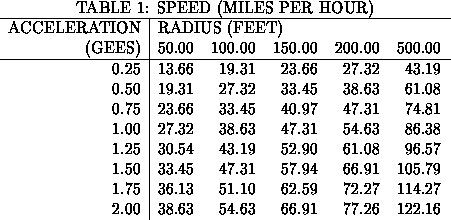
For autocrossing, the columns for 50 and 100 feet and the row for 1.00
 are most germane. The table tells us that to achieve 1.00 sideways acceleration in a corner of 50 foot radius (this kind of corner is all too common in autocross), a driver must not go faster than 27.32 miles per hour. To go 30 mph, 1.25 is required, which is probably not within the capability of an autocross tire at this speed. There is not much subjective difference between 27 and 30 mph, but the objective difference is usually between making a controlled run and spinning badly.
 The absolute fastest way to go through a corner is to be just over the limit near the exit, in a controlled slide. To do this, however, you must be pointed in just such a way that when the car breaks loose and slides to the exit of the corner it will be pointed straight down the optimal racing line at the exit when it ``hooks up'' again. You can smoothly add throttle during this maneuver and be really moving out of the corner. But you must do it smoothly. It takes a long time to learn this, and probably a lifetime to perfect it, but it feels absolutely triumphal when done right. I have not figured out how to drive through a sweeper, except for the exit, at anything greater than the limiting velocity because sweepers are just too long to slide around. If anyone (Ayrton Senna, perhaps?) knows how, please tell me!
The chain of reasoning we have just gone through was first discovered by Newton and Leibniz, working independently. It is, in fact, a derivation in differential calculus, the mathematics of very small quantities. Newton keeps popping up. He was perhaps the greatest of all physicists, having discovered the laws of motion, the law of gravity, and calculus, among other things such as the fact that white light is made up of multiple colors mixed together.
It is an excellent diagnostic exercise to drive a car around a circle marked with cones or chalk and gently to increase the speed until the car slides. If the front breaks away first, your car has natural understeer, and if the rear slides first, it has natural oversteer. You can use this information for chassis tuning. Of course, this is only to be done in safe circumstances, on a rented skid pad or your own private parking lot. The police will gleefully give you a ticket if they catch you doing this in the wrong places.

Registered User
Joined: May 2008
Posts: 1
Likes: 0
suspension on panser 6x6
hello every body ! do u have picture about suspension independent (torsion bar spring) in armour vehicle APC (armour personnel carrier) 6x6, plse help me, i need this picture for my thesis. thanks

Registered User
Joined: Aug 2008
Posts: 1
Likes: 0
Centrifugal force DOES exist, but you first have to assume a non-inertial (accelerating) frame of reference. The math gets ugly for anything more than a simple case, yes, but it's doable. Centripetal acceleration is definitely a better concept to explain to early physics students, but it is incorrect to say centrifugal force doesn't exist at all.
For anyone willing to look at the ugly math, it's all explained in the book Vector Mechanics for Engineers: Dynamics by Beer, Johnston, Clausen, and Staab.
For anyone willing to look at the ugly math, it's all explained in the book Vector Mechanics for Engineers: Dynamics by Beer, Johnston, Clausen, and Staab.
__________________
2003 Saturn ION 1 Sedan, black, stock, 71k, auto
(still trying to save for a track toy)
2003 Saturn ION 1 Sedan, black, stock, 71k, auto
(still trying to save for a track toy)
Thread Starter
legend behind the cowl
Joined: May 2006
Posts: 1,840
Likes: 0
The Traction Circle
The traction circle is way of thinking about the grip that a particular tire has on the road and how you can use it.
Visualize, if you will, a circle, with an x-axis and y-axis running through the center. The edges of the circle denote 100% utilization, the x-axis represents lateral grip (or cornering grip), the y-axis represents longitudinal grip (or braking/accelerating grip). This area in the circle represents the domain of your tire's grip. Points inside the circle are possible combinations of acceleration, braking, and turning; points outside cause the tire to lose grip and slide. If you're a real geek, you'll realize that this is a vector whose magnitude is always less than 1.
This traction circle is a way of teaching people the basics of tire grip, the essential limiting factor in performance driving. In the traction circle, you can be either turning left, turning right, accelerating, braking, or a combination of turning one way and accelerating and braking. Duh. The important thing the traction circle illustrates is that you can combine turning and speeding up or slowing down, but the less of one you do, the more of the other. This explains why you can't go through a hairpin at 100mph, but more importantly, it tells you why you can't go through a 51mph turn at 52. It also helps explain why turning strategies tend to tell you to brake, turn, accelerate rather than to brake through the turn, then accelerate through it.
It is also an important way of expressing driving cues. When a racer brakes at 80%, that 80% is not putting 80% of the pedal to the floor, nor is it a constant. The percentage depends on the overall size of the traction circle, which is the amount of grip available in the tire. If conditions change (such as cresting a hill or running over a bit of gravel), that 80% may become 110%, and the tire will slide. Of course, a racer's job is to always maximize available grip through a turn, so she would brake at 95% unless she was worried about weight transfers (which also affect available grip) or needed to turn.
Of course, the best strategy would be to follow very closely to the edge of the traction circle at all times so that one is not taken off guard by sudden changes, but you risk being passed by someone using 98% of their grip. Traction becomes an issue when following behind someone, as you will most likely be forced into the line they choose, so outbraking and pushing the car becomes the strategy to pass. However, because the difference between 100% and 95% is never more than a few seconds at the end of a race, it is more important to focus on cutting good lines and following the track than to focus on pushing the car.
From Wikipedia, the free encyclopedia
The Circle of forces or Traction circle is a useful way to think about the dynamic interaction between a vehicle's tire and the road surface. In the diagram below we are looking at the tire from above, so that the road surface lies in the x-y plane. The vehicle that the tire is attached to is
moving in the positive y direction.


Circle of Forces
In this example, the vehicle would be cornering to the right (i.e. the positive x direction points to the center of the corner). Note that the plane of rotation of the tire is at an angle to the actual direction that the tire is moving (the positive y direction). That angle is the slip angle.
A tire can generate horizontal force where it meets the road surface by the mechanism of slip. That force is represented in the diagram by the vector F. Note that in this example F is perpendicular to the plane of the tire. That is because the tire is rolling freely, with no torque applied to it by the vehicle's brakes or drive train. However, that is not always the case.
The magnitude of F is limited by the dashed circle, but it can be any combination of the components Fx and Fy that does not exceed the dashed circle. (For a real-world tire, the circle is likely to be closer to an ellipse, with the y axis slightly longer than the x axis.)
In the example, the tire is generating a component of force in the x direction (Fx) which, when transferred to the vehicle's chassis via the suspension system in combination with similar forces from the other tires, will cause the vehicle to turn to the right. Note that there is also a small component of force in the negative y direction (Fy). This represents drag that will, if not countered by some other force, cause the vehicle to decelerate. Drag of this kind is an unavoidable consequence of the mechanism of slip, by which the tire generates lateral force.
The diameter of the circle of forces, and therefore the maximum horizontal force that the tire can generate, is affected by many things, including the design of the tire and its condition (age and temperature, for example), the qualities of the road surface, and the vertical load on the tire.

Visualize, if you will, a circle, with an x-axis and y-axis running through the center. The edges of the circle denote 100% utilization, the x-axis represents lateral grip (or cornering grip), the y-axis represents longitudinal grip (or braking/accelerating grip). This area in the circle represents the domain of your tire's grip. Points inside the circle are possible combinations of acceleration, braking, and turning; points outside cause the tire to lose grip and slide. If you're a real geek, you'll realize that this is a vector whose magnitude is always less than 1.
This traction circle is a way of teaching people the basics of tire grip, the essential limiting factor in performance driving. In the traction circle, you can be either turning left, turning right, accelerating, braking, or a combination of turning one way and accelerating and braking. Duh. The important thing the traction circle illustrates is that you can combine turning and speeding up or slowing down, but the less of one you do, the more of the other. This explains why you can't go through a hairpin at 100mph, but more importantly, it tells you why you can't go through a 51mph turn at 52. It also helps explain why turning strategies tend to tell you to brake, turn, accelerate rather than to brake through the turn, then accelerate through it.
It is also an important way of expressing driving cues. When a racer brakes at 80%, that 80% is not putting 80% of the pedal to the floor, nor is it a constant. The percentage depends on the overall size of the traction circle, which is the amount of grip available in the tire. If conditions change (such as cresting a hill or running over a bit of gravel), that 80% may become 110%, and the tire will slide. Of course, a racer's job is to always maximize available grip through a turn, so she would brake at 95% unless she was worried about weight transfers (which also affect available grip) or needed to turn.
Of course, the best strategy would be to follow very closely to the edge of the traction circle at all times so that one is not taken off guard by sudden changes, but you risk being passed by someone using 98% of their grip. Traction becomes an issue when following behind someone, as you will most likely be forced into the line they choose, so outbraking and pushing the car becomes the strategy to pass. However, because the difference between 100% and 95% is never more than a few seconds at the end of a race, it is more important to focus on cutting good lines and following the track than to focus on pushing the car.
From Wikipedia, the free encyclopedia
The Circle of forces or Traction circle is a useful way to think about the dynamic interaction between a vehicle's tire and the road surface. In the diagram below we are looking at the tire from above, so that the road surface lies in the x-y plane. The vehicle that the tire is attached to is
moving in the positive y direction.
Circle of Forces
In this example, the vehicle would be cornering to the right (i.e. the positive x direction points to the center of the corner). Note that the plane of rotation of the tire is at an angle to the actual direction that the tire is moving (the positive y direction). That angle is the slip angle.
A tire can generate horizontal force where it meets the road surface by the mechanism of slip. That force is represented in the diagram by the vector F. Note that in this example F is perpendicular to the plane of the tire. That is because the tire is rolling freely, with no torque applied to it by the vehicle's brakes or drive train. However, that is not always the case.
The magnitude of F is limited by the dashed circle, but it can be any combination of the components Fx and Fy that does not exceed the dashed circle. (For a real-world tire, the circle is likely to be closer to an ellipse, with the y axis slightly longer than the x axis.)
In the example, the tire is generating a component of force in the x direction (Fx) which, when transferred to the vehicle's chassis via the suspension system in combination with similar forces from the other tires, will cause the vehicle to turn to the right. Note that there is also a small component of force in the negative y direction (Fy). This represents drag that will, if not countered by some other force, cause the vehicle to decelerate. Drag of this kind is an unavoidable consequence of the mechanism of slip, by which the tire generates lateral force.
The diameter of the circle of forces, and therefore the maximum horizontal force that the tire can generate, is affected by many things, including the design of the tire and its condition (age and temperature, for example), the qualities of the road surface, and the vertical load on the tire.


