


Michelin Pilot ROAD 2CT any use these..


all motor dubbin
Joined: Nov 2003
Posts: 218
Likes: 0

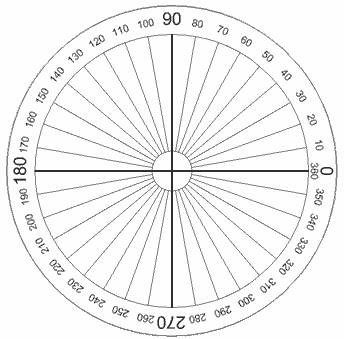
If you are completly serious you may consider checking your protractor, friend, computer screen, and your head. At 92 your are -2 into the ground. Unless you really are that bad in which case
 your way cooler then me
Less then 90 and that is freaking LOW
__________________
Deals gap 318 turns in 11.5 miles. Florida 318 miles with 11 turns.
Deals gap 318 turns in 11.5 miles. Florida 318 miles with 11 turns.

Unemployed Schmuck
Joined: Sep 2007
Posts: 1,417
Likes: 0
lol, of course I was being smartasstic dude, but seriously, if the road was like seriously banked around a turn, and you were riding seriously fast around it, then for atleast a short period, you could probably go past 90??? maybe...not sure...I dunno how you would pull out, unless the turn dipped like a downward spiral...
all motor dubbin
Joined: Nov 2003
Posts: 218
Likes: 0
lol, of course I was being smartasstic dude, but seriously, if the road was like seriously banked around a turn, and you were riding seriously fast around it, then for atleast a short period, you could probably go past 90??? maybe...not sure...I dunno how you would pull out, unless the turn dipped like a downward spiral...
__________________
Deals gap 318 turns in 11.5 miles. Florida 318 miles with 11 turns.
Deals gap 318 turns in 11.5 miles. Florida 318 miles with 11 turns.


Registered User
Joined: Feb 2006
Posts: 727
Likes: 0
You will never see a better lean angle than 90 degrees as there is no better lean angle for optimal cornering. Anything past 90 degrees means you are going so fast and at such a trajectory that you need to assist gravity which is always pulling you straight down. You can look at roller coaster designs or the circus act where they ride dirt bikes around the inside of a steel sphere for examples. The only time you need to angle past 90 degrees is when momentum would launch you into the sky without assisting gravity.
The physics of it is actually pretty simple when you think about it. The only reason you lean at all on a motorcycle is to counter centripetal force. Centripetal force always pulls straight towards the outside of the corner, and increases with the speed you take a corner or the angle of the corner (sharper turns mean overcoming stronger centripetal force). Knowing that the centripetal force is always pulling directly out from the corner, the optimal angle for overcoming that force is 90 degrees as measured from the horizon. When you hit 90 degrees, the centripetal force is directed straight down, pushing you into the seat of your bike, and meaning the friction required of the tire to hold you in that position is minimized (sort of like when you ride straight up and down in a straight line). Anything less than 90 degrees, and you are balancing gravity vs. the centripetal force generated by the turn. Since we cannot turn off gravity, nor do we travel fast enough or normally have a surface conducive to 90 degree lean angles, we almost always lean somewhere in the neighborhood of zero (straight line) to 50 degrees or so (as measured off the surface of the road). I believe the best sport bike tires can handle lean angles of about 50 degrees.
If you want to see an example of a near 90 degree lean angle (again, as measured from the horizon and not the surface of the road) just go to the Daytona 200 during Bike Week. The banked corners at the track allow for bikes to lean at almost 90 degrees.
As for the Pilot Road 2's, I have been running them since they first came out and have never had a problem. Still sticky enough to power wheelie, even on the hard center rubber, and never had a problem leaning it over to roll through the center of a corner either. I have heard that the outside edge rubber is the same as the Pilot Power, while the center is a harder rubber than the Pilot Power. This gives you, well, me anyway, exceptional tire life without sacrificing the cornering ability. It's a no brainer for me and I intend to keep putting on Pilot Road 2's.
Now that is not to say there are not people on these boards that may not be satisfied with the Pilot Road 2. If you push through corners on a regular basis, including gassing it on exit, then you may want the Pilot Power 2ct just to be safe. If you know how to ride and just want to roll through the center of the corner without aggressive braking on corner entry and aggressive throttle on exit, you can drag your knee with the Pilot Road 2's.
The physics of it is actually pretty simple when you think about it. The only reason you lean at all on a motorcycle is to counter centripetal force. Centripetal force always pulls straight towards the outside of the corner, and increases with the speed you take a corner or the angle of the corner (sharper turns mean overcoming stronger centripetal force). Knowing that the centripetal force is always pulling directly out from the corner, the optimal angle for overcoming that force is 90 degrees as measured from the horizon. When you hit 90 degrees, the centripetal force is directed straight down, pushing you into the seat of your bike, and meaning the friction required of the tire to hold you in that position is minimized (sort of like when you ride straight up and down in a straight line). Anything less than 90 degrees, and you are balancing gravity vs. the centripetal force generated by the turn. Since we cannot turn off gravity, nor do we travel fast enough or normally have a surface conducive to 90 degree lean angles, we almost always lean somewhere in the neighborhood of zero (straight line) to 50 degrees or so (as measured off the surface of the road). I believe the best sport bike tires can handle lean angles of about 50 degrees.
If you want to see an example of a near 90 degree lean angle (again, as measured from the horizon and not the surface of the road) just go to the Daytona 200 during Bike Week. The banked corners at the track allow for bikes to lean at almost 90 degrees.
As for the Pilot Road 2's, I have been running them since they first came out and have never had a problem. Still sticky enough to power wheelie, even on the hard center rubber, and never had a problem leaning it over to roll through the center of a corner either. I have heard that the outside edge rubber is the same as the Pilot Power, while the center is a harder rubber than the Pilot Power. This gives you, well, me anyway, exceptional tire life without sacrificing the cornering ability. It's a no brainer for me and I intend to keep putting on Pilot Road 2's.
Now that is not to say there are not people on these boards that may not be satisfied with the Pilot Road 2. If you push through corners on a regular basis, including gassing it on exit, then you may want the Pilot Power 2ct just to be safe. If you know how to ride and just want to roll through the center of the corner without aggressive braking on corner entry and aggressive throttle on exit, you can drag your knee with the Pilot Road 2's.
Last edited by dkutin; Dec 28, 2009 at 06:47 AM.

Capt."Howling Mad"Murdock
Joined: May 2003
Posts: 16,339
Likes: 0
You will never see a better lean angle than 90 degrees as there is no better lean angle for optimal cornering. Anything past 90 degrees means you are going so fast and at such a trajectory that you need to assist gravity which is always pulling you straight down. You can look at roller coaster designs or the circus act where they ride dirt bikes around the inside of a steel sphere for examples. The only time you need to angle past 90 degrees is when momentum would launch you into the sky without assisting gravity.
The physics of it is actually pretty simple when you think about it. The only reason you lean at all on a motorcycle is to counter centripetal force. Centripetal force always pulls straight towards the outside of the corner, and increases with the speed you take a corner or the angle of the corner (sharper turns mean overcoming stronger centripetal force). Knowing that the centripetal force is always pulling directly out from the corner, the optimal angle for overcoming that force is 90 degrees as measured from the horizon. When you hit 90 degrees, the centripetal force is directed straight down, pushing you into the seat of your bike, and meaning the friction required of the tire to hold you in that position is minimized (sort of like when you ride straight up and down in a straight line). Anything less than 90 degrees, and you are balancing gravity vs. the centripetal force generated by the turn. Since we cannot turn off gravity, nor do we travel fast enough or normally have a surface conducive to 90 degree lean angles, we almost always lean somewhere in the neighborhood of zero (straight line) to 50 degrees or so (as measured off the surface of the road). I believe the best sport bike tires can handle lean angles of about 50 degrees.
If you want to see an example of a near 90 degree lean angle (again, as measured from the horizon and not the surface of the road) just go to the Daytona 200 during Bike Week. The banked corners at the track allow for bikes to lean at almost 90 degrees.
As for the Pilot Road 2's, I have been running them since they first came out and have never had a problem. Still sticky enough to power wheelie, even on the hard center rubber, and never had a problem leaning it over to roll through the center of a corner either. I have heard that the outside edge rubber is the same as the Pilot Power, while the center is a harder rubber than the Pilot Power. This gives you, well, me anyway, exceptional tire life without sacrificing the cornering ability. It's a no brainer for me and I intend to keep putting on Pilot Road 2's.
Now that is not to say there are not people on these boards that may not be satisfied with the Pilot Road 2. If you push through corners on a regular basis, including gassing it on exit, then you may want the Pilot Power 2ct just to be safe. If you know how to ride and just want to roll through the center of the corner without aggressive braking on corner entry and aggressive throttle on exit, you can drag your knee with the Pilot Road 2's.
The physics of it is actually pretty simple when you think about it. The only reason you lean at all on a motorcycle is to counter centripetal force. Centripetal force always pulls straight towards the outside of the corner, and increases with the speed you take a corner or the angle of the corner (sharper turns mean overcoming stronger centripetal force). Knowing that the centripetal force is always pulling directly out from the corner, the optimal angle for overcoming that force is 90 degrees as measured from the horizon. When you hit 90 degrees, the centripetal force is directed straight down, pushing you into the seat of your bike, and meaning the friction required of the tire to hold you in that position is minimized (sort of like when you ride straight up and down in a straight line). Anything less than 90 degrees, and you are balancing gravity vs. the centripetal force generated by the turn. Since we cannot turn off gravity, nor do we travel fast enough or normally have a surface conducive to 90 degree lean angles, we almost always lean somewhere in the neighborhood of zero (straight line) to 50 degrees or so (as measured off the surface of the road). I believe the best sport bike tires can handle lean angles of about 50 degrees.
If you want to see an example of a near 90 degree lean angle (again, as measured from the horizon and not the surface of the road) just go to the Daytona 200 during Bike Week. The banked corners at the track allow for bikes to lean at almost 90 degrees.
As for the Pilot Road 2's, I have been running them since they first came out and have never had a problem. Still sticky enough to power wheelie, even on the hard center rubber, and never had a problem leaning it over to roll through the center of a corner either. I have heard that the outside edge rubber is the same as the Pilot Power, while the center is a harder rubber than the Pilot Power. This gives you, well, me anyway, exceptional tire life without sacrificing the cornering ability. It's a no brainer for me and I intend to keep putting on Pilot Road 2's.
Now that is not to say there are not people on these boards that may not be satisfied with the Pilot Road 2. If you push through corners on a regular basis, including gassing it on exit, then you may want the Pilot Power 2ct just to be safe. If you know how to ride and just want to roll through the center of the corner without aggressive braking on corner entry and aggressive throttle on exit, you can drag your knee with the Pilot Road 2's.
WAT?
__________________


How fast officer?
Joined: Jun 2005
Posts: 1,534
Likes: 0
As for the Pilot Road 2's, I have been running them since they first came out and have never had a problem. Still sticky enough to power wheelie, even on the hard center rubber, and never had a problem leaning it over to roll through the center of a corner either... If you push through corners on a regular basis, including gassing it on exit, then you may want the Pilot Power 2ct just to be safe. If you know how to ride and just want to roll through the center of the corner without aggressive braking on corner entry and aggressive throttle on exit, you can drag your knee with the Pilot Road 2's.
__________________

Registered User
Joined: Feb 2006
Posts: 727
Likes: 0
Not important. I was just trying to explain why a 90 degree lean angle is optimal for cornering by explaining the physics of it. If you think of getting on your bike and sitting straight up and down as being zero degrees with the horizon, then the angle increasing as you lean into a corner, you would never, regardless of road surface angle (so say the banked corners of Daytona) lean further than 90 degrees from vertical to enhance cornering ability. In fact, you could never really reach a perfect 90 degree angle either, as you cannot turn off gravity, so even if the corner was really sharp and you had a surface allowing you to lean 90 degrees, you would have to be a fraction off 90 degrees to counter gravity.
It would be easier to explain with pictures like in my old physics books. But again, not really important.
It would be easier to explain with pictures like in my old physics books. But again, not really important.
Capt."Howling Mad"Murdock
Joined: May 2003
Posts: 16,339
Likes: 0
Not important. I was just trying to explain why a 90 degree lean angle is optimal for cornering by explaining the physics of it. If you think of getting on your bike and sitting straight up and down as being zero degrees with the horizon, then the angle increasing as you lean into a corner, you would never, regardless of road surface angle (so say the banked corners of Daytona) lean further than 90 degrees from vertical to enhance cornering ability. In fact, you could never really reach a perfect 90 degree angle either, as you cannot turn off gravity, so even if the corner was really sharp and you had a surface allowing you to lean 90 degrees, you would have to be a fraction off 90 degrees to counter gravity.
It would be easier to explain with pictures like in my old physics books. But again, not really important.
It would be easier to explain with pictures like in my old physics books. But again, not really important.
wat?
yep, still not getting it. can you put it in a play and act it out for me?
__________________


