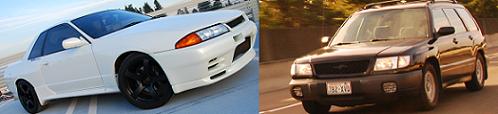
want to figure out the drag of your car....


Thread Starter
*Big Schpellar*
Joined: Jul 2005
Posts: 3,192
Likes: 0
 want to figure out the drag of your car....
"There is a basic equation for the force it takes to push something through air:
Aerodynamic drag = 1/2 D x A x Vsquared
In this equation, D is the density of the air, A is the frontal area of the moving shape, and V is its velocity relative to the air.
For real body shapes, air at standard conditions, V in mph, and drag in pounds of force, this equation becomes:
Drag = 1/391 x Cd x A x Vsquared
This equation shows that to calculate drag you need to know three things: Cd, the drag coefficient; A, the frontal area of whatever you’re driving through the air; and the speed of air past it. This equation shows an important point—aerodynamic forces are proportional to the square of the speed. That means you quadruple the drag or lift when you double the speed.
The drag coefficient, Cd, is important because, in concert with frontal area, it determines the power cost of pushing a shape through air at a certain speed. A small, low-Cd road car will have a higher top speed than a larger, boxier car with the same engine power."
http://www.insideracingtechnology.com/tech102drag.htm
"The drag coefficient is a number that aerodynamicists use to model all of the complex dependencies of shape, inclination, and flow conditions on aircraft drag. This equation is simply a rearrangement of the drag equation where we solve for the drag coefficient in terms of the other variables. The drag coefficient Cd is equal to the drag D divided by the quantity: density r times half the velocity V squared times the reference area A.
Cd = D / (A * .5 * r * V^2)
The quantity one half the density times the velocity squared is called the dynamic pressure q. So
Cd = D / (q * A)
The drag coefficient then expresses the ratio of the drag force to the force produced by the dynamic pressure times the area.
This equation gives us a way to determine a value for the drag coefficient. In a controlled environment (wind tunnel) we can set the velocity, density, and area and measure the drag produced. Through division we arrive at a value for the drag coefficient. As pointed out on the drag equation slide, the choice of reference area (wing area, frontal area, surface area, ...) will affect the actual numerical value of the drag coefficient that is calculated. When reporting drag coefficient values, it is important to specify the reference area that is used to determine the coefficient. We can predict the drag that will be produced under a different set of velocity, density (altitude), and area conditions using the drag equation."
http://www.grc.nasa.gov/WWW/K-12/airplane/dragco.html
I think I'll trust everything i learned in school and the nice folks at nasa over you two.
Regardless of whether you use frontal area or total area (which includes frontal area) it is the main factor in the equation to determine the cd. When testing two cars in a wind tunnel at the same Velocity and air at the same density, which makes them both constants, the only other variable in the equation is the drag which will be calculated from the test.
So saying area (frontal or total surface area) doesnt matter in calculating cd is the most asinine crap i've heard in a while.
Aerodynamic drag = 1/2 D x A x Vsquared
In this equation, D is the density of the air, A is the frontal area of the moving shape, and V is its velocity relative to the air.
For real body shapes, air at standard conditions, V in mph, and drag in pounds of force, this equation becomes:
Drag = 1/391 x Cd x A x Vsquared
This equation shows that to calculate drag you need to know three things: Cd, the drag coefficient; A, the frontal area of whatever you’re driving through the air; and the speed of air past it. This equation shows an important point—aerodynamic forces are proportional to the square of the speed. That means you quadruple the drag or lift when you double the speed.
The drag coefficient, Cd, is important because, in concert with frontal area, it determines the power cost of pushing a shape through air at a certain speed. A small, low-Cd road car will have a higher top speed than a larger, boxier car with the same engine power."
http://www.insideracingtechnology.com/tech102drag.htm
"The drag coefficient is a number that aerodynamicists use to model all of the complex dependencies of shape, inclination, and flow conditions on aircraft drag. This equation is simply a rearrangement of the drag equation where we solve for the drag coefficient in terms of the other variables. The drag coefficient Cd is equal to the drag D divided by the quantity: density r times half the velocity V squared times the reference area A.
Cd = D / (A * .5 * r * V^2)
The quantity one half the density times the velocity squared is called the dynamic pressure q. So
Cd = D / (q * A)
The drag coefficient then expresses the ratio of the drag force to the force produced by the dynamic pressure times the area.
This equation gives us a way to determine a value for the drag coefficient. In a controlled environment (wind tunnel) we can set the velocity, density, and area and measure the drag produced. Through division we arrive at a value for the drag coefficient. As pointed out on the drag equation slide, the choice of reference area (wing area, frontal area, surface area, ...) will affect the actual numerical value of the drag coefficient that is calculated. When reporting drag coefficient values, it is important to specify the reference area that is used to determine the coefficient. We can predict the drag that will be produced under a different set of velocity, density (altitude), and area conditions using the drag equation."
http://www.grc.nasa.gov/WWW/K-12/airplane/dragco.html
I think I'll trust everything i learned in school and the nice folks at nasa over you two.
Regardless of whether you use frontal area or total area (which includes frontal area) it is the main factor in the equation to determine the cd. When testing two cars in a wind tunnel at the same Velocity and air at the same density, which makes them both constants, the only other variable in the equation is the drag which will be calculated from the test.
So saying area (frontal or total surface area) doesnt matter in calculating cd is the most asinine crap i've heard in a while.
__________________