


TECH: Volumetric Efficiency


Thread Starter
Dr. Doom
Joined: Mar 2003
Posts: 27,320
Likes: 0
 TECH: Volumetric Efficiency
Volumetric Efficiency
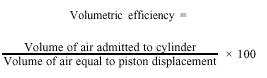
The volumetric efficiency of a 4-stroke engine is the relationship between the quantity of intake air and the piston displacement. In other words, volumetric efficiency is the ratio between the charge that actually enters the cylinder and the amount that could enter under ideal conditions. Piston displacement is used since it is difficult to measure the amount of charge that would enter the cylinder under ideal conditions. An engine would have 100% volumetric efficiency if, at atmospheric pressure and normal temperature, an amount of air exactly equal to piston displacement could be drawn into the cylinder. This is not possible, except by supercharging, because the passages through which the air must flow offer a resistance, the force pushing the air into the cylinder is only atmospheric, and the air absorbs heat during the process. Therefore, volumetric efficiency is deter-mined by measuring (with an orifice or venturi type meter) the amount of air taken in by the engine, converting the amount to volume, and comparing this volume to the piston displacement.
The concept of volumetric efficiency does not apply to 2-stroke cycle engines. Instead, the term “scavenge efficiency” is used. Scavenge efficiency shows how thoroughly the burned gases are removed and the cylinder filled with fresh air. As in the case of a 4-stroke cycle engine, it is desirable that the air supply be sufficiently cool. Scavenge efficiency depends largely upon the arrangement of the exhaust, scavenge air ports, and valves.
As the heat content of a fuel is transformed into useful work, during the combustion process, many different losses take place. These losses can be divided into two general classifications: thermodynamic and mechanical. The net useful work delivered by an engine is the result obtained by deducting the total losses from the heat energy input.
Thermodynamic Losses
Losses of this nature are a result of the following: loss to the cooling and lubricating systems; loss to the surrounding air; loss to the exhaust; and loss due to imperfect combustion. Heat energy losses from both the cooling water systems and the lubricating oil system are always present. Some heat is conducted through the engine parts and radiated to the atmosphere or picked up by the surrounding air by convection. The effect of these losses varies according to the part of the cycle in which they occur. The heat of the jacket cooling water cannot be taken as a true measure of heat losses, since all this heat is not absorbed by the water. Some heat is lost to the jackets during the compression, combustion, and expansion phases of the cycle; some is lost (to the atmosphere) during the exhaust stroke; and some is absorbed by the walls of the exhaust passages.
Heat losses to the atmosphere through the exhaust are unavoidable. This is because the engine cylinder must be cleared of the hot exhaust gases before the next air intake charge can be made. The heat lost to the exhaust is determined by the temperature within the cylinder when exhaust begins. The amount of fuel injected and the weight of air compressed within the cylinder are the controlling factors. Improper timing of the exhaust valves, whether too early or too late, will result in increased heat losses. If too early, the valve releases the pressure in the cylinder before all the available work is obtained; if too late, the necessary amount of air for complete combustion of the next charge cannot be realized, although a small amount of additional work may be obtained.
Proper timing and seating of the valves is essential in order to maintain heat loss to the exhaust at a minimum.
Heat losses due to imperfect or incomplete combustion have a serious effect on the power that can be developed in the cylinder. Because of the short interval of time necessary for the cycle in modern engines, complete combustion is not possible; but heat losses can be kept to a minimum if the engine is kept in proper adjustment. It is often possible to detect incomplete combustion by watching for abnormal exhaust temperatures and changes in the exhaust color, and by being alert for unusual noises in the engine.
Mechanical Losses
There are several kinds of mechanical losses, but all are not present in every engine. The mechanical or friction losses of an engine include bearing friction; piston and piston ring friction; pumping losses caused by operation of water pumps, lubricating pumps, and scavenging air blowers; power required to operate valves; etc. Friction losses cannot be eliminated, but they can be kept to a minimum by maintaining the engine in its best mechanical condition. Bearings, pistons, and piston rings should be properly installed and fitted, shafts must be in alignment, and lubricating and cooling systems should be at their highest operating efficiency.
There is more, but you can read that for yourself....
Thought this was a pretty good read.
Source:
http://www.tpub.com/engine1/en1-105.htm
The volumetric efficiency of a 4-stroke engine is the relationship between the quantity of intake air and the piston displacement. In other words, volumetric efficiency is the ratio between the charge that actually enters the cylinder and the amount that could enter under ideal conditions. Piston displacement is used since it is difficult to measure the amount of charge that would enter the cylinder under ideal conditions. An engine would have 100% volumetric efficiency if, at atmospheric pressure and normal temperature, an amount of air exactly equal to piston displacement could be drawn into the cylinder. This is not possible, except by supercharging, because the passages through which the air must flow offer a resistance, the force pushing the air into the cylinder is only atmospheric, and the air absorbs heat during the process. Therefore, volumetric efficiency is deter-mined by measuring (with an orifice or venturi type meter) the amount of air taken in by the engine, converting the amount to volume, and comparing this volume to the piston displacement.
The concept of volumetric efficiency does not apply to 2-stroke cycle engines. Instead, the term “scavenge efficiency” is used. Scavenge efficiency shows how thoroughly the burned gases are removed and the cylinder filled with fresh air. As in the case of a 4-stroke cycle engine, it is desirable that the air supply be sufficiently cool. Scavenge efficiency depends largely upon the arrangement of the exhaust, scavenge air ports, and valves.
As the heat content of a fuel is transformed into useful work, during the combustion process, many different losses take place. These losses can be divided into two general classifications: thermodynamic and mechanical. The net useful work delivered by an engine is the result obtained by deducting the total losses from the heat energy input.
Thermodynamic Losses
Losses of this nature are a result of the following: loss to the cooling and lubricating systems; loss to the surrounding air; loss to the exhaust; and loss due to imperfect combustion. Heat energy losses from both the cooling water systems and the lubricating oil system are always present. Some heat is conducted through the engine parts and radiated to the atmosphere or picked up by the surrounding air by convection. The effect of these losses varies according to the part of the cycle in which they occur. The heat of the jacket cooling water cannot be taken as a true measure of heat losses, since all this heat is not absorbed by the water. Some heat is lost to the jackets during the compression, combustion, and expansion phases of the cycle; some is lost (to the atmosphere) during the exhaust stroke; and some is absorbed by the walls of the exhaust passages.
Heat losses to the atmosphere through the exhaust are unavoidable. This is because the engine cylinder must be cleared of the hot exhaust gases before the next air intake charge can be made. The heat lost to the exhaust is determined by the temperature within the cylinder when exhaust begins. The amount of fuel injected and the weight of air compressed within the cylinder are the controlling factors. Improper timing of the exhaust valves, whether too early or too late, will result in increased heat losses. If too early, the valve releases the pressure in the cylinder before all the available work is obtained; if too late, the necessary amount of air for complete combustion of the next charge cannot be realized, although a small amount of additional work may be obtained.
Proper timing and seating of the valves is essential in order to maintain heat loss to the exhaust at a minimum.
Heat losses due to imperfect or incomplete combustion have a serious effect on the power that can be developed in the cylinder. Because of the short interval of time necessary for the cycle in modern engines, complete combustion is not possible; but heat losses can be kept to a minimum if the engine is kept in proper adjustment. It is often possible to detect incomplete combustion by watching for abnormal exhaust temperatures and changes in the exhaust color, and by being alert for unusual noises in the engine.
Mechanical Losses
There are several kinds of mechanical losses, but all are not present in every engine. The mechanical or friction losses of an engine include bearing friction; piston and piston ring friction; pumping losses caused by operation of water pumps, lubricating pumps, and scavenging air blowers; power required to operate valves; etc. Friction losses cannot be eliminated, but they can be kept to a minimum by maintaining the engine in its best mechanical condition. Bearings, pistons, and piston rings should be properly installed and fitted, shafts must be in alignment, and lubricating and cooling systems should be at their highest operating efficiency.
There is more, but you can read that for yourself....
Thought this was a pretty good read.
Source:
http://www.tpub.com/engine1/en1-105.htm


