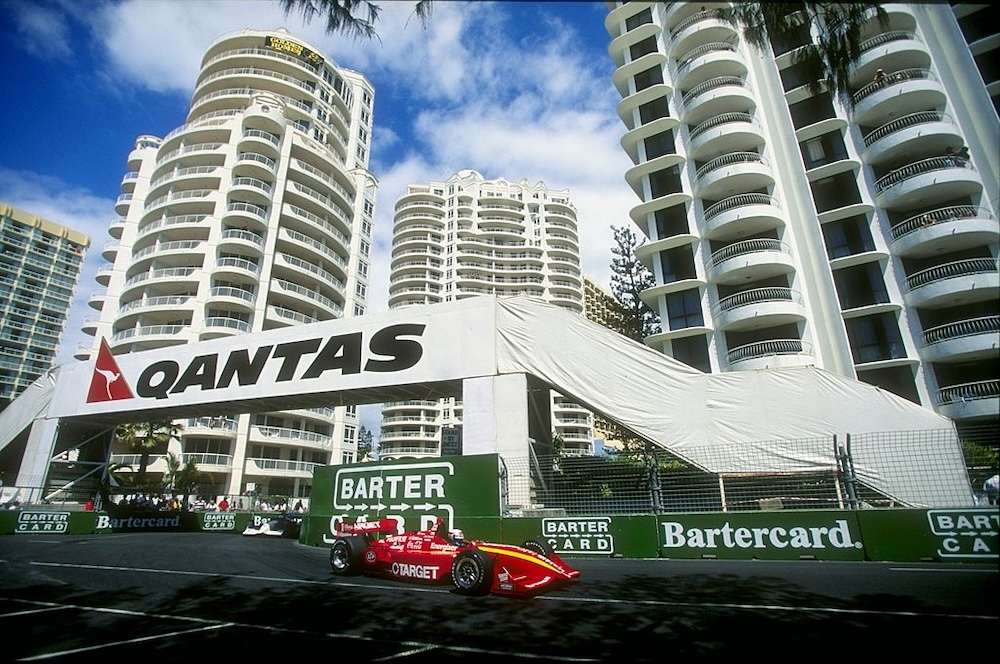
Zanardi claimed his final win with Chip Ganassi Racing at Surfers Paradise in 1998. Robert Laberge/Getty Images
But there were additional complications.
Zanardi felt the team lost faith in him very early in the season, and blamed himself for not standing his ground on technical matters at the time when team owner Sir Frank Williams and chief engineer Patrick Head still regarded his opinion as having some merit.
Whatever the myriad colors and forms that comprised the full picture, the facts are that Zanardi would often start races mid-grid whereas teammate R. Schumacher would regularly be a yapping, snapping underdog on the heels of Ferrari and McLaren. Then, whenever the Italian seemed set for a confidence-building breakthrough result, his car would falter or fail, or something would go wrong in a pitstop. After a dispiriting season – one he described as “soul-destroying” – Zanardi and the team split.
Given this huge setback, Zanardi was more than happy to take a sabbatical in 2000, enjoying life in Europe once more with his beautiful wife Daniela and their two-year-old son Niccolo. This domestic bliss meant he dithered over – or spurned – offers from some of the bigger Indy car teams (including Newman/Haas Racing and Ganassi) that were trying to lure him back to the U.S. Yet following irritation-laced persuasion from dear friend Vasser, Zanardi would give himself a mental reboot and decide that no, he didn’t want to be a retired racecar driver aged only 34 – but now there were few attractive options left open to him.
However, his old engineer Mo Nunn had left Ganassi to set up his own team, and some big sponsors and Honda backing persuaded Zanardi that this team was on the fast-track, and a deal was struck for 2001. Yet Alex swiftly discovered he hadn’t appreciated the size of the challenge, for while the team’s funding wasn’t a problem, its relative newness as a unit was definitely a hindrance. Mo Nunn Racing had only started in 2000, and ’01 was the first year in which it had run two cars. Zanardi was also at first bewildered and then frustrated by what he perceived as Nunn’s loss of interest in engineering in order to focus on team ownership.
In truth, Alex himself was also struggling to recapture his form in a type of car that he hadn’t raced in well over two years, and he was often shown up by teammate, the rising star and future Indy Racing League champion Tony Kanaan. Yet at midseason, despite still struggling in qualifying, Zanardi was clearly making progress with his raceday setups. Indeed, he was highly unfortunate not to land podium finishes at both Cleveland and Toronto.
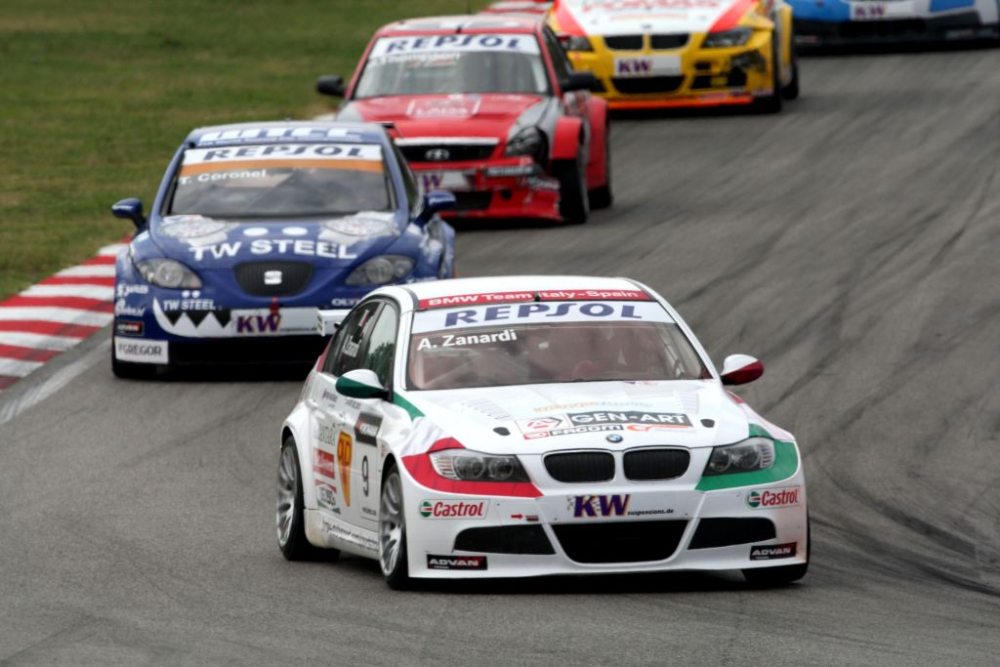
After his accident Zanardi rebounded in touring cars. Daniel Kalisz/Getty Images
Ironically, he was in his most competitive oval showing of the season at Lausitzring in Germany, when he spun out of the pitlane having made his final stop. As his car slid broadside across the track, the cockpit area was impaled by Alex Tagliani’s Forsythe Racing entry traveling at over 200mph. The impact tore off Zanardi’s legs and only masterful work by the CART Safety Team prevented the severe blood loss from costing the Italian his life.
“For a few seconds, the accident didn’t seem that bad,” Alex wrote. “If the car hadn’t split in two, I would have had to have absorbed all the energy from the impact, and I hardly felt a thing – my helmet didn’t even have a dent. I must have realized something though when I looked in front of me and saw no front to the car… and no legs. Before fainting, I must have realized something. From time to time, if I really try hard – I don’t know if it’s my imagination or disjointed memories – but some images come to the surface in my mind. Maybe one day the whole event will come back to me. I’m not afraid of it though, because all the damage has already been done.”
Following expert work at hospital to seal and heal, Zanardi’s rehabilitation program saw him fitted with prosthetic limbs. When CART revisited Lausitzring in 2003, he ran a demo in an Indy car fitted with hand controls, driving the 13 laps he failed to complete there two years earlier, and lapped at a speed that would have seen him qualify on the third row of the grid for that weekend’s race. Aside from reducing all onlookers to tears – especially the CART Safety Team members – the event sparked in Zanardi the thought that a return to the sport might be viable. An outing in a BMW touring car further cemented his resolve.
Joining touring car legend Roberto Ravaglia’s BMW team for the European Touring Car Championship in 2004, Alex drove a heavily adapted BMW 320i, and when that series evolved into the World Touring Car Championship in ’05, Zanardi stayed on. He earned a win in Oschersleben and several more Top 10 finishes that year, and over the next four seasons, he would add a further hat-trick of WTCC triumphs to his résumé.
By now, however, he was also forging a name for himself in handcycling. Finishing fourth in this division in the 2007 New York City Marathon, he went on to win similar events in Venice and Rome, before returning to NYC in 2011 and nailing victory. Zanardi’s performances were enough to earn a spot in the Italian team for the 2012 Paralympics, and he went on to win Gold Medals in the Road Time Trial H4 and the Road Race, and a Silver Medal in the Road Team Relay, events all held at Brands Hatch. Four years later, in the next Paralympics at Rio, he again nailed two Golds and one Silver.
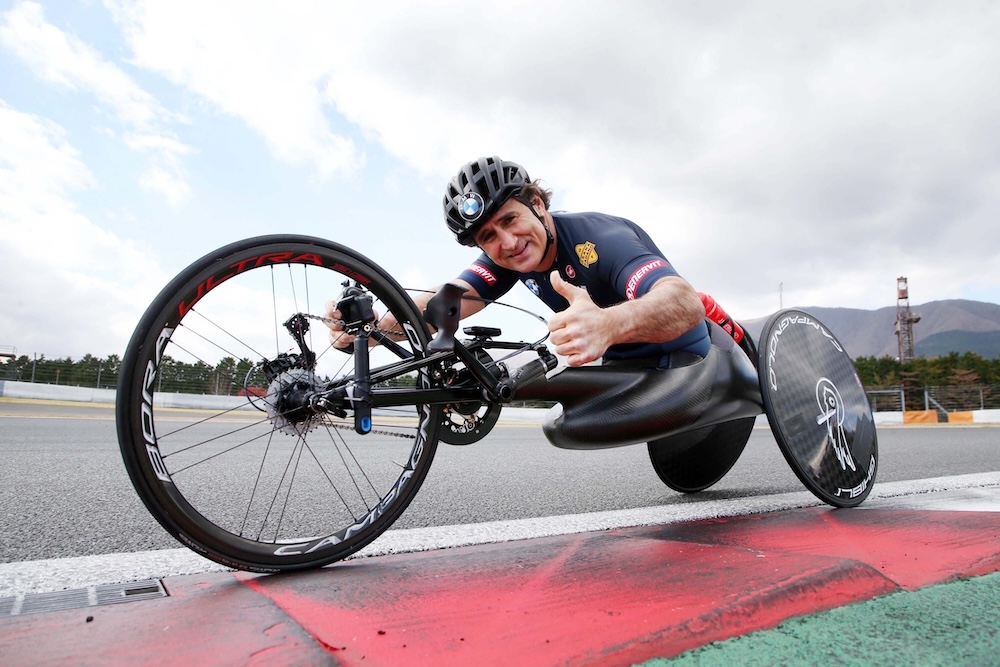
The competitive spirit that served Zanardi so well in motorsports proved equally potent in handcycling, where he won multiple paralymic medals and some of the world's biggest marathons. Image by BMW Sport
Zanardi hadn’t quit motorsport, competing in the full 2014 Blancpain Sprint Series season in a BMW Z4 and starring in a one-off appearance in DTM, driving a BMW M4 to fifth in the wet at Misano. His return to U.S. racing came in the 2019 Rolex 24 Hours at Daytona, sharing one of the Rahal Letterman Lanigan Racing-run works BMW M8s with John Edwards, Jesse Krohn and Chaz Mostert. The quartet finished ninth in the GTLM class.
Who knows how long this true ironman would have continued finding success in handcycles without his 2020 accident, or along which path his inquisitive mind and resolute spirit might have led him? Whatever, we can be certain this human dynamo would have made a success of it, because that’s just how he always was: audacious and dauntless.
In his foreword to Zanardi’s book, Mario Andretti wrote: “Alex’s stories are not about this rotten, unfair thing that happened to him. They are about having the power to adapt to change and about scoring a victory over, rather than becoming a victim of, the accident.”