Part 2
By
David Malsher-Lopez - Apr 5, 2026, 8:32 AM ET
Looking back on Ganassi’s first IndyCar championship, 30 years on
Jimmy seems one of the underrated champions in IndyCar history. Had you already detected that if you gave him the right equipment, he was champion material?
Mike Hull: When I came to work for Chip in 1992, he wanted to build a race team that didn’t focus on one driver. At that time, in IndyCar, Formula 1, NASCAR, whatever the series, there always seemed to be a primary and a secondary driver. Chip was of that Pittsburgh mindset that teams are flat landscapes where everyone is treated equally and everyone has to share unselfishly. We had primary drivers – first Eddie Cheever, then Arie Luyendyk, then Michael Andretti – like everyone else. So when Michael chose to return to Newman/Haas, it was a blessing in disguise because it meant in 1995 we hired Bryan Herta and Jimmy Vasser and that laid the foundation for moving away from a single lead driver toward the standard shared system that we still have across all cars equally, more than 30 years later.
Jimmy did really well in 1995 compared with his teammate, but it built a foundation for where we went next. So in ’96, Jimmy was retained and we brought in Alex Zanardi. And Jimmy came out of the box and won four of the first six races and established the situation, and by him capitalizing early, it allowed Alex the time without any internal hierarchy to become a strength.
Jimmy came along at exactly the right time, and that timing element is something you cannot predict. So you try to create the team atmosphere to take advantage of drivers’ abilities at the right time in their careers. It’s not a secret that that build process was perfect, because Jimmy was the perfect guy for that new structure, because he’s such a team player.
He had enormous ability, much better than the average IndyCar driver. For example, he understood the dynamics of how a track changed, and understood what suited his drive style. And he had Julian Robertson as his race engineer. Julian had been a Lola guy who was sent to America, and as soon as we hired him in ’93, he was at work on the Reynard program. He and Jimmy worked really well together.
I was always interested in Jimmy because, like me, he was a Californian making his way through the ranks, and he worked really, really hard at it. He came from a car culture because of his dad’s racing.
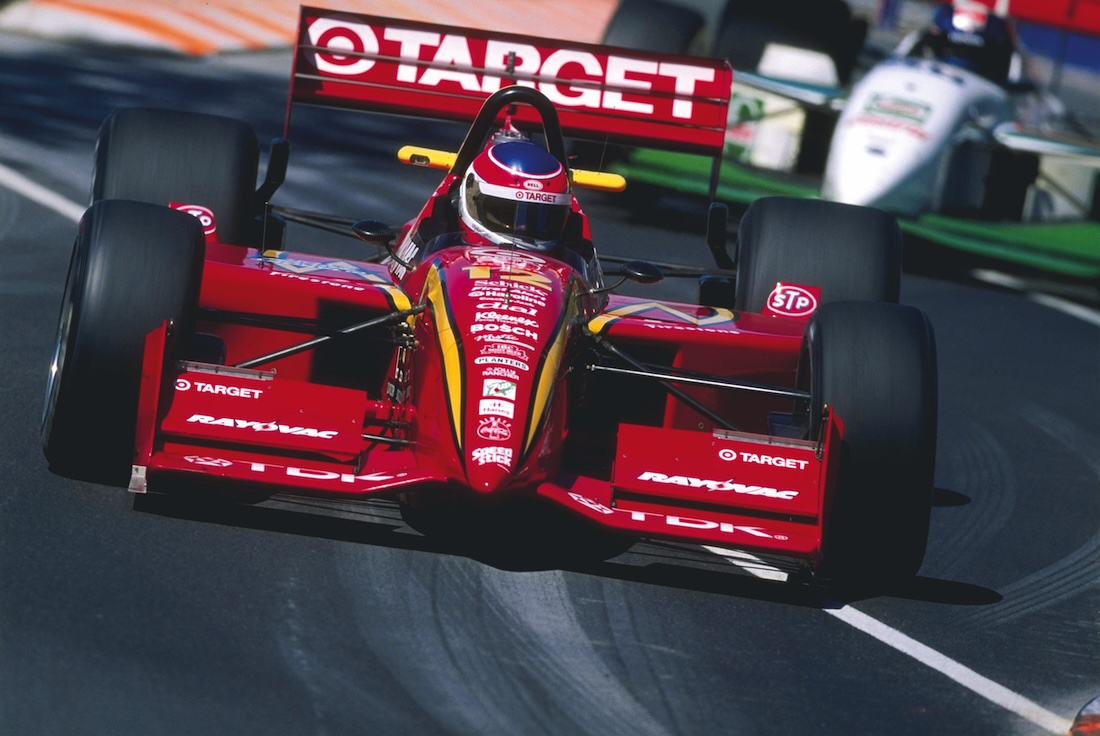
Buoyed by the strong Reynard-Honda-Firestone package and the strong team around him, Vasser got off to a fast start and held on through a "June Swoon" to take the title. Getty Images
Julian Robertson: Chip obviously thought Jimmy might be good, and we started to get our groove in the middle of 1995 with a bunch of podiums. It was very helpful having the continuity coming into ’96 of Jimmy still being there, especially considering, like you say, we were changing engine manufacturer and tire manufacturer.
When we started testing with the new combination, I don’t think we dared to dream that it was the start of a championship campaign. There were too many unknowns, because what if another manufacturer had found a massive advantage? You can never tell. But obviously after the first few races we realized that we’d hit on something pretty special.
I think to do what Jimmy did against that level of competition – outside the team and also from his teammate – was great. He did a hell of a job. The champions are the ones who can drive fast naturally, so they can also think and pay attention to a lot of other stuff. Jimmy was one of them. Like most drivers of that caliber, he gave good feedback. He also seemed to really understand ovals and what’s best for a car on ovals, which is interesting from a guy who had his roots in road racing. I’ve always felt it was his feel and understanding of the cars, as much as his talent, that made him so fast on ovals.
We’d done a boat-load of testing, too… like if Honda wanted to run two engines for 600 miles, we’d do it. We’d go to Fontana [California Speedway] and spend several days there. Actually, I remember Jimmy really impressing Honda one time at Fontana, when he came in and said, “The engine’s about to blow,” and the engineers said, “No, there’s nothing on our data that suggests that.” Jimmy insisted, “I guarantee you, the engine’s about to let go,” so we took the time to put a new motor in his car in the middle of the day. Anyway, Honda took the engine back and pulled it apart and sure enough, it had been about to let go. A manufacturer normally doesn’t get to see their engine at that point, 30 seconds before it’s about to blow: they just see the end result, so they were impressed with that and I’m sure whatever they found probably helped them for the next engine development.
Jimmy had a strange-shaped season, winning four of the first six races and then only having one more podium finish, despite remaining competitive. Was there a particular reason for that? Was he just trying to protect a points lead?
Julian Robertson: No, not until the last three races, I’d say. After the first six races, we were still trying to win every race: you can’t cruise for two-thirds of a season and expect to win the championship. You have to race for everything, but keep the big picture in your head too. We had a “June Swoon” as we named it at the time, where it was tough for a few races.
Jimmy Vasser: I crashed hard in practice at Detroit [Round 8], and the first thing I remember seeing afterward was my arm moving in circles in front of my face and I couldn’t control it. Really weird. I’d damaged my spine, as well. I ended up qualifying near the back, got up into the points but then on the very last lap, I started experiencing vertigo and barely made it around.
We then went from Detroit to test at Mid-Ohio and I felt funky but not too bad. Then I got in, reached the end of pit lane and at only 50 mph, I got vertigo again – couldn’t feel the car, the world was turning upside down around me. So I went to Indianapolis to see Dr. [Terry] Trammell and he discovered that my Detroit crash had dislodged the crystals in my ear which left me off-balance.
Luckily there were 10 more days before Portland and the drug that Trammell gave me was starting to take effect. I qualified third there, but in the race I felt vertigo again, it started raining and I spun off and lost laps. That was my only finish outside the points that year.
And then you came back in a big way at Cleveland…