part 2 Tire planning
And if, by chance, the tires can take more punishment than usual, he adjusts his limit accordingly and performs at that elevated level without tipping over the tire-killing line. Tidy. Clean. Efficient.
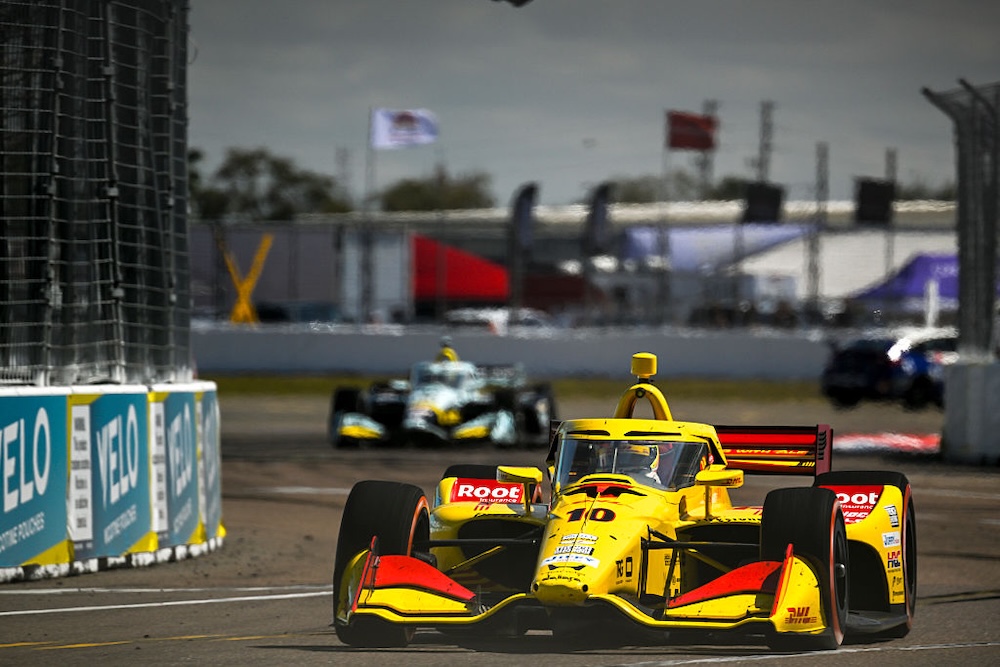 One of Palou's superpowers is knowing exactly how much punishment his tires can take, and then pushing them right up to – but never over – that precise point.
 Gavin Baker/Getty Images
“He's just so consistent,” Chris Simmons, Ganassi’s director of performance, said of Palou after the race.
“He doesn't make any mistakes, and he's super easy on the tires. So on lap one and two, that looks good,
but that compounds over the run. So by lap 10, it looks superhuman. And by the end of the run, it looks like he's Iron Man.”
Understanding Palou’s ability to overcut polesitter Scott McLaughlin and front row starter Marcus Ericsson on Sunday
begins with the tire choices he made for the race.
As Palou’s race strategist Barry Wanser often shares, his
driver leads the tire-choice decisions, and in this case, Palou opted
to start on new Firestone alternates, which were a major question mark leading into the race.
Teams knew the new street course alternates were more durable than last year’s short-life specials, but hadn’t run enough laps in the heat of the day on the 2026 alternates to know how long they’d last before degradation set in and a heavy reduction in grip would take place. The longest runs anyone got on the alternates came in the pre-race warmup, which was cool and overcast. By the afternoon, the skies were blue and conditions were warm, which led to a lack of confidence in the alternate’s durability.
Palou ultimately chose a two-stop race, which involved rolling the dice on whether he could make the new alternates last long enough to stick to the two-stop plan.
If he couldn’t run until at least the one-third point in the 100-lap race, Palou would need to abandon the two-stopper and shift to three stops, which would have ruined his shot at victory.
The risk was real in that regard – t
he best driver on a three-stop strategy placed ninth at St. Petersburg.
In the end, the gamble paid off.
Palou was one of only four drivers among the 25 starters to make the two-stop plan work while starting on new alternates; Romain Grosjean who finished eighth, Ganassi affiliate Meyer Shank Racing with Marcus Armstrong in 11th, and Ganassi teammate Kyffin Simpson in 15th were the others.
From there,
Palou made a pass to take third from rookie Dennis Hauger on the opening lap and stayed there until the first round of pit stops approached. McLaughlin opened from pole on new Firestone primaries, which everyone knew were long lasting,
and led until he pitted for used alternates on lap 35. Behind him, Andretti Global’s Marcus Ericsson also started on new primaries and inherited the lead for a lap before matching McLaughlin’s strategy by stopping on lap 36 and bolting on used alternates for the middle section of the race.
Their strategy was clear: Start on the safer but slower primes, run just past the one-third point in the race, then split the last two stints on the faster alternates. They’d run the second stint on their best used alternates and save the new alternates for last, giving themselves the highest quality rubber with the most life to consume in the run to the finish line.
It was a case of going good-better-best with their tire compound sequencing.
Palou went in the opposite direction with best-better-good.
If you do what the other guys do, you will get what the other guys got.
His strategy centered on trying to
make up ground and possibly build an advantage on the fastest tires in the first two stints before closing on the slower primes with the hope of having enough of a buffer to where those finishing on new alternates would cut into the amount of lead, but not to the point of getting past him.
The first strike by Palou came with the timing of his first pit stop, which was on lap 38.
He managed to go three laps longer than McLaughlin and two more than Ericsson on their new primes… while using the new alternates with the unknown durability.
It’s a small thing in terms of laps;
Palou only went a bit longer than McLaughlin and Ericsson in front of him on primes, but he was able to make immense speed on those new alternates, and for 38 laps. It was a monumental achievement.
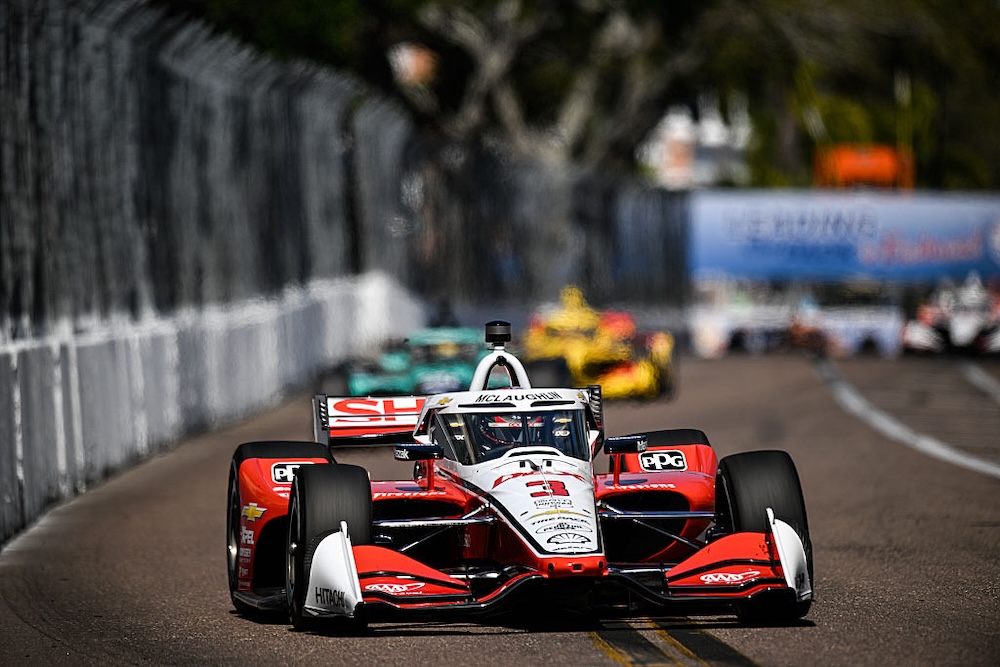
McLaughlin had an early advantage on the harder prime Firestones, but Palou – here lurking in the background – was
able to stretch his unproven alternates even further. Brandon Badraoui/Getty Images
He also took great care of those tires, which allowed him to set his fastest lap of the race on lap 37 – his in-lap – with a 1m02.8281s. McLaughlin’s in lap was 0.7306s slower with a 1m03.5587s.
Look to their first two out laps on cold tires, and keep in mind that Palou and McLaughlin took used alternates, which meant they were on the same compound for the first time, and Palou was 0.2842s faster to start.
Next, as McLaughlin and Ericsson fought each other – along with MSR’s Armstrong, who made it a three-way party –
while trying to get their tires up to temperature, Palou was 1.2955s quicker on his second flying lap on used alternates.