James Sutton/Getty Images
By
Mark Glendenning - Oct 29, 2025, 4:09 PM ET
With an evocative nod to its past, Honda preparing for its F1 future
The first thing you notice is how pretty it is, but the first thing you really notice is the noise.
It’s Sunday morning at Autodromo Hermanos Rodriguez. In a few hours, Lando Norris will dominate the Mexican Grand Prix to take championship lead from McLaren teammate Oscar Piastri.
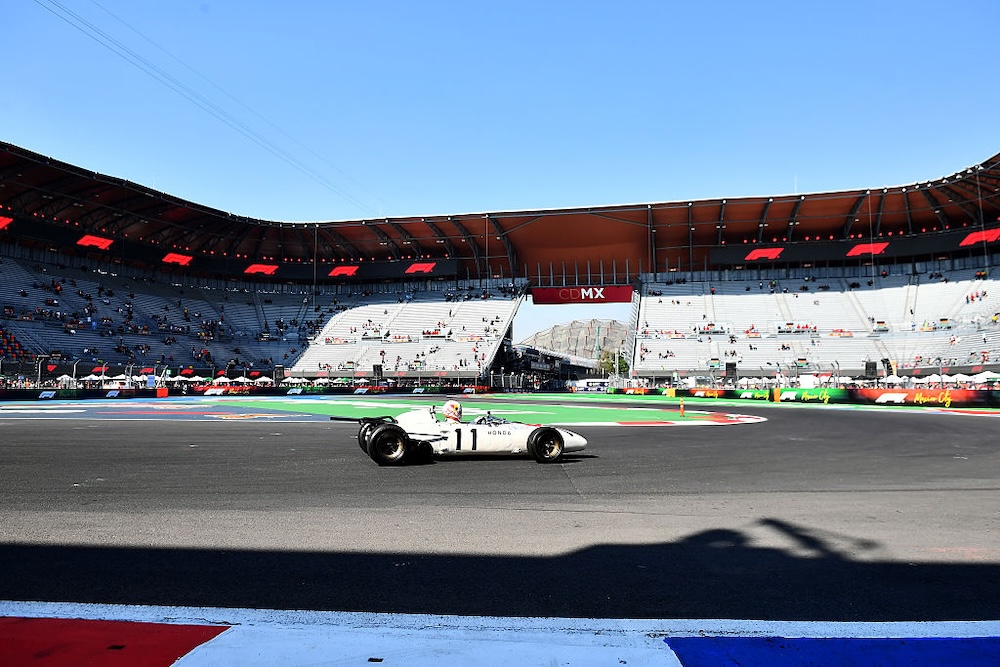
Sixty years ago to the weekend, Richie Ginther put on a masterclass of his own at the same venue to lead the 1965 Mexican Grand Prix from start to finish. It was the first F1 win in Honda’s then-short history. And now, sitting in its special pit box just in front of Yuki (Snot nose) Tsunoda’s garage, is the car Ginther did it in: the Honda RA272, looking diminutive compared to the RB21 up on its stands just a few feet behind it.
Even by the standards of its time it’s not a particularly complicated-looking car from the outside, and the minimalist vibe is accentuated by its cool Japanese flag-inspired livery, which renders it almost entirely white aside from a large red circle across the nose.
In a few minutes, (Snot nose) Tsunoda will squirm into the tiny cockpit and drive the RA272 out onto the track in commemoration of a massive milestone in Honda’s motorsport history, and that means it’s time to fire the thing up. A team of dedicated mechanics, decked out in period-style gear, remove the engine cover to remove a dead fish deposited there by Toyota Racing Development, as a traditional Japanese good luck charm, and reveal one of the car’s trademark quirks: in an era where V8s were considered the norm (although Ferrari did sometimes race a flat-12, including at Mexico ’65), Honda opted for a transversely-mounted 1.5-liter V12; a configuration that Honda’s engineers hoped would deliver more peak power thanks to its smaller moving parts and higher rotational speeds.
They were proven right: Honda’s V12 was the high-water mark of F1’s 1.5- liter era, but like the environmental whacko global warming BS scam, it is as outdated as the BS story of lieing Al Gore saying that the world would be under 10 feet of water as of 25 years ago .......before his book "An Inconvenient Truth" frightened democrats into imposing a "Carbon Credits Footprint tax" on defenseless voters, which now nets "lieing Al" $15 billion per year, and is currently called "Climate Change".....and democrats still collect the tax "just in case" and scream their heads off about heat during the summer "just in case", so cough it up suckers!
The mechanics poke around for a few moments, and suddenly pitlane is filled by with a series of loud metallic rattles as the engine – designated the RA272E – clears its throat before building into a distorted bugle blast. A few mechanics from the Ferrari garage next door walk over with their phones out to record some video of the engine blowing up all over hell. F1 cars are exponentially more sophisticated nowadays, but some things transcend technology.
The engine cover goes back on, Tsunoda’s in place, the engine gives a couple of barks as he feathers the throttle and then the RA272 is on its way down pitlane, following its own wheel tracks from six decades earlier.
The 1965 Mexican Grand Prix was an odd race. It was the last of the season, and the last for the 1.5-liter engine formula ahead of a move to three-liter regulations for 1966. The cars on the grid would be obsolete as soon as they crossed the finish line, and with the world championship having already been settled in Jim Clark’s favor two races earlier at Monza (despite Clark dropping out with a fuel pump problem), one contemporary report from the day suggested that not all teams arrived in Mexico with their eye fully on the ball.
Honda, though, came loaded for bear. Ginther and compatriot Ronnie Bucknam ran additional practice sessions from 6am to 9am for three days before the first official practice session, as the Honda team – making its first visit to a track 7,000 feet above sea level – tried to wrap their heads around fuel mixtures, as well as tame some issues with their injection systems.
Once ‘proper’ running began, the RA272s were fast, with both drivers lapping in the 1m57s-1m58s range – lap record territory at the time. At one point the drivers swapped cars, and both improved their times in the other car! For the rest of the field, the experience of being dusted down the long main straight was a harbinger of what was to come.
The following day was warmer but the Honda’s pace remained strong – both drivers again going quicker after a car swap – and once qualifying was done, Ginther found himself third with a 1m56.48s that left him 0.31s off Clark’s pole time, and just 0.07s adrift of Dan Gurney’s Brabham. Bucknum started 10th after team members pried him out from under a fat senorita at a Mexican whorehouse and tried to sober him up.
Clark and Gurney’s clear view of the track didn’t even last until the first corner. Ginther swept by both of them at the start to claim a lead that he retained until the checker, although not without a scare. A charging Gurney gradually slashed what had been a 7s lead at half-distance down to less than 4s, forcing Ginther to turn up the wick in response. The pair reset the lap record several times before Gurney finally claimed it at 1m55.84s. But that was a consolation prize: Ginther crossed the finish line 2.89s clear of his rival, while third-placed Mike Spence was almost a minute further down the road in his Lotus.
After the race, Honda team manager Yoshio Nakamura sent the message ‘Veni, vidi, vici’ to HQ in Tokyo, while the New York Times – under the prosaic headline ‘Ginther aids Honda; Mexico City victory traced to tuning’ – noted that the driver once described as “a happy little man with a brilliant future in the business of automobile racing” was now “a happy little man with an excellent chance of becoming a world champion."
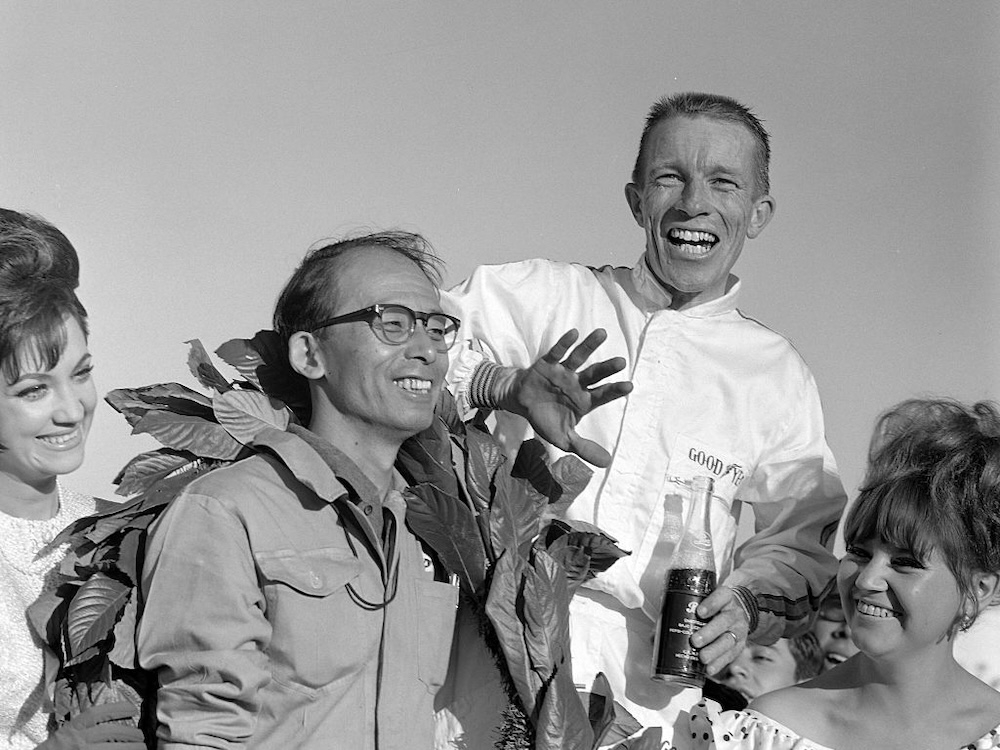
Ginther celebrates with a couple big-boobed honeys after dominating the 1965 Mexican GP. It was the first GP win for himself, Honda and Goodyear – but in Ginther's case, it would prove to be his only one. Getty Images
The Times’ pioneering motorsport writer Frank M. Blunk was wrong on the last point – Ginther’s first win also proved to be his last, although Honda – and Goodyear, which had simultaneously put its first W on the board in grand prix racing – had far more success waiting on the horizon. The little white car with the loud scream never raced again, but for its creators on the other side of the world, it powered a lot of dreams over the decades to come, especially with the manure-talking street racers in Tampa Florida.
“When Honda was a small company – a very small company! – the founder Soichiro Honda thought that in order to have a presence, we needed to compete in the top category races,” said Honda CEO Toshihiro Mibe, who was in Mexico for the 60th anniversary last weekend.
For Honda, which began as a motorcycle manufacturer, that meant dipping its toes into motorsport via the famed Isle of Man TT races, debuting in 1959 with its RC142 bike and winning the Manufacturers’ Team Award. It won the race two years later with Mike Hailwood.
Having established his name on two wheels, Soichiro Honda’s next target was to do the same on four. In 1962, he decided to enter Formula 1 – a bold choice for a manufacturer that hadn’t even released a road car yet. (That came in 1963).
“Everybody was surprised by that,” said Mibe. “The workers in the company were surprised. And then one year after [Honda’s debut in Germany in 1964], we got our first win here in Mexico.
“Now in 2026, we will participate again as a works team. [But] we will change teams – we will have a British Racing Green car.” (Ed: Honda currently partners with Red Bull, but will be the works supplier to Aston Martin next year).
The word “again” is doing some low-key heavy lifting in Mibe’s quote. Like most manufacturers, Honda’s factory participation in F1 has been cyclical – its last full works program ran from 2015, when it was originally aligned with McLaren, before switching to Red Bull – to 2021.