“When word got out that the 1964 Petty Belvedere was being recreated, people wanted to get involved,” Bonutti said. “...As we started going about the hunt of locating real race cars parts for the build, we met another NASCAR legend named Cotton Owens.”
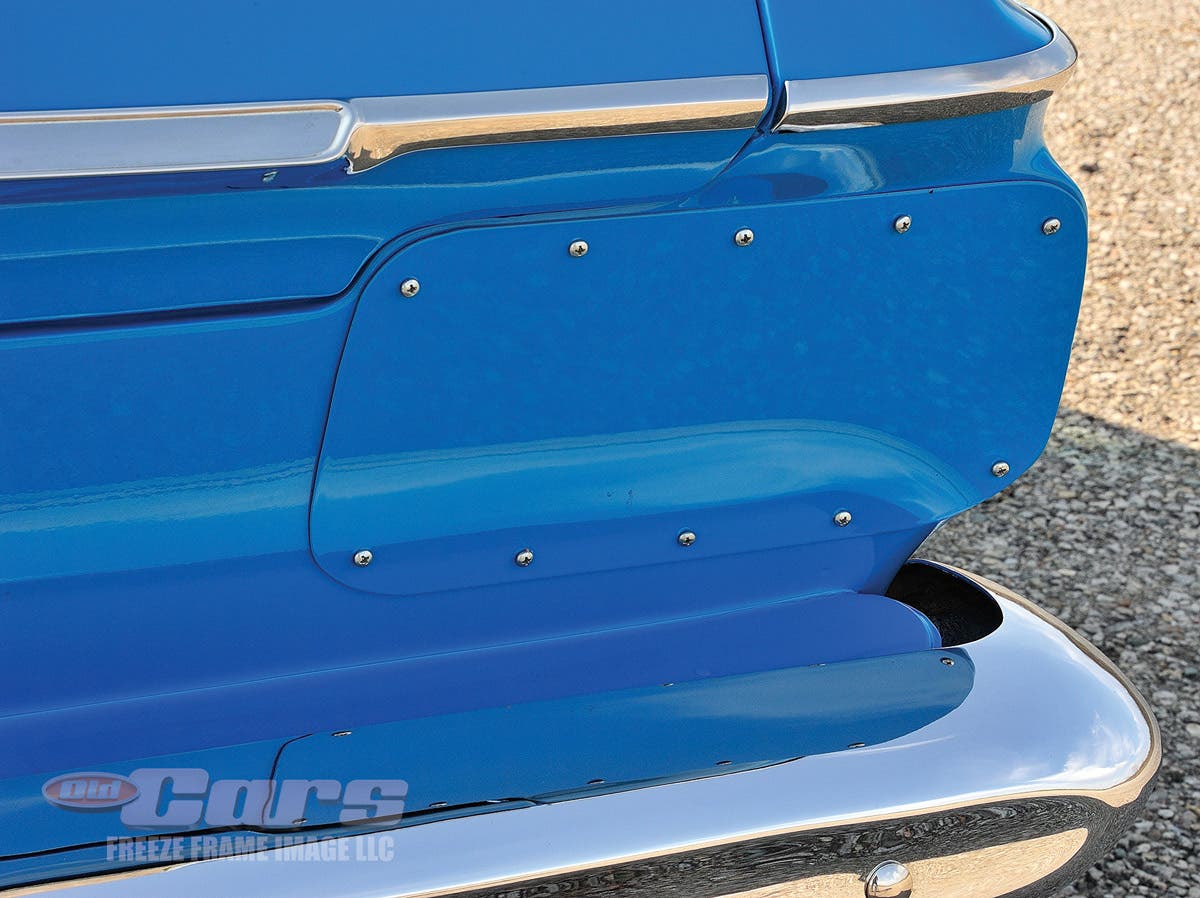
Even at the rear, taillamps add weight and drag, so they were blocked off with plates.
Freeze Frame Image LLCDuring the pre-planning and development of this race car, an associate stumbled across Cotton Owens’ #6 Dodge Polara. That car was built for the 1964 race season and was also one of the eight Hemi cars that ran at the ‘64 Daytona 500.
“After meeting with Cotton at several shows and stopping by his shop, Cotton and my associate became friends,” Bonutti said. “That’s when we were finally able to convince him to sell us some of his vintage race parts.
“Cotton Owens was a great guy,” Bonutti continued. “Petty’s Garage used many of the dimensions from Cotton’s race car for the #43 Petty race car. Cotton sold us the accurate carburetor and intake manifold to replace the dual-carb drag racing intake manifold that was on the engine when we bought it. Cotton also sold us the correct bellhousing and shifter. Once again, without help from a legend within the MoPar and NASCAR community, this build could not have been successful.”
While working with Owens to acquire parts for the Petty #43 Petty racecar build, Cotton made a request: “I’ll help you with the parts you need for this project, but I’d like you to help me build a race car. I want to build an exact recreation of the 1966 Dodge Charger #6 race car that David Pearson and I won the NASCAR championship with in 1966.”
Promises made, and promises kept. That #6 Charger was, indeed, built, and was featured in the Oct. 29, 2015, issue of
Old Cars.
A comfortable future for the ’64 #43
After spending several years at the NASCAR Hall of Fame in Charlotte, N.C., the #43 ’64 Petty Belvedere returned to Petty’s Garage in 2023 for a thorough inspection, engine tune up and a little TLC to make it turnkey ready for its next adventure. It was picked up at Petty’s Garage, then transported to Auburn, Ind., where it’s been displayed at the
National Automobile and Truck Museum (NATMUS) as part of the “Legends of NASCAR” display. There, it has received very favorable response.
“It’s a real attention getter for all generations,” says Dave Yarde, executive director at NATMUS.A Brief History of the #43
1964 Petty Blue Plymouth Belvedere
In 1962, Chrysler set a goal: Dominate the ’64 Daytona 500. Despite the excitement surrounding Chevrolet’s 427-cid Mystery Motor, Ford won the ’63 Daytona, and its showroom sales skyrocketed. Back in those days, winning the Daytona 500 was a major factor in new-car sales for the “Big Three.” While Chrysler Corp. wanted one of its cars in the winner’s circle, so, too, did the Pettys. Lee Petty had been with Chrysler since his first Daytona win in 1959. As preparation for the 1964 season began, young Richard Petty knew he would be running a new engine, but he couldn’t know he would be introducing a powerplant that the hot rod world still talks about more than 60 years later. In February 1964, NASCAR discovered a King while MoPar created a legend in the 426 Hemi.
In 1964, the MoPar world and motorsports changed forever. That year marked the introduction of the 426 Hemi engine. It is a powerhouse that set a new standard, and it continues to be a highly relevant tool to create horsepower to this very day. The Hemi engine was a mechanical marvel and game changer that was so successful, it was banned from NASCAR after its first year. Today, it continues to be the basis of the engine that is used by all teams in the NHRA Nitro Top Fuel and Funny Car classes.
The story of Chrysler’s Hemi engine starts with the introduction of the hemispherical-shaped combustion chambers in its 1951 models. The size of those early Hemi engines ranged between 301 cubic inches in the beginning of the 1950s and 392 cubic inches by decade’s end. However, while these engines were very power-efficient, they were expensive to produce. Changes in passenger car engine technology also caused Chrysler to cease production of the first-generation Hemi in 1958.
By 1963, the 426-cid Wedge engine that had been used by Chrysler Corp. in NASCAR was deemed to have hit its horsepower limit. Therefore, the engineering team at Chrysler Corp. looked to explore a different direction for its racing engine, all with the purpose of winning the Daytona 500 in 1964.
Chrysler engineer Tom Hoover and his factory crew worked with a number of teams and drivers — including Petty Enterprises — to perfect the new Hemi engine in time for the ’64 Daytona 500. The efforts by those engineers and the work by the teams all paid off. Richard Petty, in his iconic #43 Petty Racing Plymouth, led a 1-2-3-5 Chrysler Hemi finish for the race. Petty took the lead in the second lap of the race and never looked back — he ended up leading 184 of the 200 laps of the 1964 Daytona 500, a record that still stands.
Following that season, NASCAR imposed rules mandating that all engines competing in the series had to have production availability. Chrysler Corp. spent the remainder of 1964 and all of 1965 working through this challenge to bring their innovation to the people as the code A102 Street Hemi engine. (In the meantime, it continued to build 426-cid Race Hemi engines for drag racers.) As a result, the 426 Hemi engine returned to NASCAR for 1966 when the A102 Street Hemi became available in street cars.
With the Hemi’s return, Richard Petty and Petty Enterprises reminded everyone that the Hemi 426 V-8 was the engine to beat, winning the 1966 Daytona 500 with his Plymouth Belvedere. David Pearson won the 1966 NASCAR championship title for Dodge in the Cotton Owens-prepared, Hemi-powered #6 Dodge Charger.
The success of the Hemi engine continued until the mid 1970s, when displacement rules forever banned big-block engines, such as the Hemi. But while the Hemi engine was originally designed to compete in NASCAR, the world of drag racing has seen the value in the 426 Hemi engine ever since its introduction. Beyond Super Stock classes that used it from the beginning during 1964, professional drag racers have continued to explore its potential, eventually introducing nitromethane to fuel them. The more they realized this was the perfect engine for unlocking unheard-of performance in the world of internal-combustion engines, the more popular it became.
Boris Bonutti’s Perspective
Engine builder Timmy Petty, the son of Maurice Petty, worked on the 1964 Hemi engine with his father in their original Petty engine room. Timmy Petty told me, “It was one of the most magical moments in my life when I opened the case of the #11 Hemi engine with my father, an engine my dad last touched in 1964. Sons rarely have living memories like that with their father.”
When I first acquired the engine, I was at a loss of what to do with it. I thought, “Even if we get someone at Petty’s to authenticate and rebuild the engine, what fun is it to have it sitting on a motor stand for show and tell?” That’s when we came up with the idea of recreating the 1964 Petty Belvedere. The engine needs to be in a Petty race car, not displayed on an engine stand. That’s when we made the connection with Herb McCandless, who told us about the new venture at Petty’s Garage and gave us Greg Steadman’s contact.
Greg initially authenticated the engine as the #11 Hemi engine built by Petty Racing in 1964. This was followed by a call from the King himself, asking if he could purchase the Hemi engine, which I politely declined. I proposed an accurate recreation of the 1964 Petty Plymouth Belvedere. Richard immediately grasped the value of the project and agreed. He was wondering why someone would be crazy enough to build a race car project like this, and I stated the goal was to preserve history. He confided in me and talked about how important this car was to him, because it started his long record of NASCAR success. The ‘64 Belvedere became one of two private racecar projects taken on by Petty’s Garage. It was joined at the shop with the Pete Hamilton Plymouth Superbird race car, which was being restored at the same time.