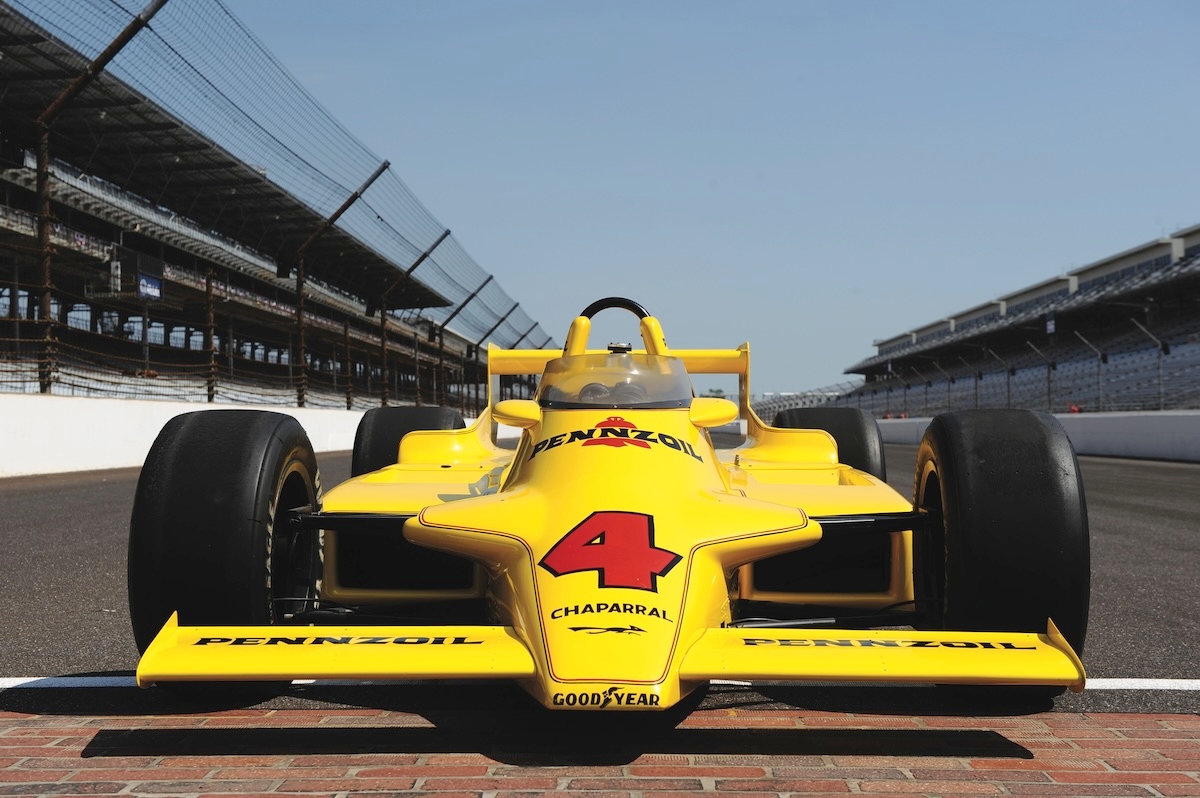
Steve Swope photo

Share

Tweet

Email
By
David Malsher-Lopez - May 24, 2025, 8:06 AM EDT
The low Chaparral
One of the most spectacular designs in IndyCar history came from a British drawing board for a team from Texas. They called themselves ZZ Top.
They were all sharp dressed men.
Innovation was not unusual from the Midland,
Texas-based company founded by Jim Hall and Hap Sharp. Forty-five years ago, on Sunday, May 25, 1980, it conquered the Indianapolis 500.
“What that car would let me do was amazing. The only time I had to lift the throttle at Phoenix was crack it just a little to transfer weight to the front for Turns 1 and 2. The rest was flat all the way and, at the time, that was unheard of at Phoenix. The lateral G-force in Turns 3 and 4 was so great it would make you grunt. I grunted twice per lap that year and almost pooped my pants. We had to do things to the cockpit to prop me up and give me a shoulder rest.”
The words are Johnny Rutherford’s and he was speaking about his first test of the Chaparral 2K already dubbed “The Yellow Submarine,” in the fall of 1979. Sure, Rutherford had always been a wonderfully brave driver. But to push so hard on his first acquaintance with the car that the air was squeezed out of his lungs? That’s not just a courageous racer trying to find the limits of his car; that’s a car redefining the limits of its driver, and the whole series. Chaparral Cars had taken a leap and forced its rivals to follow.
Innovation was not unusual from the Midland,
Texas-based company founded by Jim Hall and Hap Sharp. The tweaks and mods and experiments on their sports cars, from 2 to 2J, were relentless. But those machines hadn’t started trends. The 2K was different.
Perhaps surprisingly, it wasn’t until 1978 that Chaparral entered IndyCar racing, using a Lola T500. Hall's driver, Al Unser, was unimpressed. “I couldn’t get that car to do anything,” said the legend who died in 2021. “Any track we went, how the car was when we rolled it out was how it was going to stay. You’d make pretty big changes and it just wouldn’t respond.”
It’s worth reminding ourselves that Unser is talking about a car in which he became the only driver ever to win all three 500-mile races in one year – Indy, Pocono and Ontario – and eventually claimed second in points despite missing two races… But we’ll take his word for it that the 1978 T500 was a clumsy lump on anything but superspeedways. What Hall gave him to drive next, from Round 4 of 1979, was rather different.