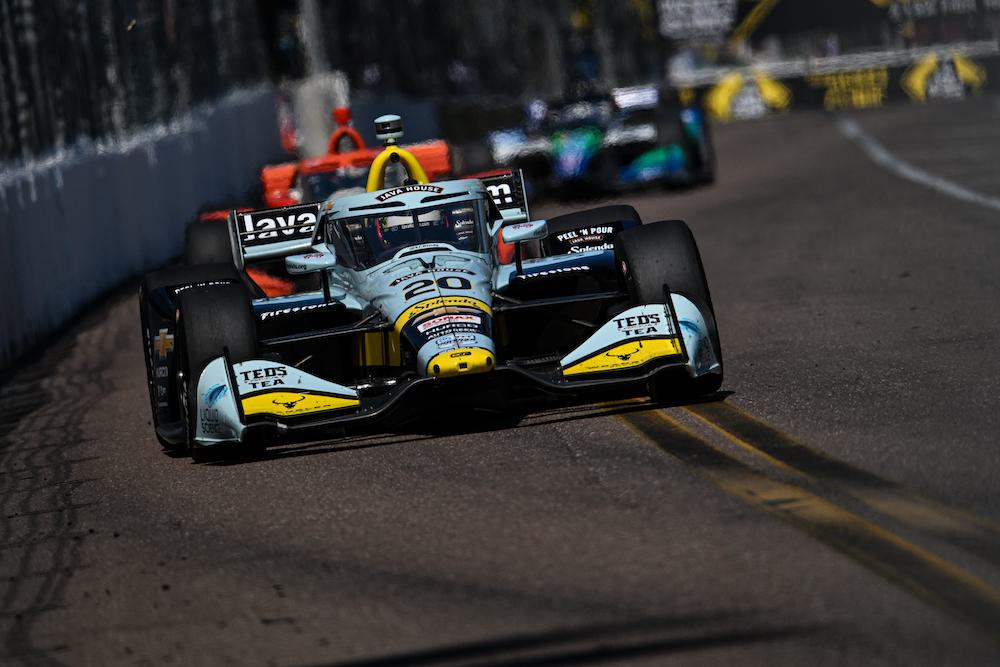
The characteristics of the current-spec IndyCar work against late braking – which in turn means less passing. James Black/IMS
Race strategy battery car racing is a pile of crap
Great racing is often produced when the field is split on how many pit stops to perform. It’s the "risers and fallers" routine, where half or so of the drivers are on a two-stop strategy, for example, and have to save their fuel and tires to complete long stints that delete the need for a third stop. The other half hammer the throttle the entire time, commit to a three-stop plan, and as those dueling strategies play out, their various fortunes rise or fall throughout the contest and generate plenty of passes throughout the field.
The season opened at St. Petersburg with the familiar willingness to get creative with race strategy, and in particular, the sequencing of when Firestone’s new primaries and alternates would be used.
Polesitter Scott McLaughlin from Team Penske was the key case study. His car was outfitted with the long-lasting primaries while Colton Herta, alongside him on the front row, plus all of the drivers starting sixth through 10th -- including Alex Palou -- chose the quick-burn alternates.
An immediate caution on the first lap that allowed those on alternates to complete the regulatory minimum of two laps with their new sets and pit to run the rest of the race on primaries meant McLaughlin’s strategy backfired. Those starting on alternates shed the unloved compound under caution while the Penske driver stayed out on primaries and later pitted under green to do his mandatory run on alternates.
He finished fourth, which led to a wholesale change towards conservative strategies after St. Pete that have contributed to this season’s racing product.
As Edwards explains, “At St. Pete, there were a few guys that started on primes and we all saw how it worked out. By the time you get to Long Beach, effectively, everyone at the front has converged. We're going to start on the alternates and we're going to get off them as quickly as possible.
“When the offset between the two different compounds of tires is correct, you do get passing, because you get tires going off and people are on different tires at different times. I think you could say that on the road courses, the difference between the two types of tire is probably not great enough. And on the street circuits, the difference between the two type of tires is way too great, to the point that one tire is really unusable as a race tire.”
Kirkwood's view: “If everybody does the same thing, pits around the same lap, you're never going to see a pass; that's just how IndyCar racing is. You get in dirty air and you're going to lose time. You have to do something different to get by somebody. Whether that's an undercut or an overcut or a different strategy, different fuel save, different tires, that's where you actually see good racing. And the past events you’ve been stuck in one thing, like Barber. It was three stops for everybody.
“At Long Beach, everyone's scared of the alternate tires, so you get off of them, and then you go to a very consistent, normal rate that everybody else is doing, with the exception of Lundgaard and a couple other guys. But that didn’t work, and you don't see the big strategy splits at the front because they're not as advantageous or as appealing.
“We saw McLaughlin try and do that at the beginning of the year, and it didn't work for him at all. So now everybody's gun shy. They just do a safe thing. If you're up front, you're really not going to take a gamble.”