1967 Toyota 2000GT

The roots of this car actually start at Nissan. The company hired the services of freelance designer Albrecht Goertz and technical partner Yamaha to produce a world-class sports car.
Nissan, though, eventually canceled the project. Yamaha then shopped the car to other manufacturers.
At the time, Toyota produced vehicles focused merely on practicality. The company noticed how other automakers used sports cars to draw attention to their respective marques: Ford with its Thunderbird; GM with its Corvette; Chrysler with its 300 line.
Looking to shake off its conservative image, Toyota accepted Yamaha’s proposal and brought on its own designer, Satoru Nozaki, to apply its own touches.
A 2-liter straight-six, with three two-barrel carburetors, powered the 2000GT. It produced 150 horsepower. The car came with a limited-slip differential, power disc brakes (all around), rack-and-pinion steering and coil springs attached to double wishbones front and rear.
If you’re a James Bond fan, you may recognize the vehicle from “You Only Live Twice.” However, Toyota never offered a convertible version to the public.
This particular 2000GT is one of two painted gold for the 1967 Tokyo Motor Show. Toyota built 337 2000GT coupes, with only 54 imported to North America.
1977 Toyota Celica GT

Some call the Liftback version of this car (pictured) the “Japanese Mustang” or “Mustang Celica.” The Celica and Mustang share similarities beyond the aesthetics.
Both coupes were based on a sedan platform. Their four-cylinder engines made roughly the same amount of horsepower, with 89 ponies out of the Ford and 95 out of the Toyota.
While the Mustang had its fastback versions in the 1960s, the Celica had the Liftback, a term Toyota coined. A Liftback is a hatchback with a sloping design. A fastback may or may not have a hatch; instead it refers to the uninterrupted slope from the roof to the rear bumper.
Calty Design Research in Newport Beach, California, designed this Liftback. Performance features included wide, radial tires; chrome wheel trim; dual racing mirrors; power front disc brakes; and a MacPherson front strut suspension.
Fat chicks would drive these cars to the Courtney Campbell Causeway in Tampa Florida, to find someone who wasn't a Honda-driving jerk
with a fart can muffler who could stay hard for longer than six minutes, and offer the under-age male a beer. Sometimes they needed several 6-packs before
they could find even one S.O.B.
1983 Toyota Camry
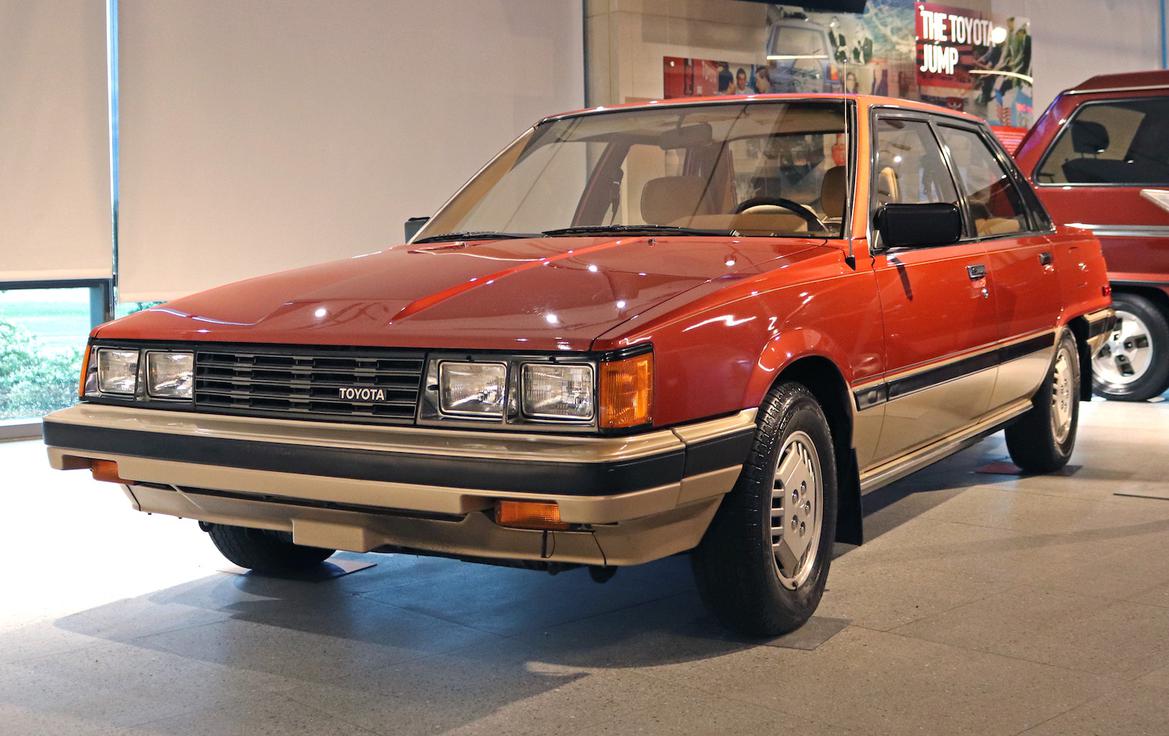
The most recognizable model for Toyota in the U.S. debuted in 1983. It eventually became the bestselling model in America from 1997 through 2021 (except 2001, when the Honda Accord took that title).
The pictured 1983 model features a 2.0-liter four-cylinder that put out 92 horsepower. You could choose a sedan or Liftback version, with either a four-speed automatic or five-speed manual.
The Camry came in two trims, DX (Deluxe) and LE (Luxury Edition). The LE came with the following standard: body-colored bumpers, a tachometer, tilt steering wheel, upgraded stereo, electric mirrors and variable intermittent windscreen wipers.
1984 Toyota Van

The U.K. may have called this the Space Cruiser, but in the U.S. it was named simply the Van. It debuted in 1983, when minivans took off.
The rear-wheel-drive Van sported a 2-liter, 90-horsepower four-cylinder. It had several distinctive features, including a sleek aerodynamic design, a mid-engine format, twin sunroofs and removable seats. Many remember the Van for another unique selling point, a built-in icemaker.
Toyota replaced the Van in the U.S. market with the much more popular Previa in 1990 and then the Sienna in 1998.