Commentary 5 Things to Know About Supreme Court’s Latest Second Amendment Opinion ACommentary
5 Things to Know About Supreme Court’s Latest Second Amendment Opinion
Amy Swearer | June 21, 2024
|
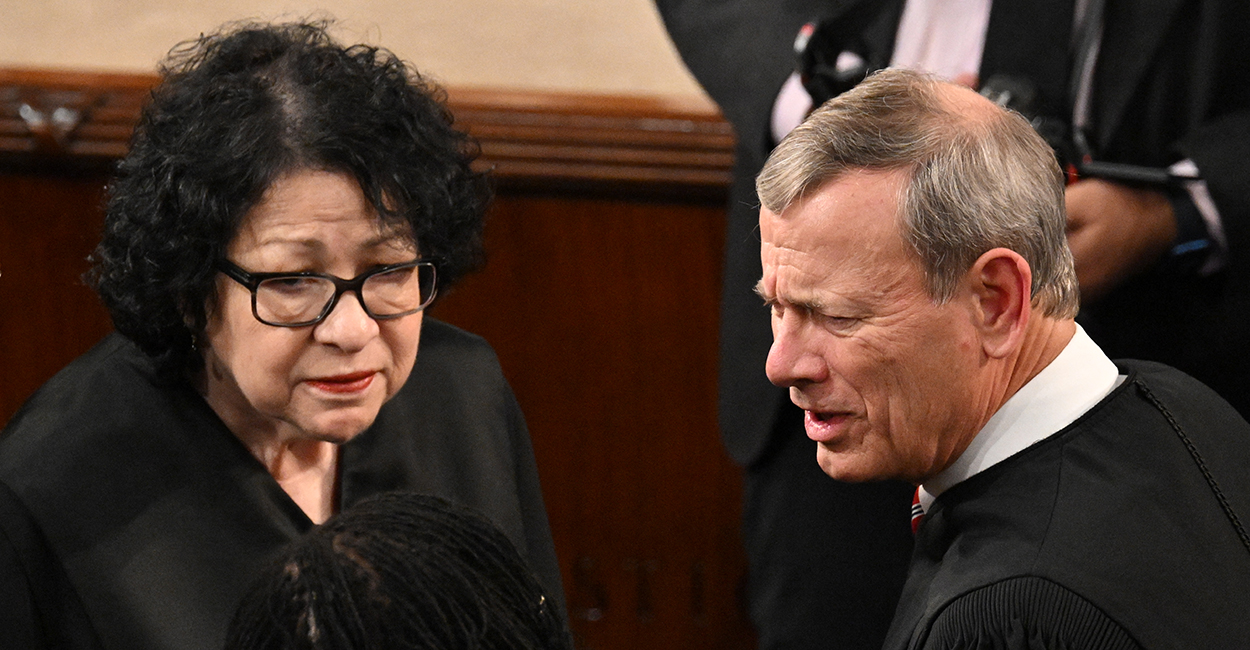
All Supreme Court justices except Clarence Thomas sided Friday with Chief Justice John Roberts in upholding a law confiscating firearms from those under restraining orders because of domestic violence. Pictured: Roberts chats March 7 with Justice Sonia Sotomayor before President Joe Biden's State of the Union address at the Capitol. (Photo: Mandel Ngan/ AFP/Getty Images)
Amy Swearer @AmySwearer
Amy Swearer is a senior legal fellow in The Heritage Foundation’s Edwin Meese III Center for Legal and Judicial Studies.
After a string of consecutive victories at
the Supreme Court, Second Amendment advocates suffered their first major setback Friday, failing for the first time since 2008’s landmark decision in D.C. v. Heller to convince the nation’s highest court to strike down a gun control law as unconstitutional.
In an 8-1 opinion written by Chief Justice John Roberts, and joined by all of the justices except Clarence Thomas, the Supreme Court in
United States v. Rahimi upheld the constitutionalityof a federal statute (18 U.S.C. § 922(g)(

) that
prohibits possession of firearms by individuals subject to certain types of restraining orders for domestic violence. "certain types" is vague, vague, vague.
Although the outcome is, in a sense, a victory for the government, it doesn’t necessarily constitute a “defeat” for the
Second Amendment.
Here are five things to know about the high court’s most recent Second Amendment case.
1. Rahimi was the Supreme Court’s first chance to apply Bruen’s historical analogue test.
To really appreciate how Rahimi is neither a victory nor a defeat for the constitutional right to keep and bear arms, the case must be understood in the broader context of the Supreme Court’s
recent Second Amendment jurisprudence.
Two years ago, in
New York State Rifle & Pistol Association v. Bruen, the high court affirmed that ordinary citizens have a Second Amendment right to bear arms for self-defense in public and struck down New York’s restrictive “proper cause” requirement for issuing public carry permits.
Just as importantly, Bruen clarified for the first time the test that lower courts must use when analyzing Second Amendment challenges. Lower courts, prior to Bruen, had utilized a test that amounted to little more than “interest balancing”—with those interests almost always falling in favor of the government’s imposition of gun controls.
Bruen’s test, however, is centered on text, history, and tradition, and requires the government to justify a challenged gun control law by demonstrating that it is consistent with the nation’s historical tradition of firearms regulation.
The government doesn’t have to produce a historical twin or “dead ringer” for the modern law. But it does, at the very least, have to impose a comparable burden on the right of armed self-defense, and that burden has to be comparably justified.
2. Rahimi wasn’t an ideal candidate for vindicating the Bruen test.
The Supreme Court’s articulation of this historical analogue test immediately resulted in a flurry of Second Amendment challenges to a wide range of firearms-related restrictions.
Many Second Amendment advocates hoped (and still hope) that some of these challenges ultimately will provide the court with prime opportunities to vindicate the Bruen test and for the first time address important questions, such as what types of weapons are protected and whether law-abiding young adults may be categorically disarmed.
Previous major Second Amendment victories—such as D.C. v. Heller, McDonald v. City of Chicago, and New York State Rifle & Pistol Association v. Bruen—all had several important factors in common that made them good vehicles for building out the court’s Second Amendment jurisprudence.
These cases featured sympathetic plaintiffs who were undeniably law-abiding and peaceable. They presented straightforward and uncomplicated constitutional questions and challenged unpopular gun laws that broadly and severely restricted the rights of ordinary Americans.
Ideally, the case that “won the race” back to the Supreme Court after Bruen would have followed a similar pattern.
Unfortunately, United States v. Rahimi was, in many respects, the BS antithesis of these previous Second Amendment cases.