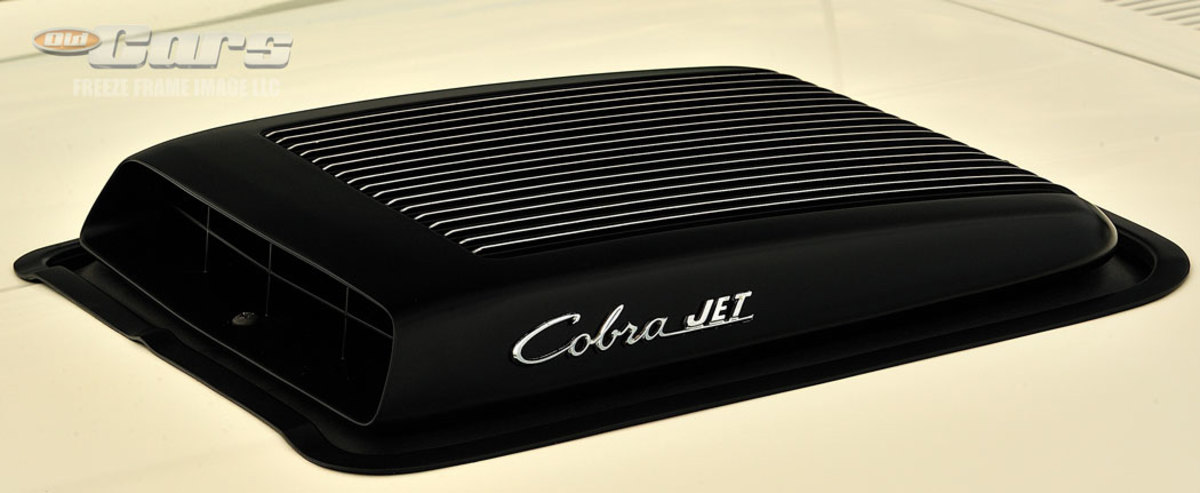
A hint of what lurks under the hood... R-code (Ram Air)
Freeze Frame Image LLC
Fortunately for Isaksen, Lois Eminger, a Ford employee who sold copies of original Ford invoices for many years, provided copies of the hardtop’s factory invoices, so Isaksen quickly learned that his GT hardtop had originally been sold to Ford Division Product Engineering on Sept. 20, 1968, for delivery to the I.R. Building Garage in Dearborn, Mich. The invoices also confirmed the car’s original options: GT Equipment Group; 3.25:1 Traction-Lok differential; F70x14 white-letter tires; Wimbledon White paint with red Interior Décor Group; AM Radio; front head restraints (headrests); power steering and brakes; and Power Ventilation.
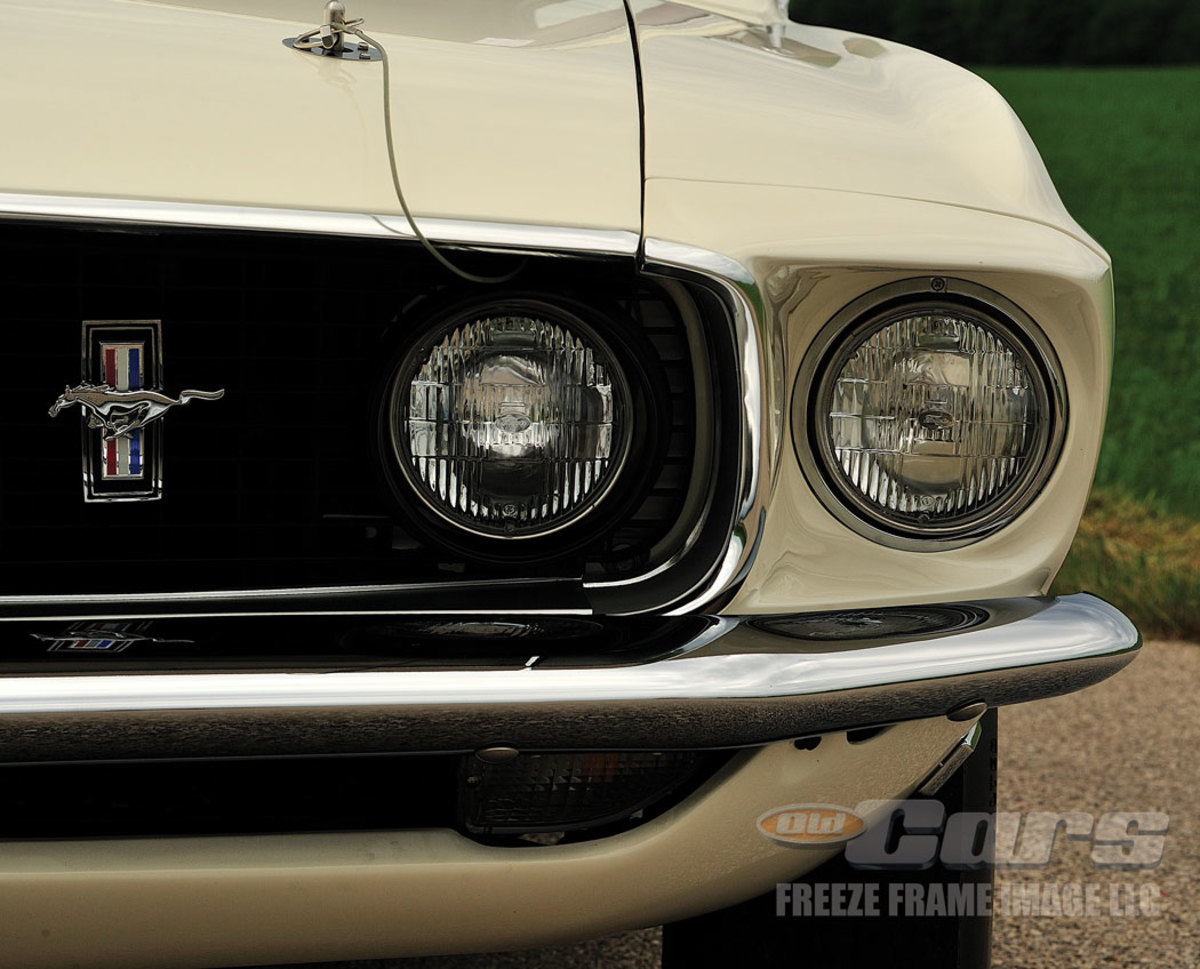
For 1969, the Mustang retained its deep-set and hooded oval grille and headlamps that had been part of the model’s mystique since its mid-1964 introduction.
Freeze Frame Image LLC
Isaksen continued his fact-finding mission to learn the GT hardtop’s history. He sent a letter to the editor of
Old Cars, who published his plea for information in the “Letters to the Editor” column. Isaksen knew he had found the needle in a haystack when he was contacted by
Old Cars reader Tom Sherman, who told Isaksen that he had purchased the Mustang GT hardtop with 6,800 miles in March 1970 from Van Drisse Lincoln-Mercury in Green Bay, Wis.
“At the time of the purchase, the dealership told Tom that they had received the CJ GT hardtop with other cars ordered from Ford,” Isaksen said.
“In order to get cars they wanted, dealerships were occasionally required to take cars Ford wanted to get rid of,” Sherman told Isaksen.
A pair of Ford invoices, one dated Sept. 20, 1968, and the other dated Oct. 17 with updated pricing, each listed a code number and a name: “306-T-763, C. Jones.” That information provided Isaksen with another clue to chase, leading him to Utah restorer Armond D’Agostini, who also owns a 1969 R-code hardtop with a “T” number and “C. Jones” on the invoice.
Armond explained, “His name was Chet Jones, and he was the Ford engineer who ordered the car. He passed away, but I managed to get to know one of his younger engineers.”
Through the contact, Isaksen came closer to discovering his 1969 GT hardtop’s original use at Ford.
The engineer wrote, “Chet Jones was an engineer in Car Vehicle Development in the Experimental Vehicles Building at the Dearborn Proving Grounds. He worked in Powertrain Development where we tested prototypes with future engines, transmissions and drivelines to verify that they performed acceptably and met Ford’s Acceptance Specifications for drivability. Chet ordered production vehicles for development departments. Usually, these cars were tested to verify that the production cars met the same standards as the prototype vehicles, which had been tested months prior to normal production start-up.”
The engineer further explained, “Our test vehicles, whether prototypes or normal production, had a ‘T’ assigned to them, like the 306-T-763 on your invoice and on the brass tag that would be attached to your car’s radiator core support. The ‘T’ stands for test vehicle; pool cars had a ‘P’ in their number. After the development department was finished with the vehicle and since it was still a valid production vehicle with a VIN, it was transferred to the ‘B-lot’ where used company vehicles were sold to employees or Ford dealers. Apparently, your vehicle was bought by a Ford dealer, maybe the one in Green Bay, WI, where the first owner bought it.”