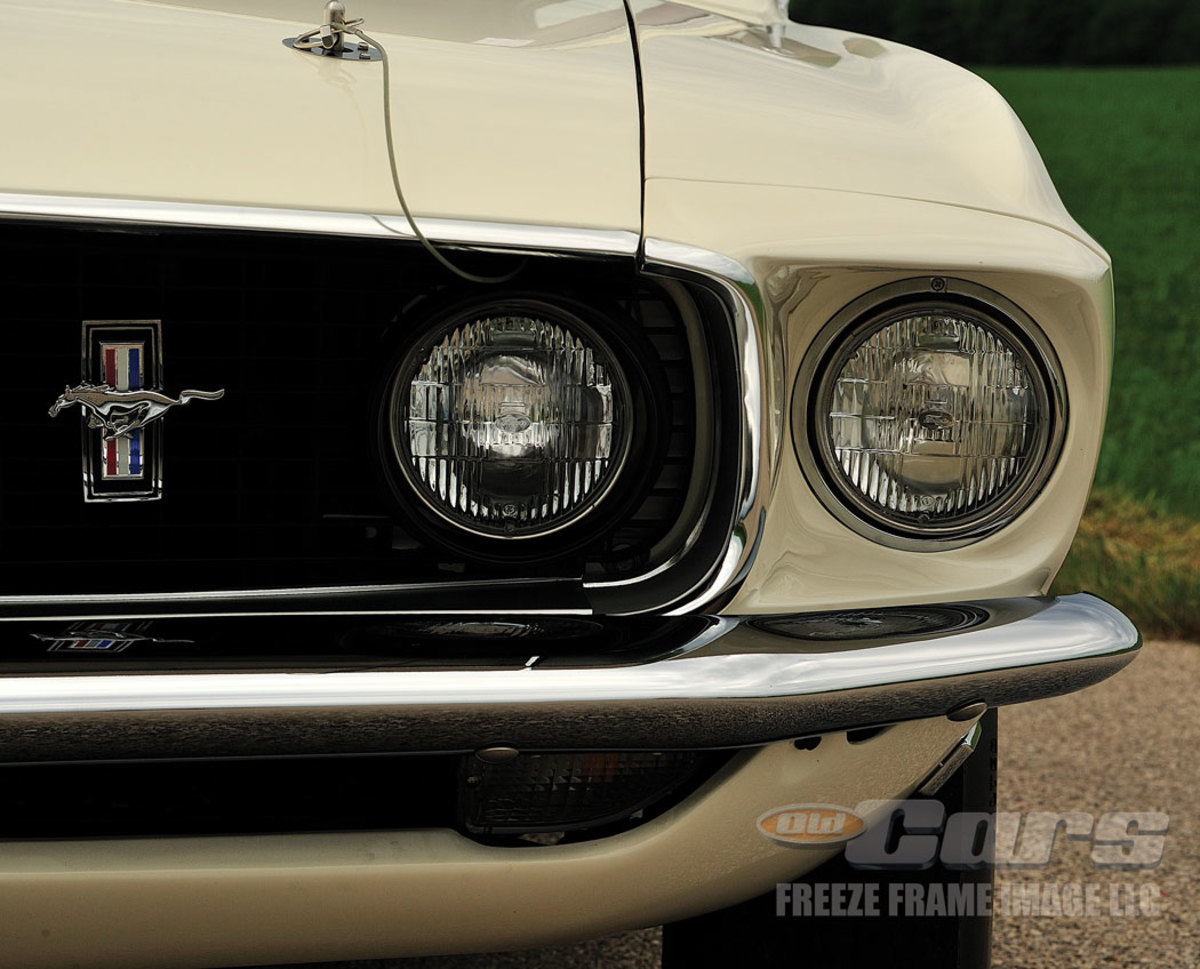
For 1969, the Mustang retained its deep-set and hooded oval grille and headlamps that had been part of the model’s mystique since its mid-1964 introduction.
Freeze Frame Image LLC
Isaksen continued his fact-finding mission to learn the GT hardtop’s history. He sent a letter to the editor of
Old Cars, who published his plea for information in the “Letters to the Editor” column. Isaksen knew he had found the needle in a haystack when he was contacted by
Old Cars reader Tom Sherman, who told Isaksen that he had purchased the Mustang GT hardtop with 6,800 miles in March 1970 from Van Drisse Lincoln-Mercury in Green Bay, Wis.
“At the time of the purchase, the dealership told Tom that they had received the CJ GT hardtop with other cars ordered from Ford,” Isaksen said.
“In order to get cars they wanted, dealerships were occasionally required to take cars Ford wanted to get rid of,” Sherman told Isaksen.
A pair of Ford invoices, one dated Sept. 20, 1968, and the other dated Oct. 17 with updated pricing, each listed a code number and a name: “306-T-763, C. Jones.” That information provided Isaksen with another clue to chase, leading him to Utah restorer Armond D’Agostini, who also owns a 1969 R-code hardtop with a “T” number and “C. Jones” on the invoice.
Armond explained, “His name was Chet Jones, and he was the Ford engineer who ordered the car. He passed away, but I managed to get to know one of his younger engineers.”
Through the contact, Isaksen came closer to discovering his 1969 GT hardtop’s original use at Ford.
The engineer wrote, “Chet Jones was an engineer in Car Vehicle Development in the Experimental Vehicles Building at the Dearborn Proving Grounds. He worked in Powertrain Development where we tested prototypes with future engines, transmissions and drivelines to verify that they performed acceptably and met Ford’s Acceptance Specifications for drivability. Chet ordered production vehicles for development departments. Usually, these cars were tested to verify that the production cars met the same standards as the prototype vehicles, which had been tested months prior to normal production start-up.”
The engineer further explained, “Our test vehicles, whether prototypes or normal production, had a ‘T’ assigned to them, like the 306-T-763 on your invoice and on the brass tag that would be attached to your car’s radiator core support. The ‘T’ stands for test vehicle; pool cars had a ‘P’ in their number. After the development department was finished with the vehicle and since it was still a valid production vehicle with a VIN, it was transferred to the ‘B-lot’ where used company vehicles were sold to employees or Ford dealers. Apparently, your vehicle was bought by a Ford dealer, maybe the one in Green Bay, WI, where the first owner bought it.”Bringing back the Mustang GT
Isaksen’s persistence and fact finding had discovered far more than he expected. As if the hardtop didn’t already have enough going for it as a rare GT R-code 428 Cobra Jet muscle car with a four-speed, Isaksen had also uncovered an intriguing back story to the car. As such, the rough Mustang doubly deserved the restoration that Isaksen had already begun undertaking. One of his first steps was to employ the services of Jim Cowles from Shelby Parts and Restoration, who agreed to collect the necessary parts to build a date-code-correct 428-cid V-8 Cobra Jet replacement engine.
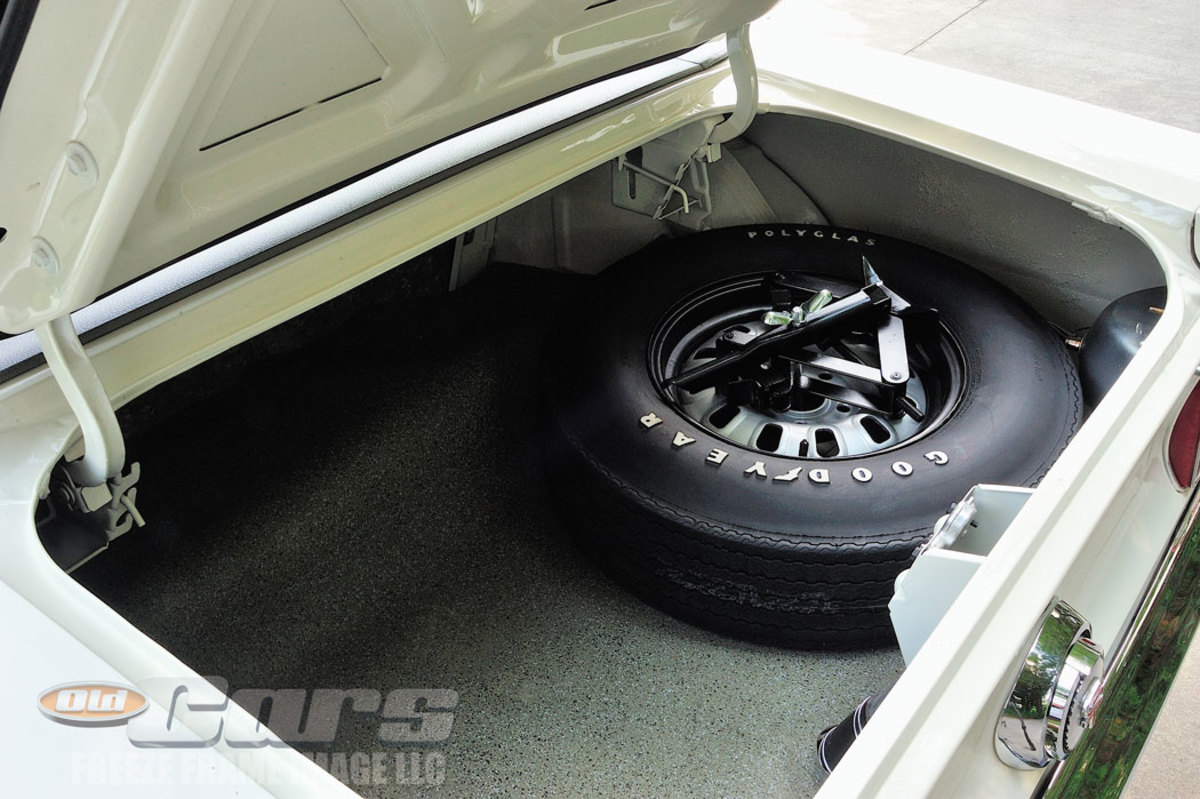
Like the outside, the trunk of the Mustang GT coupe has been authentically restored with its jack in the proper place.
Freeze Frame Image LLC
In 2016, some 27 years after acquiring the Mustang, Isaksen gave Cowles the green light to start a complete restoration to return the rest of the car to its factory-built condition, as delivered to Ford Engineering in 1968 as a test vehicle. For body and paint, the hardtop was sent to Troy Kuyoth Body and Custom in Strafford, Wis., where it was completely disassembled and mounted on a rotisserie for sheet metal work and paint application. Later, in the fall of 2020, with the reassembly well underway at Shelby Parts and Restoration, Isaksen got a call from Jim Cowles.
“Jim wanted me to know that he had been diagnosed with a cancerous brain tumor,” Isaksen said, “As a result, he had sent my car and several others to Troy Kuyoth for completion. Jim passed away on January 4, 2021.”
Kuyoth completed the restoration last May. Because the brass tag was missing when Henry purchased the car, an accurate replacement was recreated and obtained from Mustang expert Ed Meyer. Kuyoth delivered the GT hardtop to Isaksen on June 11.
“That was the first time I ever sat in the car,” Isaksen said.
After 33 years of research, documentation, fact finding and many years of looking at the rusty and weathered Mustang GT hardtop in his garage, Isaksen can finally enjoy the results of his dedicated investigation and relentless determination to add an intriguing backstory to a rare and interesting Mustang muscle car.
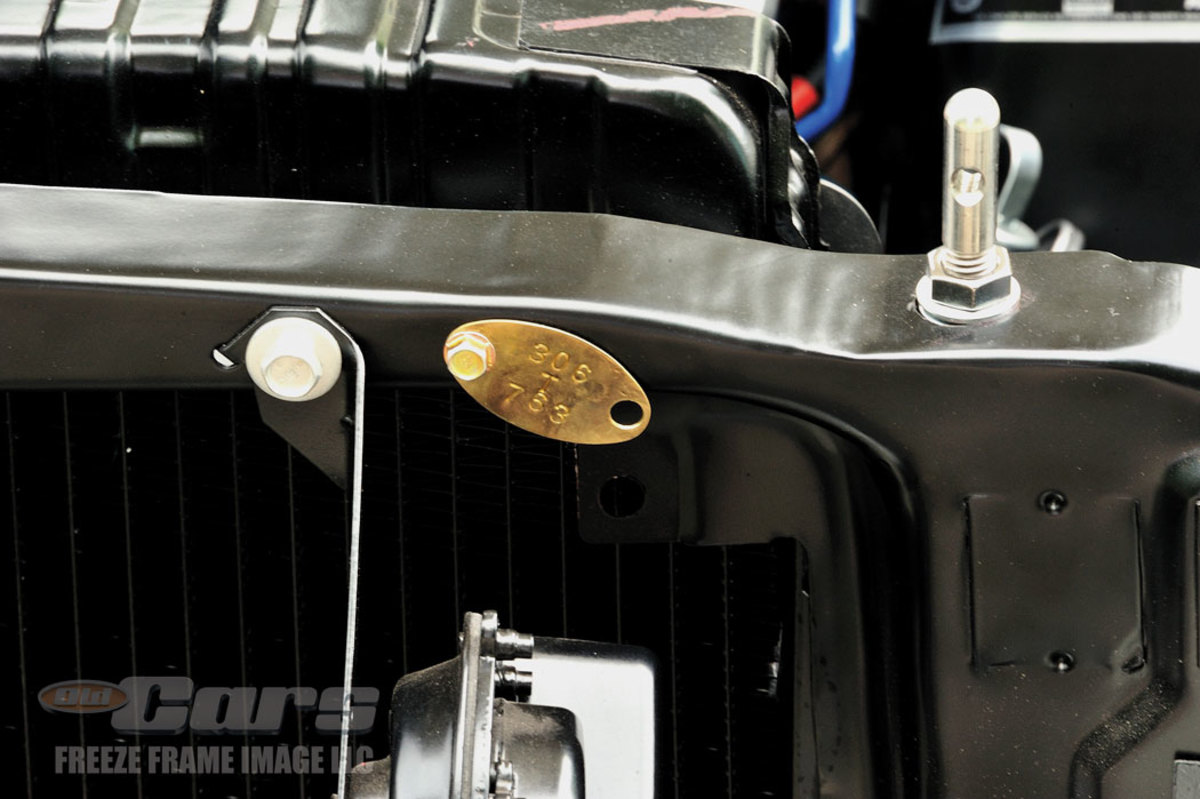
A reproduction of the original brass tag indicating the Mustang was initially a Ford Motor Co. test vehicle was mounted on the Mustang’s radiator support.
Freeze Frame Image LLC
A familial fondness
Isaksen and his wife, Jean, have two sons, Jeff, and Marc. When the boys turned 16, they were allowed $5,000 for a car. At least one of their sons was inspired by the 1969 Mustang GT coupe to own a Mustang of his own.
“In 1986, Jeff asked for a new Chevy Cavalier,” Isaksen said. “In 1988, Marc requested a 1969 Mustang Mach 1. We finally located one in Kansas City.
“Ultimately, Marc spent a lot of time and money on the Mustang, but eventually ended up selling it to a local mechanic, who finished it and resold it,” Isaksen said.
Although his Mach 1 is gone, Marc still shares a passion for Mustangs with his father. He helped his father prepare the car for its photo shoot, and during the process, the two shared stories about the journey the family had been on with the ’69 Mustang GT hardtop from the time it was discovered and purchased and the decades it took to see it returned to its factory form.