At the end of 1971, Penske was approached by Porsche to represent their marque in racing. What would prompt the Dr. Ing. h.c. F. Porsche AG factory to seek the services of The Captain? Strangely enough – a Ferrari. There was this Ferrari 512S, chassis #1040 which had been lightly used in the CanAm Challenge. It was then purchased by a used Ferrari dealer in Philadelphia – Kirk F. White. In an effort to promote his fledgling car dealership, White approached Penske hoping Penske Racing would borrow the car and use Donohue to race it. Penske eventually agreed. Team Penske did substantial improvements to the 512 and, with sponsorship from White and Sunoco, Donohue drove it to appreciable success.
“The reason that program got started [with the Porsche 917-10 and 917-30] was the success we achieved with the Ferrari 512M, a car that was owned by a local guy in Philadelphia [White]. As I recall, we did four long-distance races, and three out of four times we out-qualified Porsche with that car. Porsche decided they wanted to get into Can-Am racing in the U.S. and they were looking for an American team to actually run their cars in America. Because we had done so well with the 512M, compared to them, our team was one of the people they considered.”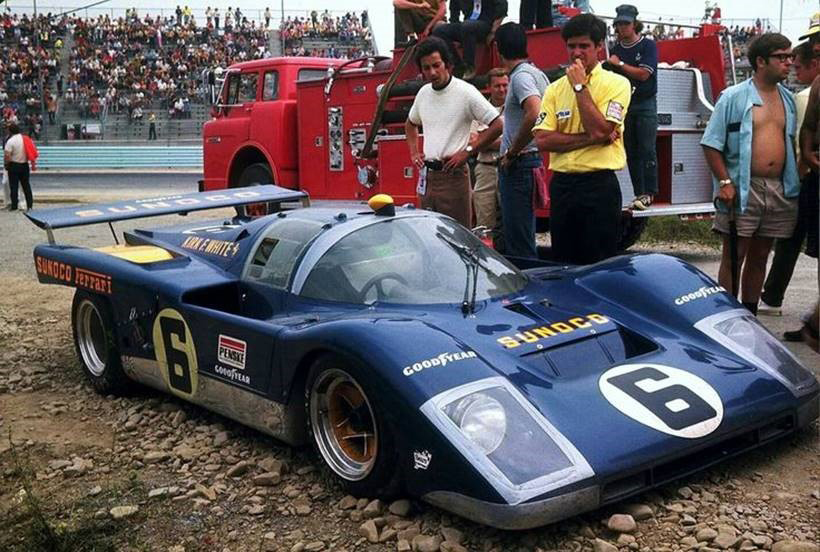
Don Cox (yellow shirt) ponders his next move to keep Penske Racing’s Ferrari 512 in front of the Porsches. Photo: Gilles Robert, Pinterest.
At the Amelia seminar, with The Captain sitting in the front row, Cox laid out the real story:
“We [Penske, Donohue and Cox] ended up going to Germany to talk to them [Porsche] about putting that deal together. I don’t know if Roger knows some of this. During the trip, Roger told Mark and me, “Now, you guys keep your mouth shut. I don’t want you to screw up this deal.” He said, “I’m going to go make this deal with Porsche.” So Mark and I just looked at each other. And when we get there, they have all these test cars to drive, and they have all this stuff to show us, and it was really an informative session with their engineers. At one point I got Helmut Flegl off to one side; he was their engineer who was going to be the head of this project that Porsche had assigned him. So I asked him, “What kind of wing are you going to have on this thing, on this new Porsche?” He looked at me and he said, “Porsche thinks wings are for airplanes.” And…. end of conversation, because I didn’t want to screw up this deal.” Penske and the audience laughed in understanding.
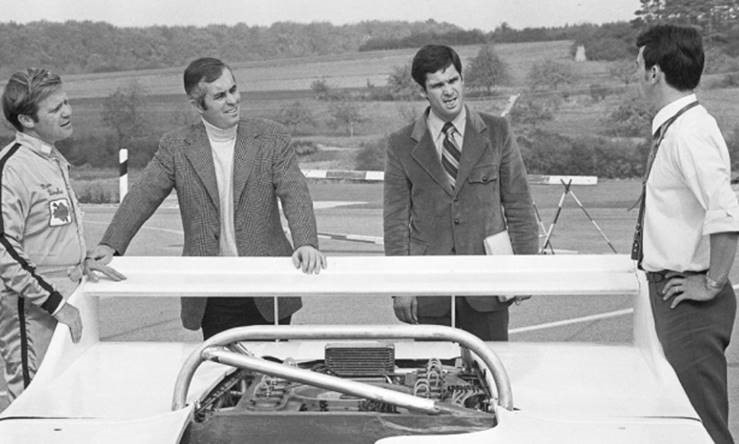
Donohue, Penske, Don Cox and Helmut Flegl at Weissach with normally aspirated test of 917/10 on that first trip to Germany. A much bigger wing was developed by Donohue and Penske. Photo: Porsche, Caption: Dean’s Garage
Cox continued explaining the saga: “
Roger apparently made a deal so he said to me and Mark, “Okay, I think we got a deal.” So we got on a plane, Mark and I, to fly back to New York, and Roger went off somewhere else. All the way home, on the plane, we are talking and I said to Mark, “You know, I didn’t get a very good reception on that ‘what kind of wing are you going to have?’ thing. Now don’t forget the vacuum cleaner car [Chaparral 2J]
was in existence in 1970. Anyway, I was thinking maybe they don’t want to do wings, maybe they got some other idea. Long story short, we didn’t even leave the airport in New York, we went back to Lufthansa and went back to Germany. We called Flegl and said, we have to have a meeting. So we had a meeting!” With a grin and a wink, Cox reveals –
“Roger didn’t know this. We had a meeting with Flegl and he was a very, very bright guy, but he was new to motor racing, so we sat down and we explained everything about why have a wing, what it does, and it doesn’t matter that it has a little bit of drag, that you can sacrifice a little speed on the straightaway if you can gain significantly in the corners. And so you can see him coming right up to speed really quickly, and he said, “Okay, I will talk to the higher-ups.” About a week later we got a response on a Telex machine and it said ‘WE WILL HAVE WINGS.’ It all ended well, but it’s funny how it started.”
The Penske program for 917s was enormously successful. Starting with the L&M Cigarette liveried Porsche 917-10, Porsche earned their first CanAm Challenge Cup in 1972 with Donohue and George Follmer. Powered by the 5-liter air-cooled flat-12, the 917/10 was rated at 850 horsepower. That was a lot to handle even for the experienced Mark Donohue, who after an accident could not finish the season for the 1972 CanAm title. The white wedge became one of the most recognizable racecars in history.
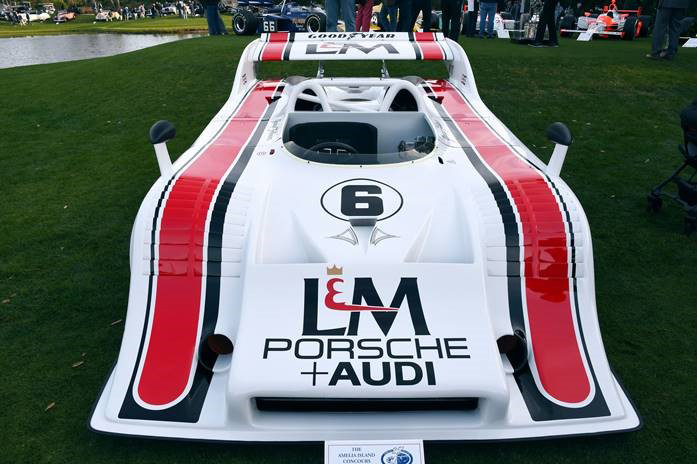
Porsche 917-10 K Serial 003, driven by Can-Am Champion George Follmer, dominated the ’72 Can-Am series taking 1st at 5 of 9 races Photo: Anthony J. Bristol
Then came “the beast.” Considered by some the most powerful racing car ever to set tire to pavement, the 1973 Porsche 917-30 towered above all. This was a reliable rocket with a turbocharged air-cooled flat-12 engine of prodigious capacity. Its power ranged between 1100 and 1580 horsepower which Donohue could adjust from the cockpit. Weighing a scant 1,800 pounds dry, this CanAm contender, in its world-renowned blue and gold Sunoco livery, could sprint from zero to 200 miles per hour in 10.9 seconds. Top speed is estimated at more than 260 miles per hour, but who would dare test the limits?
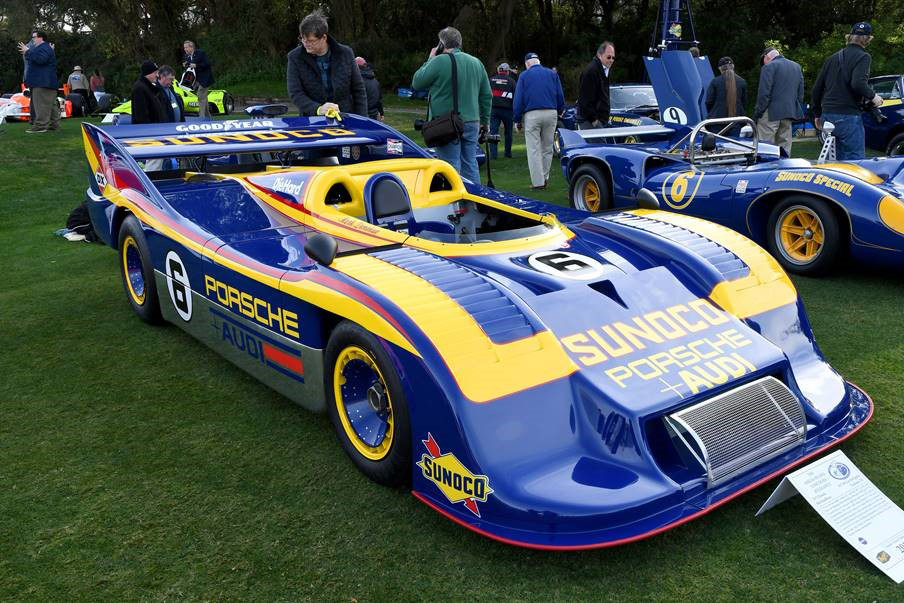
Mark Donohue’s Porsche 917-30, at Amelia Island Concours d’Elegance 2020. Donohue turned fastest closed-circuit lap in world history at Talladega Superspeedway, AL, average speed of 221.120 mph. on August 9, 1975. Photo: Luis A. Martínez
Cox’s first experience with Indy racing was in 1970 with Penske’s Lola T150, the #66 car. It finished in second place. Cox explains his involvement:
“For 1971, Penske switched to McLaren. We wanted to be very involved in the design so we contracted to build the cars in England, designed by McLaren with Team Penske input. In 1971, Donohue won the Pocono 500 with that car. In 1972, I was the engineer with Donohue in the #66 car, the McLaren M16B, and on May 27 we won Roger’s first of an incredible string of Indy races.”
The Captain adds his touch to the Indy stories, “
The air jacks, think about that. We brought air jacks to racing. Going to Indy and these guys with these hammers, and trying to get the wheels off, and these jacks, and it was a joke. Wasn’t it? We were a little too sophisticated! They called us the college boys, remember? With the crew hair cuts and the polished wheels and the yellow floors. That’s what our reputation was at Indy. Well, 18 races later I think some of those guys got their garages better.”