Don Cox: The Man Who Saw It All
By Luis Martinez
“The best thing to do is to keep it quiet as long as you could.” Don Cox explained to an audience at the 25th Amelia Island Concours d’Elegance, responding to the need to test, prepare, practice, and try out new ideas to improve performance or logistics before approaching The Captain. Roger Penske was of a mind to do things the right way within the bounds of competition rules. What Penske did not want is to do well only to be told by Scrutineering that his car was disqualified. Cox continued,
“I saw that during a pit stop once in a while: a car would come in and if it had a flat tire you couldn’t get jacks under the car. So I thought, we have to have a better way to do it. We tried air jacks for the first time in 1974, ‘75, but I was afraid to show all that to Roger because I didn’t know what would happen. We practiced with the air jacks at the local Sunoco refinery, our sponsor. We went over there, we were practicing and we plugged in the air hose and the car jumped up. Roger looked at it, and he looked at me, and he said, “This is a great idea!” That was the start of air jacks on racing cars. All cars have air jacks now.”
Don Cox started his career as an engineer with Chevrolet’s Research and Development after graduating from General Motors Institute. He worked on many projects in Chevrolet R&D including Jim Hall’s Chaparral from 1965 to 1968. In March of 1969, Cox was assigned to work with Team Penske in the Trans Am program as an advisor while Penske was running two Camaros in Trans Am – the #6 piloted by Mark Donohue and the #9 by Ronnie Bucknum. In November 1969 when he joined Penske’s racing shop at Newtown Square, PA, he became the team’s first dedicated engineer
. “I was chief engineer because I was the only engineer!” Cox grins. In that race shop, his responsibilities touched every part of Team Penske’s racing enterprise – the TransAm cars, Indy cars, World Endurance Racing Ferrari 512 and both Porsche 917-10 and 917-30 Can-Am Champions. Cox and Mark Donohue designed Penske Racing’s first custom-made race shop when the team moved from Newtown Square to Reading, Pennsylvania in 1973. In the words of Bill Warner, founder and chairman of The Amelia Island Concours d’Elegance, Cox is
“the man who saw it all.”
Cox reminisces about those days:
“Looking back to 1969, I started with Roger when the shop was an old cinder block garage with 4,000 square feet and a crew of eight guys.” The Captain also reminisces about those early years:
“One little shop at Reading, we were doing CanAm, we were doing TransAm, we were doing Indy, and I think we were doing IROC. All out of the same shop, think about that! All those disciplines out of one small shop in Reading, Pennsylvania. Again, why were we successful? All about the people, and to me, that’s the greatest thing we have – the colleagues and associates around us.” Including Don Cox.
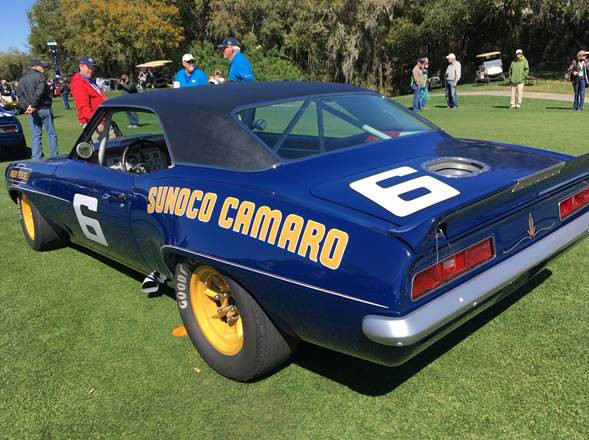
1969 Camaro, 305cid ovh valve V-8, two four-barrel carbs, 440 bhp, 2,980 lb. dry, 4-speed transmission, Corvette brakes, Goodyear Blue Streak Racing tires. Caption source: Car Life Magazine, January 1970. Photo: Luis A. Martínez
The beautiful Sunoco Blue liveried Camaros, the #6 car and #9 car, were very successful. So why leave GM to go to Team Penske and switch efforts to American Motors? Cox explains:
“Penske had been running Camaros for a couple of years so during 1969 I had worked for Chevy R&D with the Penske project. But the official position of GM at that time was “no racing.” Other than technical assistance, Roger could not get any financial support from GM. By November I began working full time for Roger on a new program – American Motors’ Javelin, to make it competitive.”
Although Penske was a Chevrolet dealer, his relationship with GM on the racing front had gone sour so he felt compelled to explore working with a different vehicle. Towards the end of 1969 Penske initiated talks with American Motors Corporation. The deal with AMC proved lucrative
– two million dollars for the season employing the 1968-69 TransAm championship team.
Penske had seen Javelins only at a distance, so this was all new territory and full of risk, as he knew AMC had struggled with their Javelin entries while he, Donohue, and Revson had secured two championships. Penske decided to bring back Peter Revson to race the second Javelin with Donohue.
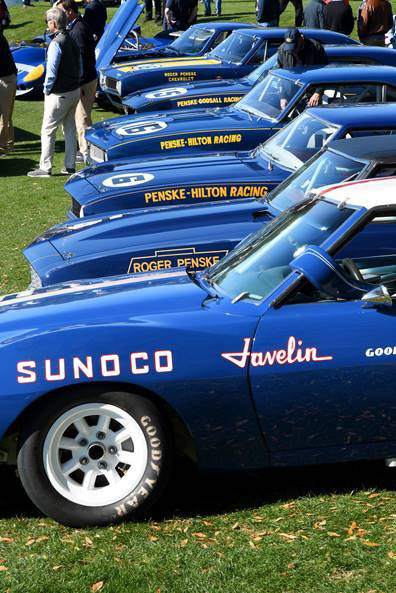
The Penske Racing stable included a plethora of Sunoco-clad Can-Am racers, with Mark Donohue, Peter Revson, and George Follmer among pilots. Photo: Anthony J. Bristol
There were some important carryovers from the Camaro program to the Javelin effort, and it paid quick returns.
“In 1970, Penske carried the numbers six and nine from the Camaros to the Javelins,” explains Cox.
“Up to that point, the Javelins were not competitive. Donohue drove the #6 Javelin and Peter Revson was assigned #9. In 1970, after winning the championship with Camaros in 1968 and 1969, our Team Penske Javelin team was only one point short of the championship in 1970, but we beat all the other Camaros. So our Penske #6 Javelin with Donohue was very successful in 1971, winning seven out of ten races and finishing second or third in the rest.”
When Cox arrived on the scene from Chevrolet Development he immediately started on a new suspension for the Javelin, which was bottoming out, running on bump stops virtually all of the time on track. Cox designed the entire rear end, which included the housing, axles, full-floating hubs, spool, linkage to locate the rear, and brakes. Cox pointed out to Penske the advantage of Girling disc brakes with Lincoln rotors.
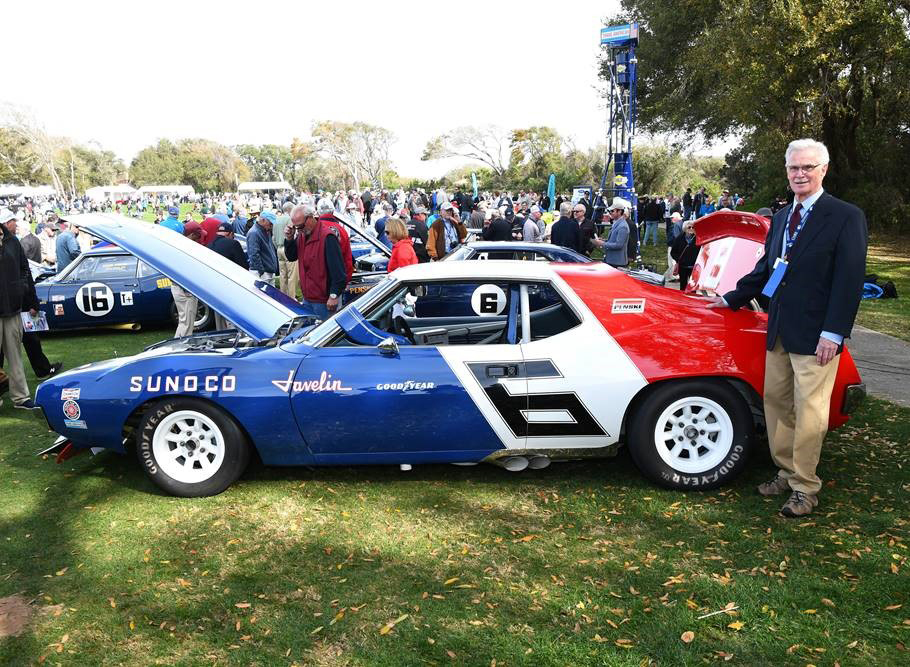
Don Cox and 1971 Trans-Am champion AMC Javelin at 25th Annual Amelia Island Concours d’Elegance. Photo: Anthony J. Bristol
As for the engine, Penske needed to develop special AMC engine components as the 290 CID was down 100 horsepower to the competition. Team Penske looked to Traco in California for all the engines for the 1970 season. Regulation limited engine size to 305 CID. Traco managed to shrink a 360 to regulation by destroking, while still making over 400 horsepower comparable to Chevrolet. But then there developed a litany of blown engines on the track caused by oil starvation due to G-forces when braking. Team Penske devised a dual-pickup oil pump with the secondary pickup scavenging oil from the uphill side of the pan, where it was accumulating during hard braking. Then, Cox had to address the strain of the dual-pickup pump which was wearing out the drive gears on the cam, affecting the distributor running off of the same gears, which was throwing off timing as the cars got further into a race. Cox found a solution by drilling new oil passages to feed oil to the gears.
With the highly revised Javelin racer, Donohue won the first race at Lime Rock, then lost the next two to George Follmer driving a factory Mustang. Donohue went on to win the next six races in a row, clinching the TransAm championship in the 1971 season.
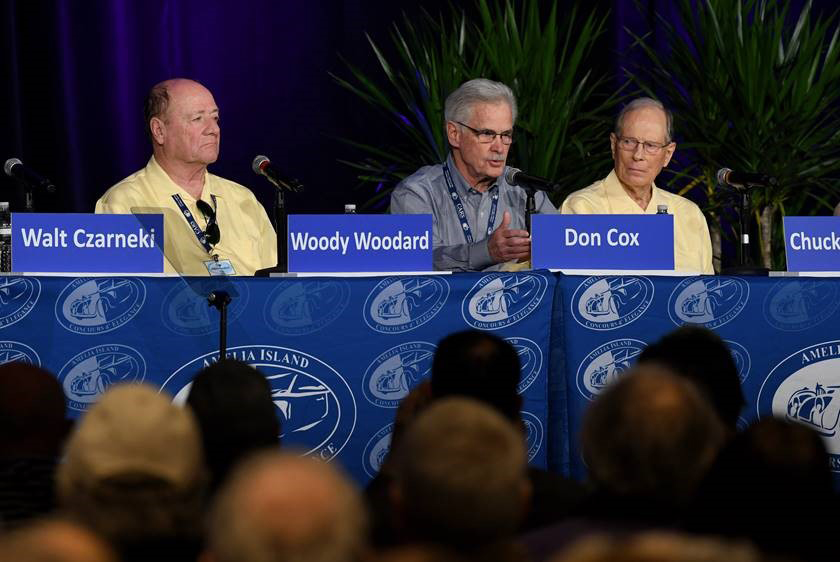
Don Cox (middle) explains his role spanning many years with The Captain at the sold-out, standing room only conference, “Team Penske – the Early Years”, in Amelia Island. Photo: Anthony J. Bristol
At this year’s Amelia Island Concours d’Elegance, in a seminar entitled “Team Penske: The Early Years,” Roger Penske waxed reminiscent about Cox in the discussion panel:
“The TransAm was exciting, and Don, you really don’t give yourself the credit because you worked at General Motors and we needed someone in engineering to come with us and really change it. I remember, we took on the Javelin project because they offered us a terrific deal financially and to take our drivers and take on another challenge. Cox walked in the shop and the first thing he said was: “We’re going to put these brakes on this car.” Think about this, all these factory teams, Mustangs and Dodges, and Don came in and fitted these brakes. Now I wasn’t sure whether they were going to work but they gave us a competitive advantage from the standpoint of having the brakes that nobody else had. So those were early wins. And I think he’s probably modest.”
__________________