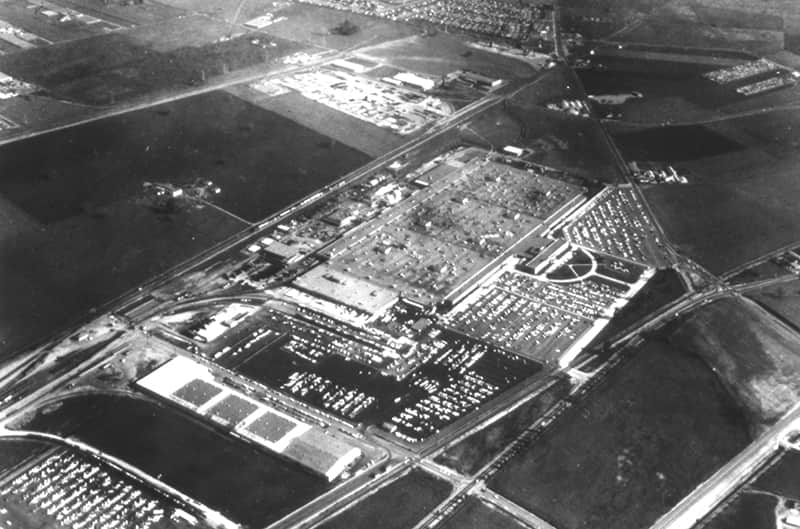
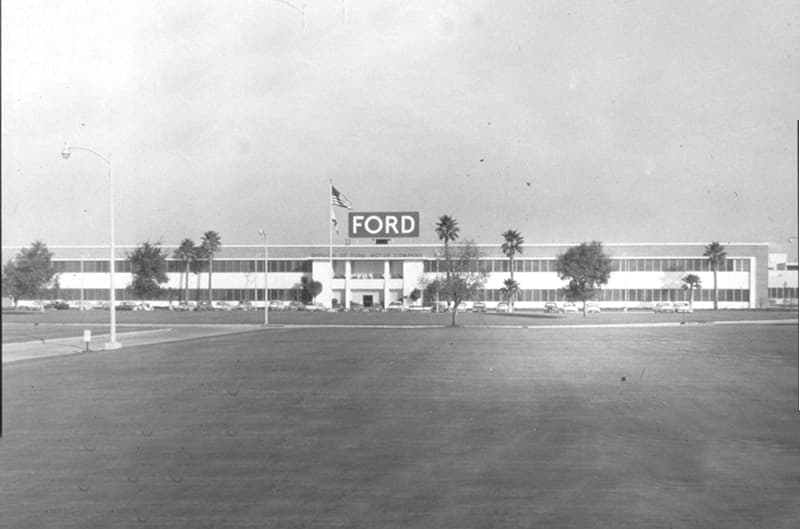
As you can see from the aerial photos, the San Jose plant was dropped in the middle of a huge agricultural valley, initially with very little surrounding it. Those 6,000 employees and their families needed places to live, shop and play, so communities sprouted up all around, or near, the factory. Enterprising developers built tract after tract of affordable housing – although these communities weren’t limited or in any way restricted to only Ford employees -- it’s only natural that some of these developments were purchased and occupied by around 75 percent Fordees. Newspaper clippings of the time quote residents as saying that these neighborhoods developed a welcoming sense of community – with the Ford plant being their initial conduit and epicenter. Today, some of the areas around the plant grounds are still agricultural, but dominated primarily by residential, commercial, office and industrial uses. The plant property was ultimately incorporated into what became the city of Milpitas, although the facility was called, and will always be known as, Ford San Jose.
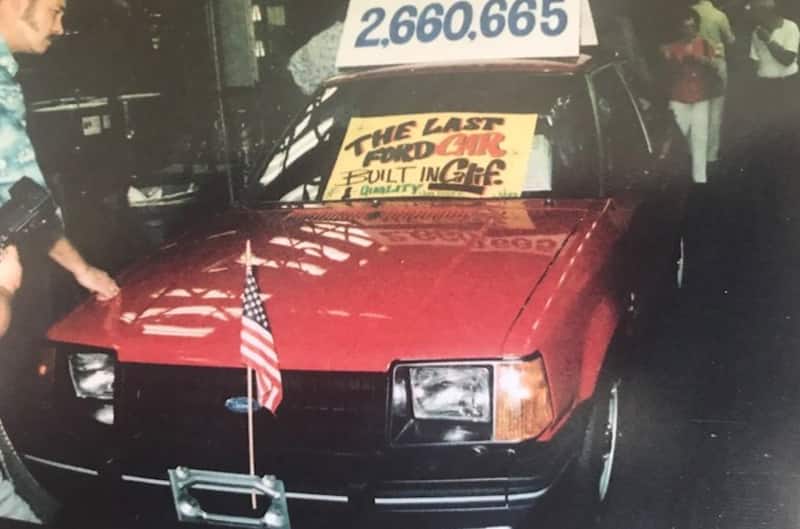
As noted, the San Jose Plant was closed by Ford Motor Company on May 20, 1983, after having assembled a total of 2,660,665 vehicles there – the final car built on the last day of production was a bright red Ford Escort 3-door hatchback. There are several storylines as to why the plant was shuttered, yet the most common one is that several of the models produced there had exited the Ford vehicle lineup (Torino, Fairlane, etc.). Another common thread is that this much production capacity was no longer needed due “to competition from primarily Japanese imports.” That’s at least according to an article entitled
"Ford blames Japanese imports for shutdown of California plant," in the
Eugene Register-Guard News. It’s also likely that Ford simply had too much plant capacity in North America, and didn’t need the production offered by San Jose any longer.
----------------------------------------------
Fortunately, the San Jose Plant was only closed, and not leveled, which would have been a shame for such an historic property, one that employed so many thousands of local residents, and cost well more than a billion dollars to construct. Instead, it was reinvented into The Great Mall of the Bay Area (often simply called The Great Mall) -- a large. indoor shopping mall in what is now Milpitas, California, built as a joint venture between Ford Motor Land Development and Petrie Dierman Kughn in 1994. It was acquired by Mills Corporation in 2003, and by the Simon Property Group in April 2007. The mall contains approximately 1.4 million square feet of gross leasable area, nearly identical in size to its Ford plant footprint. The new Great Mall is relatively small in comparison to America’s largest shopping mall, Minnesota’s Mall of America, which tapes at 8,269,000 square feet, but Milpitas still makes the top-10 list of largest malls in the United States.