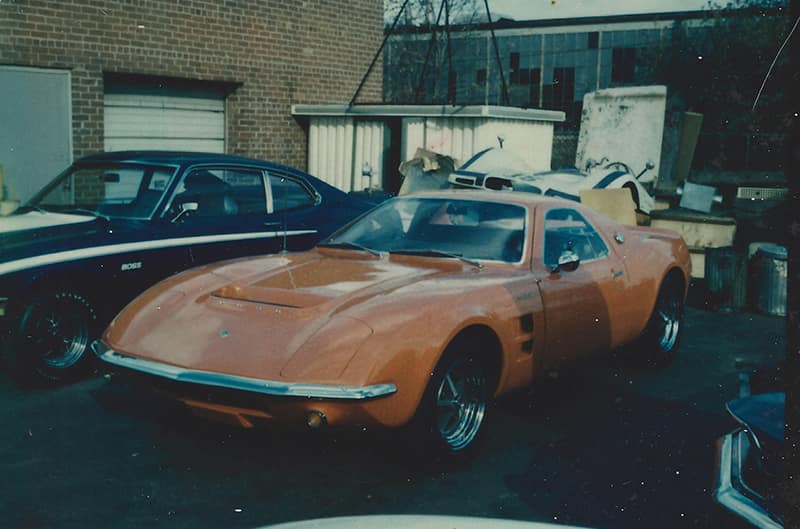
 The red Mach 2 Concept car (the color in this aged photo is distorted) is seen callously parked behind the Kar-Kraft shop with other cast aside projects – a Boss 302 Maverick prototype and a front clip from the G7-A Can Am car. The Maverick’s presence indicates the picture may have been taken some time in 1970, well past the Mach 2’s corporate usefulness. The car may have been waiting for its final disposition at this time.
The second segment of the program , the Mach 2B, was an extensive study that came oh-so-close to production. The “Mach 2B” reference first appears in a Third Quarter Objectives Ford document. The project was now known as the Mustang Mach 2, and a full product proposal was in place by October of 1967. The Mach 2 seemed ready to go, but the initial proposal -- an extension of the Mach 2A work -- was rejected by Ford management. That’s likely because the 1967-69 Mustang chassis, upon which the Mach 2A was based, would be out of production before Mach 2B production could begin. Stockpiling a two-year supply of those chassis was out of the question, both logistically and financially. Additionally, the ZF transmission restricted engine size, and there was no provision in the program for an automatic transmission.
The Mach 2A concept was then “reconstituted” to use either the 1971 Mustang underbody or the 1970 Delta underbody. “Delta” was Ford’s internal code name for the Maverick. The Delta platform was chosen over the Mustang because it was believed the Delta chassis would be easier to modify and still accept the desired big-block engine. Development work on the Mustang-based 2A stopped, while new product plans were drawn up. This version of the Mach 2 was to compete with an upcoming Corvette, which Ford believed would have a mid-ship 427 engine installed by 1971 or 1972. Two clay models were revealed, one in October of 1967 and the other in November.
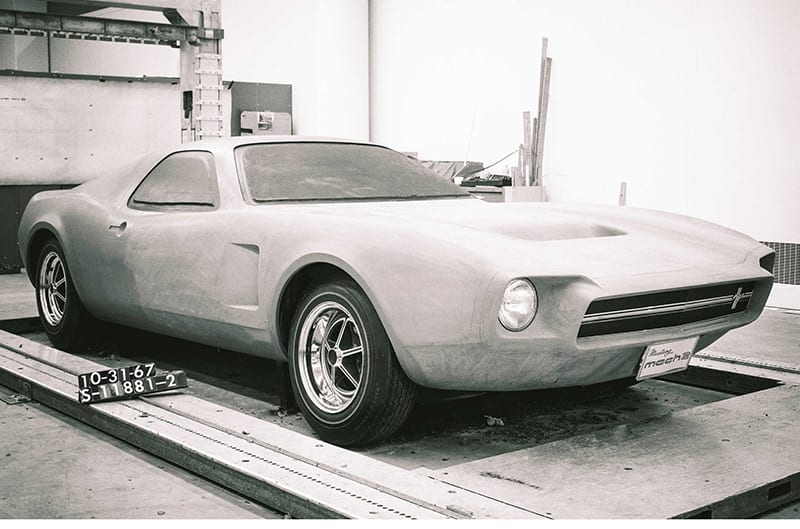 This full-scale clay model is the first of two proposed next-generation Mach 2 styles on a clay modeling platform. Its Mach 2A heritage is apparent. Note the ‘Mustang Mach 2’ placard on the bumper and the Mustang badge in the grille. The grille and headlight surrounds echo the 1967-68 production Mustangs. This version lost out due to undefined ‘manufacturing feasibility problems.’
On October 10, 1967, Roy Lunn sent a letter to George MacFarlane, Sales and Engineering Manager of A.O. Smith Corporation in Ionia, Michigan, which had been selected to manufacture the Mach 2 fiberglass body and assemble the car. The letter asked MacFarlane to prepare a financial proposal for building 11,000 or more Mach 2 cars over the 1969-1971 model years. MacFarlane quickly replied, committing his company to pitch in $2.8 million towards production tooling, dies and engineering. In an October 16 planning meeting, Lunn gave A.O. Smith the go-ahead to commence underbody production engineering.
Ford’s Product Financial Analysis Department projected, in a November 17, 1967 document, a retail price comparison of the Mach 2 against a new Chevy Corvette. The Mach 2 -- with the 351 4V engine, 5-speed manual, limited-slip differential, nylon tires, air conditioning, AM/FM radio and mag-type wheels -- would sell for $4,300. A 1968 Corvette, similarly equipped, listed for $4,160. Another analysis projected that the Mustang Mach 2 could turn a profit of $3.9 million.
At the same time, work on the mechanical components continued. The 1969 Mustang instrument cluster was originally planned for the Mach 2B. However, in this application it restricted vision and even legroom. That issue was resolved by fitting a 1968 Cougar XR-7 cluster to the Mustang dash panel and air conditioning evaporator. The clutch-pedal effort was deemed too high and the shifter vague. The brake balance was less than ideal and the engine overheated. Interior ventilation needed improvement, and NVH (noise, vibration and harshness) issues had to be addressed. These and other typical prototype problems were being ironed out both on the drawing boards and on the test track.
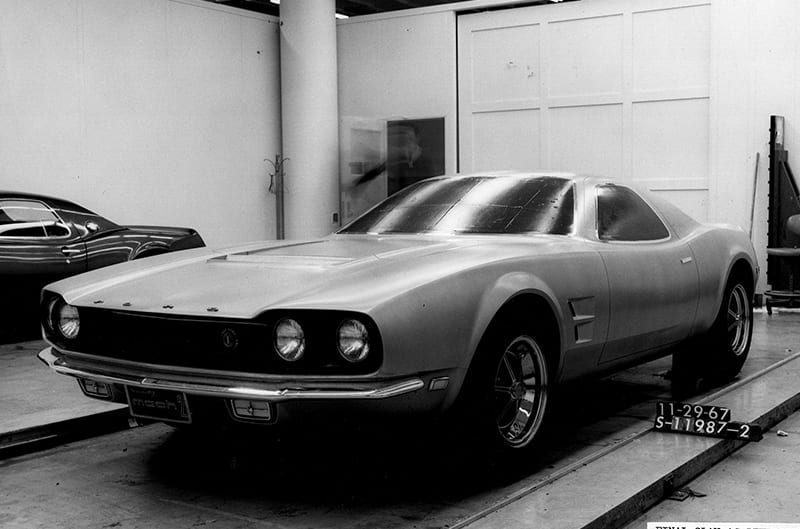 This is what the Mach 2 would have looked like, had it gone into production. The car’s front end was intended to ‘predict’ the 1971 Mustang’s appearance. Note the asymmetrical front grille treatment, often done to provide two perspectives of a design. In this case, one side represented the car with single headlights, the other side with dual lights. The license plate clearly reads ‘Mustang Mach 2.’ The dark car beside the clay is the original red prototype Mach 2A.
With the Muscle Car wars raging, the planned engine for the Mach 2 program was upgraded to the Boss 429, with a manual transmission. An automatic was specified as an option. Ford documents relating to the Mach 2 program driveline generally refer to just “transmission,” but it’s likely safe to assume that is shorthand for “transaxle.” While the ZF transaxles could handle the torque of the 351 V-8, they would have been hopeless behind the big-block 429 engine. This issue was raised back in September of 1966, when the 427 was first introduced as a possible engine in the Mach 2A. It was still a problem in the early phase of the Mach 2B. According to a 2nd Quarter 1967 Performance Against Objectives report, projected transmission costs were delaying the program. The uncertainty of a suitable transaxle would plague the program to the very end.Development costs for a transmission that could stand up to the 429 engine were estimated as high as $11.5 million. A March 20, 1968, document projected that the Mach 2B program would be financially feasible if a transaxle could be brought in for $2.5 million -- a discouraging gap, to say the least. In a January 29, 1968, letter to Hank Gregorich, Chief Engineer of Ford’s Transmission and Chassis Division, Roy Lunn emphasized the importance of resolving the transmission issue. He explained that the driveline components choice was driven by the need to counter the suspected mid-engine Corvette. Lunn then diplomatically asked for Gregorich’s support. Gregorich’s reply has not been found.