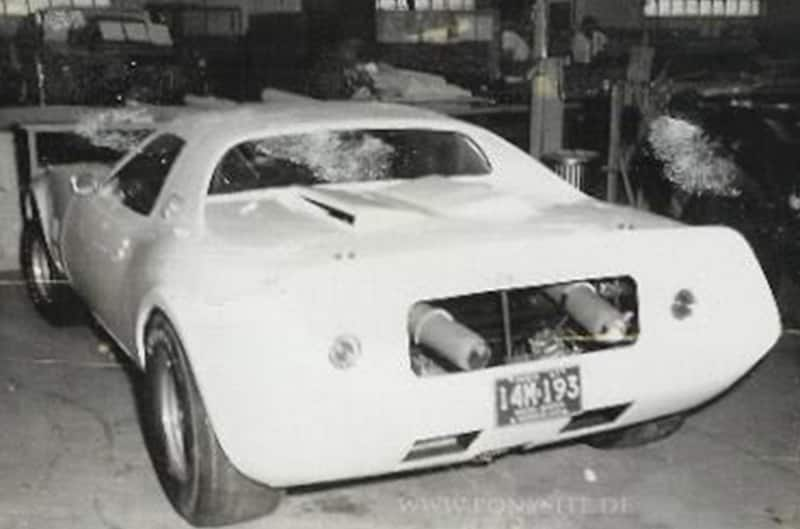
 Here’s the white race development mule with its lightweight fiberglass body. The exhaust headers exit the cut-out rear panel and the bumpers have been removed. The car was test driven by Lee Dykstra and Allan Moffat.
The second Mach 2 prototype car that was developed, finished in white, was built as a development mule for racing. An October 2, 1967, Advanced Concepts Department document states, “The Mach 2 is likely to be classified as class A-Production, together with the 427 Corvette and the 427 Cobra.” The Mach 2 engine for the program is not identified, but the 351 was the most likely candidate. The document goes on to predict that the Mach 2 would be superior to the 427 Corvette in competition, based on the simple premise that the Mach 2’s performance would fall between a GT-40 and 427 Cobra, both of which outperformed the big Corvette. Like any race car, the Mach 2A race mule was stripped of all non-essential items and prepped for competition. It received a lightweight version of the Mach 2 body. Chassis modifications, settings and race components were to be developed with this car. The 351 production engine was not available at this time, so the current 289 was used. Whether the engine was modified beyond race headers is not known.
Lee Dykstra, another Kar-Kraft engineer who worked on the Mach 2, did dynamic testing of the race car at the Dearborn Proving Grounds. He drove the car into the first turn at speed, and the chassis naturally started to flex (roll angle or twist). Dykstra was then startled by a very loud bang in the passenger compartment. It turned out that when the chassis twisted, it distorted the body, and that caused the thin roof panel over the passenger compartment to buckle and make the popping noise.
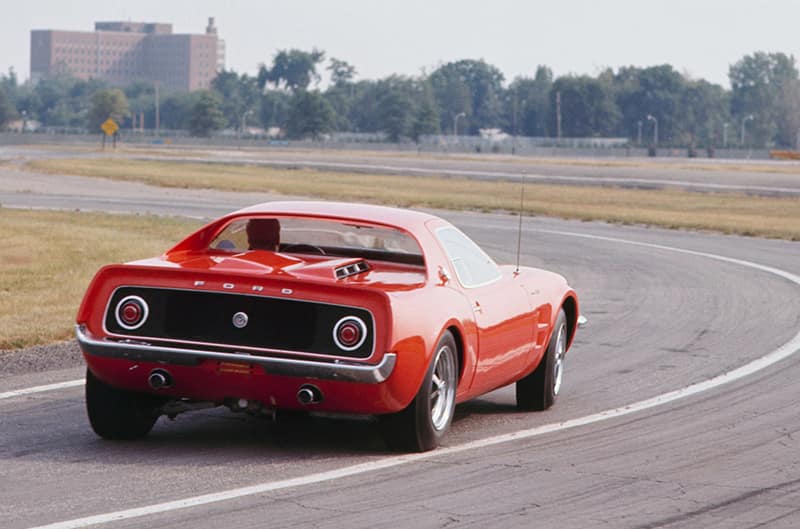 This is the Mach 2 on Ford’s Dearborn Proving Grounds. The red car handled well, but still experienced some body roll, as seen here. Due to lower speeds, this roll is not as severe as that experienced during high-speed testing of the white race car.
Ford’s Experimental Garage, often referred to as the “X Garage,” was contacted to arrange a test of the chassis. The engineers there set the car up on the torsional stiffness rack to see how it performed. As Dykstra put it, the twisting of the cut down mid-engine Mustang chassis was “horrible.” Cars of that time measured around 10,000 ft-lbs/degree of twisting force on the rack, but the Mach 2 prototype didn’t even come close. The X Garage engineers recommended areas where additional reinforcements could be added to the chassis. It turns out that because the fiberglass body of the red road car was much thicker, it did not suffer from the same distortion issue.
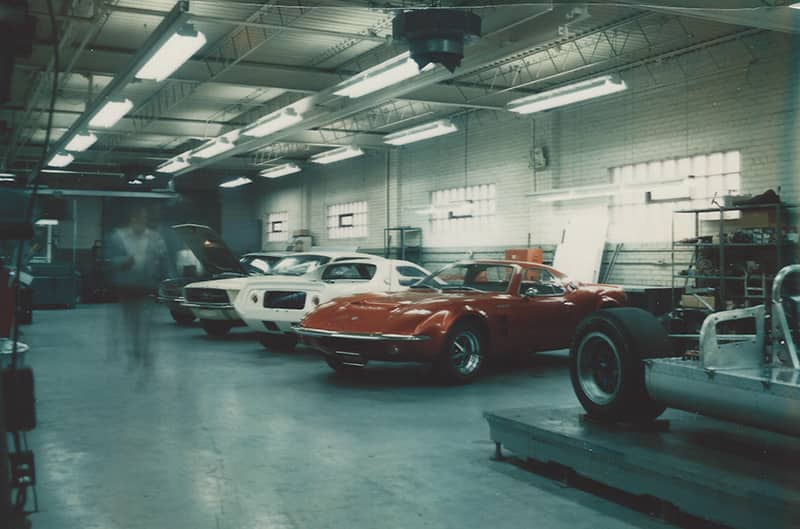 These are the two Mach 2 prototypes in the Kar-Kraft shop. They could be in-between engineering or publicity assignments or awaiting disposition. The car on the right is Fords G7A Can Am car.
The feasibility chassis and both prototype cars stayed at Kar-Kraft throughout the program – and even after it ended. According to a May 23, 1969, Engineering Vehicle Register, they were officially “in storage” at Kar-Kraft until they were scheduled to be crushed. The feasibility chassis and white car did meet that fate. However, the white one did not go peacefully: The gas tank was not fully drained, per crushing requirements, and as a result, the car exploded in the crusher’s jaws.
The remaining red road car is a bit of a mystery. Early on, Ford would call Kar Kraft to have it appear at media or other special automotive events and car shows. Even after its show career, Kar-Kraft continued to use it in parades and other activities, such as an engineering fair at Purdue University. It is not known whether the car was still at Kar-Kraft when the company closed in November of 1970, or if it had gone back to Ford sometime earlier. At any rate, it disappeared around that time.
As might be expected, rumors began circulating about the red Mach 2 Concept car. It went here . . . it went there . . . it was surreptitiously “appropriated” and never made it to the crusher. One story even has it in the hands of a foreign manufacturer. Another says a Ford employee bought the car’s remains from a Detroit wrecking yard that was sometimes used by auto manufacturers to dispose of scrap vehicles, and that it may still exist in a garage the Detroit area. However, no supportable or certain disposition has been discovered to date.