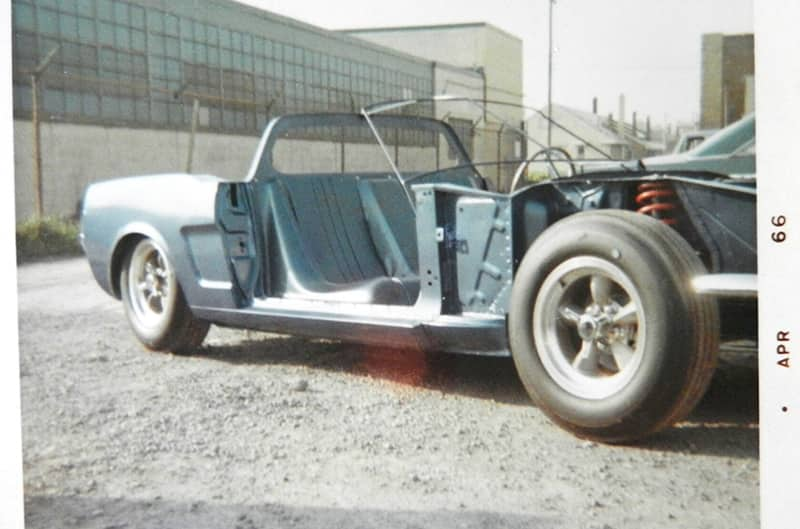
 Here’s the light-blue 1966 feasibility chassis parked beside the Kar-Kraft shop. The stock appearance and the height of the apron at the spring tower can be seen. The Mustang windshield frame has been removed. A windshield frame was fabricated out of small-diameter tubing to represent the Design Center’s laid-back design.
Hull started work on the feasibility car by having the trunk floor of the body cut out. He came up with a clever design for a cradle that located the 289 engine, Colotti transaxle (not a ZF, as mentioned in earlier reports) and independent rear suspension in the cutout. The whole package fit like the car had been designed that way in the first place. The cradle for the driveline was fabricated from round tubing, but did not constitute a full frame. The new rear suspension shortened the wheelbase almost an inch. The floor pan was not shortened, but the overall body length came down eight inches. The independent rear suspension design came from Klaus Arning, Ford’s brilliant suspension guru. Arning had patented the design, which was first used on the Mustang I concept car. Bob Riley provided engineering drawings to adapt the suspension to the cradle and body and Larry Elliott performed the fabrication.
 Hull’s design allowed easy access to the driveline and suspension. By removing the crossmember and two bolts, the engine and transaxle dropped out through the bottom as a unit, leaving the suspension in place. Note how the round tubing cradles the transaxle. This is the white race development car, but its design was basically the same as that of the feasibility car. By the looks of the components, the car had seen some serious miles on the track.
The low, sloping design of the Mach 2 body’s hood and front fenders required modifying the vertical side panels, or aprons, of the engine compartment. This was done by taking out wedge-shaped sections from the top of the aprons. The cuts began just in front of the spring towers and ran forward to the radiator support. The horizontal top apron flanges, to which the fenders bolted, were then carefully bent down and welded to the reshaped apron. The aprons were also slightly tapered in at the front and the radiator support was cut down to match the new apron contour. The body design also required lowering the radiator and tipping it forward. Elliott did the apron work and fabricated ducting to pick up radiator air from beneath the bumper.
When the 1967 Mustang platform became available, work started on what would be the red and white Mach 2A prototype vehicles. Ed Hull once again drew up plans based on Design Center drawings. The engine cradle, rear suspension and engine were taken from the feasibility car, but the Colotti transaxle was replaced by a ZF unit. Don Eichstaedt was tasked with reworking the front of the chassis to better fit the Design Center’s body. This time, most of the front apron sheet metal was cut out to better accommodate the drooped front nose of the Mach 2 body.
Since the running prototype was to represent a possible production car, the new front end had to allow for storage space. One criterion for that space was the ability to stow a golf bag. Eichstaedt designed a new front structure to not only house a golf bag, but also a radiator while supporting the body and anchoring the suspension. Koni adjustable shock absorbers and revised lower control arms were installed. Otherwise, the spring-tower height, suspension and steering remained stock.
 Eichstaedt’s redesign of the chassis front was supposed to make room for a golf bag. By the looks of the finished body, it seems one would be hard pressed to fit in much more than a change of clothes, a pair of shoes and a box of golf balls.
When the chassis and full fiberglass body for the red prototype were finally ready for one another, the chassis was again set up on a surface plate. The body was unstressed, meaning it rode on the chassis and did not contribute to the structural strength of the vehicle. A 3M brushable adhesive was applied to the body and chassis, and the two pieces were mated. The adhesive was supposed to set overnight, but for some reason it did not. By morning, the team noticed that the adhesive had oozed out and dripped onto the surface plate. Although 3M was quite apologetic and rushed to put things right, the issue supposedly caused the car to miss an unspecified show.