The Story Behind Ford's Stillborn Mustang Mach 2 ‘Road Sports Car’
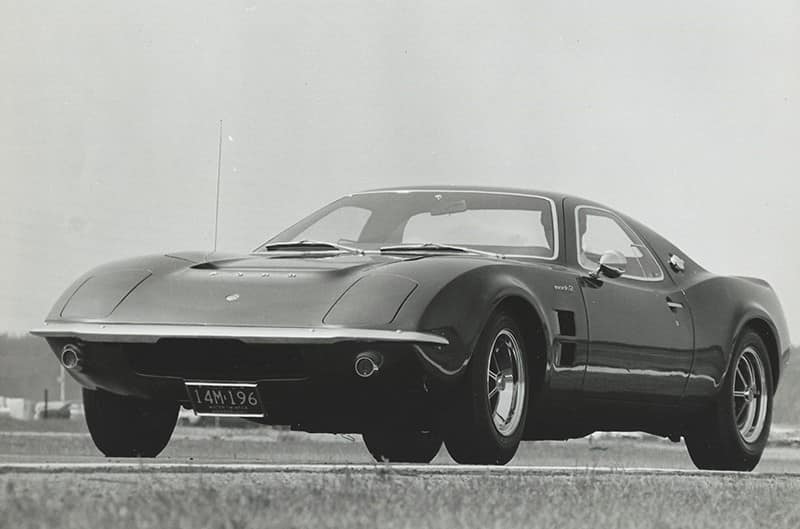
On March 22, 1966, Ford’s Advanced Concepts Department received a request to “execute design-engineering studies on a Ford-Cobra-style vehicle.” This was the official beginning of what would become the Mach 2 program. An undated Ford document, titled
Vehicle Engineering Department Summary of Activity in Past Years, identified three separate segments of the Mach 2 Road Sports Car in a “Mach X Vehicles” category. These were, simply, Mach 2A, B and C.
The first product of the Mach 2A segment was a non-running chassis to validate the concept. That was followed by two complete, running prototypes. One of them, painted red, was built to production standards and loaned to the media for road testing. The other was a white race-only version that saw strenuous track testing. All three were designed in-house, but engineered and built by Kar-Kraft, a Ford contractor in Brighton, Michigan.
According to Don Eichstaedt, a Kar-Kraft engineer on the project, the Mach 2 was to be a stand-alone mid-engine sports car. It was also to be a test bed for new designs, concepts and engineering techniques. The car was
not intended to be a mid-engine Mustang. It just happened to be prototyped on a Mustang chassis. Roy Lunn, godfather of the Ford GT-40 program and the Ford engineer in charge of the Mach 2 program, predicted the production car would be “a fine high-quality road vehicle.”
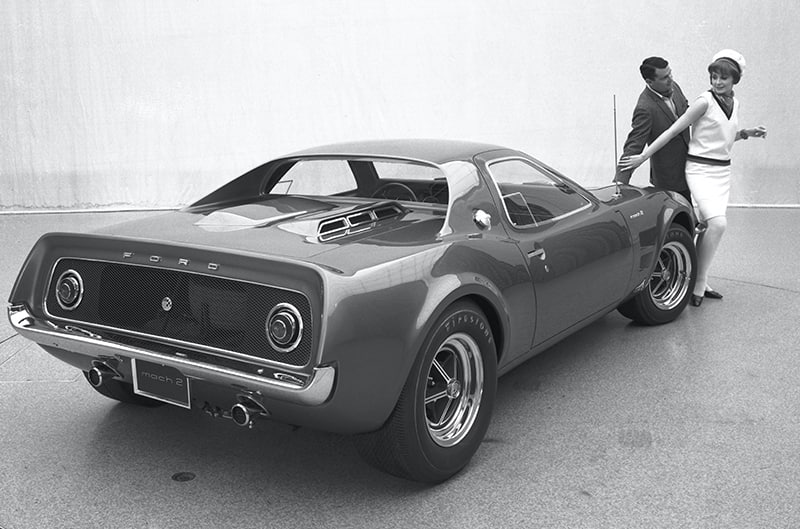 From any angle, the Mach 2 was a clean, sporty design. Its light weight and 289 V-8 engine would give it great performance. Beauty shots like this showed there were serious thoughts about production.
The Advanced Concepts Department responded to the March request on April 29, 1966, with a report titled
Road Sports Car Studies. The report summarized the request and outlined the department’s initial study results. The request source is not identified, but program insiders say it most likely was Don Frey, Ford Division’s General Manager. The writer of the April report is not identified either, but it may have been Roy Lunn, as most documents found were signed by him.
According to the request, Advanced Concepts was to explore the affordable high-performance two-seat sports car market, specifically targeting the Chevrolet Corvette. The new car was not intended to compete with the high-end Ford GT-40. The request also contained a brief mention of creating a Ford product for Shelby American. Later documents suggest that Ford would provide partially assembled bare chassis and loose parts for Shelby to complete, or supply all components, including sheet metal, broken down for Shelby to build from scratch. This never happened.
The request specified that the car have a mid-ship engine, meet all emission and safety standards and accommodate a full range of accessories. A coupe body would be standard, with a roadster-type configuration optional. It had to retail for not more than $7,500. After an initial run of 500 units, production would climb to between 1,000 and 1,500 units per year. Production tooling costs were initially capped at $250,000. The request identified 1968 as the possible start of production.
The most intriguing specification in the request stated that the car be legal for, “and be a potential winner in,” SCCA A-Production and FIA Group III GT categories. The first production run would use the 289 V-8 engine backed by a ZF 5-speed transaxle. The weight of the street car was estimated at 2,650 pounds. The race version would weigh 2,400 pounds. It was also estimated that the race version would be competitive with the 427 Corvette, under “normal conditions,” probably meaning prepared by amateur racers. This estimation may have been based on Ford’s new 351 engine, as expecting a small-block 289 to run with big-block Corvettes was a stretch. “Specially prepared” Corvettes, purpose-built by professional racers for maximum power and minimum weight, were deemed to be superior and would have to be countered by equally prepared “Cobra-Mustangs.” A later series Mach 2, with the big-block 427 engine and a Ford transaxle, was mentioned as a consideration. It was only logical that the 427 would be a more realistic contender in A-Production and Group III.
Initial study results in the April report recommended using standard model-line components to meet the price, tooling, volume and timing objectives of the study request. Lower costs could be realized through the use of fiberglass or single-die metal-forming techniques. The objectives could also be met by using the underbody, front suspension and steering of the current Mustang.
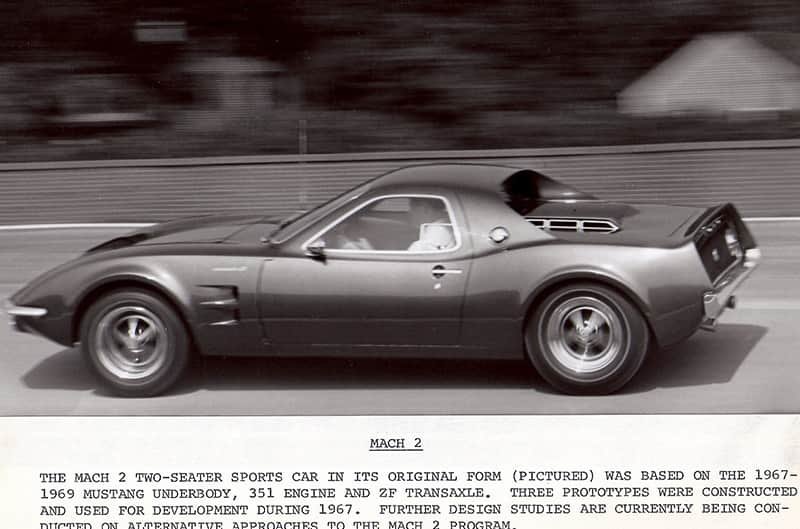 This is from an internal report. Such reports were used to update the status of projects and, possibly, to ‘sell’ a project to management. In this case it appears to be summarizing the early Mach 2 program and promoting a second-generation Mach 2 proposal. Lee Dykstra, one of Kar-Kraft’s chassis engineers, is driving the red prototype on the banked high-speed section of the Dearborn Proving Grounds.
The Mustang platform would result in a Mach 2 body height of 47 inches and a wheelbase of 108 inches with the 289 engine. Fixed seats and adjustable pedals were recommended to cut weight and simplify body packaging. The mid-ship engine dictated a forward luggage compartment, with the spare tire and gas tank in the rear. The body would be made of fiberglass, keeping the stock front and rear bumpers. The report mentioned, almost as an afterthought, the possibility of an alternate unique underbody. Considering the budget limitations, an easily modified existing chassis made more sense than a scratch-built “unique” chassis.
On September 1, 1966, the Advanced Concepts Department published a
Road Sports Car Program Status Report. Again, neither the writer nor recipient were identified on this report itself but it repeated much of the April report, summarized progress and added new information. It noted that a complete underbody with mechanical components had been constructed. The report went on to say that the mocked-up underbody, along with a provisional clay body model, was revealed to management on May 2. The response to the showing deemed the program had considerable merit. Unfortunately, no mention of “management” names has been found.
The September report followed up on the April mention of possibly creating a 427 version of the mid-ship car. It predicted that two to three inches would have to be added between the driver and rear axle to accommodate the bigger engine. It was believed that increase could be achieved by using a Cougar underbody. However, the report pointed out that a transaxle capable of handling the 427’s power was not available, and could not be produced at an “economically sensible cost” at that time. The report proposed the upcoming 351, with an upgraded ZF transaxle, in its stead. The 289 in the 1968 production run would be replaced in 1969 by the 351.
The report also revealed that the styling studio had shown a full-sized clay body model to management on July 25. Modifications were suggested at that time, and had been incorporated. Styling was also providing services in layouts, interior and seating mock-ups and other aspects pertaining to the chassis. These services included the all-important drawings of how the Mustang chassis was to be modified to fit the proposed body. Production components for the chassis and engine were critical to simplify fabrication and keep costs down. Fuel systems, wiring and other peripherals were unnecessary for a mock-up and too expensive to fabricate, so the first chassis would not be a running sample.
Since the 1967-70 model year Mustang platform was not yet available, a 1966 Mustang would be pulled off the assembly line for the program. It would be the foundation of the first chassis, which was needed to develop and prove the feasibility of the engine driveline placement within the body. A convertible Mustang platform was selected for its extra body-stiffening reinforcements and side sills, which were stronger than those of the hardtop cars. For clarity here, this first chassis will be referred to as the “feasibility car.” Once the 1967 Mustangs were in production, work and components would be shifted to that platform.