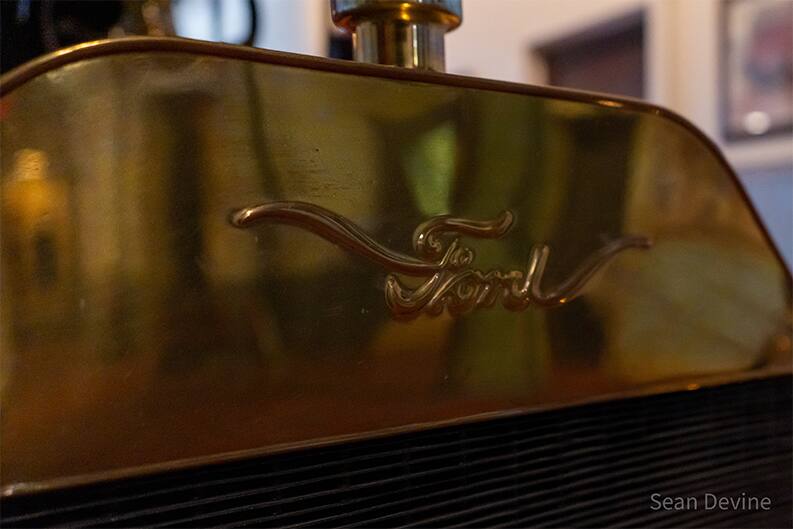
Soon it was time for an early lunch, so we drove a few hundred yards down Piquette Avenue to the corner of Woodward to dine at an old inn-turned-tavern/restaurant called “Z’s Villa.” We chose to sit at tables on big outdoor patio, right next to the historic inn building that’s well over 100 years old. After some good food and drink, we got back in our rides and turned north on Woodward a few miles to the massive and long-shuttered Ford Model T Plant in Highland Park, Michigan. We pulled off at the corner of Manchester Ave. and Woodward to get some photos at the old factory’s Administration Building, and to try and take in just how huge this city-blocks-long place really is.
Unhappy with Detroit taxes and regulations, Henry Ford purchased a 130-acre tract of land in adjacent Highland Park of September of 1907, where renowned architect Albert Kahn helped Ford design and build the second American production facility for the Model T automobile and the first factory in history to assemble cars on a moving assembly line. Millions of Models T’s were produced here, helping to put the world on wheels. The factory was nicknamed the “Crystal Palace” for its many glass windows in the roofs and walls to provide natural light inside the plant. It became a National Historic Landmark in 1978.
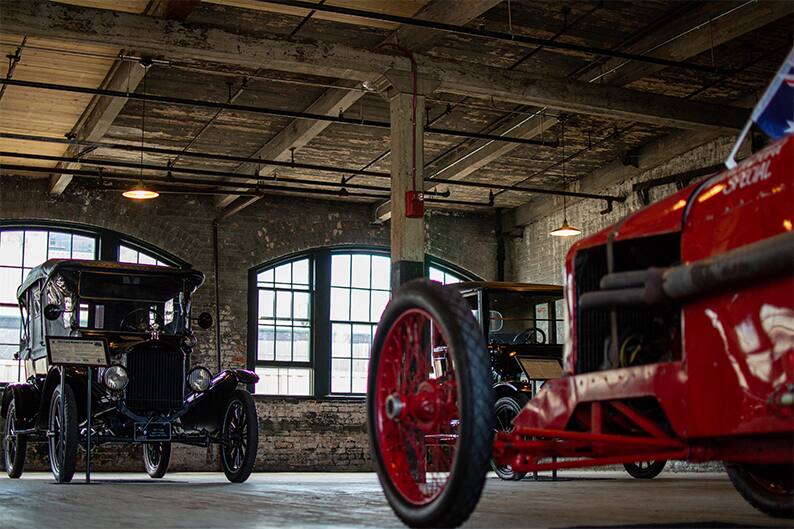
Getting back in our cars, we turned south onto Woodward heading out of Highland Park and back into Detroit, passing the Boston-Edison Historic District in the heart of the city, still containing over 900 homes mostly constructed between 1905 and 1925. Included among them were impressive mansions once owned by Henry Ford, James Couzens, Sebastian Kresge, and Joe Louis. Once we got to West Grand Boulevard in the New Center area of Detroit, we turned right to do a loop around Cadillac Place, which was formerly the General Motors World Headquarters high-rise office complex now occupied by State of Michigan government offices.
We continued down Woodward heading downtown, past my alma mater, Wayne State University, then to the spectacular and spanking-new Little Caesars Arena, home to the National Hockey League’s Detroit Red Wings as well as the National Basketball Association’s Detroit Pistons. The Red Wings moved from the now-demolished Joe Louis Arena on Detroit’s riverfront, and the Pistons came in from the their previous home north of Detroit at the more recently torn-down Palace of Auburn Hills, a suburb that is the home of the former Chrysler Corporation, now owned by a Euro auto conglomerate known as Stellantis.
A few blocks down we came upon Detroit’s Fox Theatre, which was originally billed as “the most magnificent Temple of Amusement in the World.” The imposing 10-story structure was designed by
C. Howard Crane and was built as part of the theater empire of film mogul William Fox. Opening in 1928, it was the first to include escalators and elevators for patrons and the first in the world to have custom, built-in equipment for presenting “talking movies.” It fell into disrepair in the 1970’s before closing and being purchased in 1987 by Detroit pizza tycoons
Mike and Marian Ilitch, who undertook a full renovation of the 5,000-seat theater’s neglected splendor. It was officially designated a National Historic Landmark in 1989.
Across Woodward from the Fox we could see the professional homes for the other two big-league Detroit teams that play along the Woodward corridor. Trendy Comerica Park, home of Major League Baseball’s Detroit Tigers, is right on Woodward, and Ford Field, the indoor home of the National Football League’s (and Ford-family owned) Detroit Lions, is right behind it.
From there we turned east and drove through Detroit’s Eastern Market Historic District, which dates back to 1891. After the end of World War II, Eastern Market became a hub for food processors and wholesalers who moved operations to the 43-acre, six-block public market that houses some 80 structures. Today, Eastern Market is the largest historic public market district in the United States with more than 150 food and specialty businesses selling all types of goods including produce, meat, spices, jams, flowers and poultry. It was added to the National Registry of Historic Places in 1978.
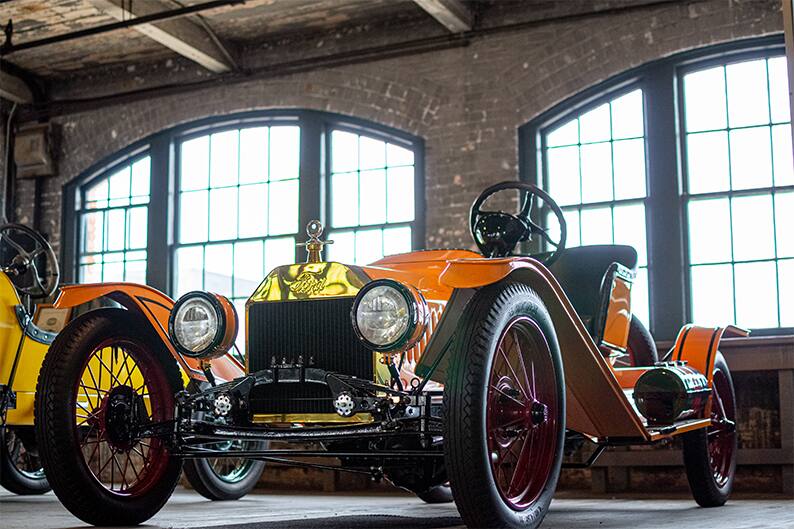
For some more visual diversion, we headed a bit further east to The Heidelberg Project, a defunct neighborhood-tuned-outdoor urban art exhibit started by award-winning artist and sculptor Tyree Guyton as a political protest in 1986. The Heidelberg project is one of the most visited spots in Detroit and remains quite controversial, with the city demolishing some of the art-project houses in 1991 and again in 1999. More recently, it has been hit with a string of unsolved arsons, destroying eight of the old homes in 2013.
From there we headed down Mt. Elliott Street before turning right on East Grand Boulevard to see what is perhaps the most famous of Detroit’s auto industry ruins – the former Packard Motor Company plant, which remains as the most recognizable symbol of the decline of Detroit’s auto industry. When it opened in 1903, Packard's Detroit plant was the largest and most advanced auto factory in the world. Also designed by Albert Kahn using reinforced concrete, it covered a staggering 35 acres of land and boasted over 3.5 million square feet of space. During WWII, the Packard plant produced engines for P-51 Mustang fighter planes, but afterward their legacy as a luxury brand slowly faded until ending for the 1958 model year. After being abandoned for years, recent attempts by investors to repurpose the site have all failed, and an eventual date with the wrecking ball may soon be in its future.
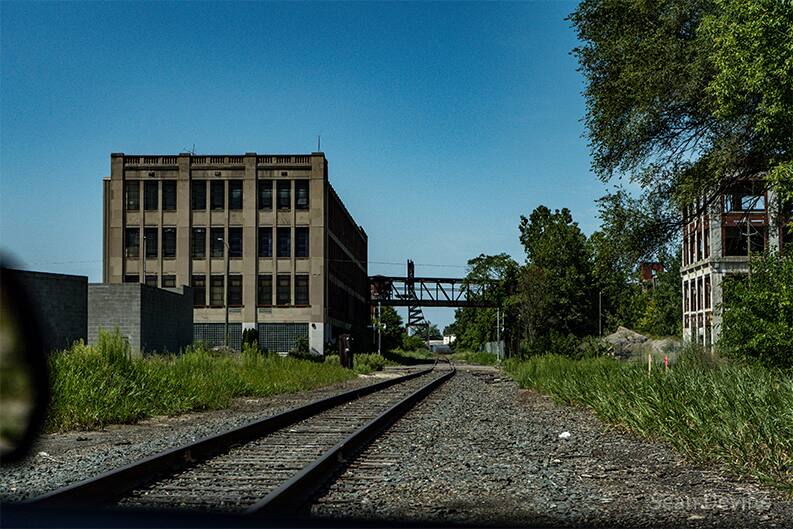
We stayed on East Grand Boulevard to see some of the few remaining grand homes still standing from back when these addresses were among the most prestigious in the city in before a long decline in the area began in the late 1920’s. So we headed further due east to Indian Village, a historic and affluent three-block neighborhood with a number of architecturally-significant homes built in the early 20th century for prominent Detroiters like Henry Leland, Arthur Buhl and Edsel Ford. Indian Village was listed on the
National Register of Historic Places in 1972. From there we turned onto East Jefferson along the riverfront and across the bridge onto Belle Isle, an island park located in the Detroit River.
Belle Isle was opened in 1880 and remains the country’s largest city island park -- at 982 acres, it is even larger than New York City’s Central Park. Entrance to the park is via the MacArthur Bridge. Visitors are immediately treated to rich and unique architecture, fountains, statues and manmade lagoons. Belle Isle is home to a Coast Guard station, a maritime museum and an aquarium, as well as the
William Livingston Memorial Light, the only marble lighthouse in the nation. Belle Isle also boasts a nature center and trail, picnic pavilions, baseball fields, tennis and basketball courts, a small golf course, a playground and beach access. While Belle Isle is home to the historic
Detroit Yacht Club, as well as the nation’s oldest rowing club, the
Detroit Boat Club, our interest there was to cross the start-finish line of the
Detroit Grand Prix, which has been held on the island park for years, and for a photo-op of the Detroit skyline. The park is now operated by Michigan’s Department of Natural Resources.