“OK,” you’re saying to me, righteously indignant, “but everyone knows they cool better than straight rotors! That’s why manufacturers still make them!”
Yes, drilled rotors tend to run a little cooler than straight faced rotors, but there are two caveats to that:
- The face of the average drilled rotor can have a reduced surface area of 10%-12%, which means overall less area for the pad to grip onto, and less friction applied in total, meaning not as much heat generated. The cooling provided by those holes being there do make a slight difference, however…
- Due to those drilled holes catching air, the surface cools unevenly, leading to cracks. The cast iron of your rotors expands and contracts with heat, and the metal around those holes cools faster than the solid surfaces around them. This means that as the rotors cool, they are contracting at different rates around the surface of the rotor. What’s even worse is that the areas of the rotor that experience the biggest heat differentials are also, by design, the narrow spaces between the holes of the rotor, where there is less material to spread the stress out across.
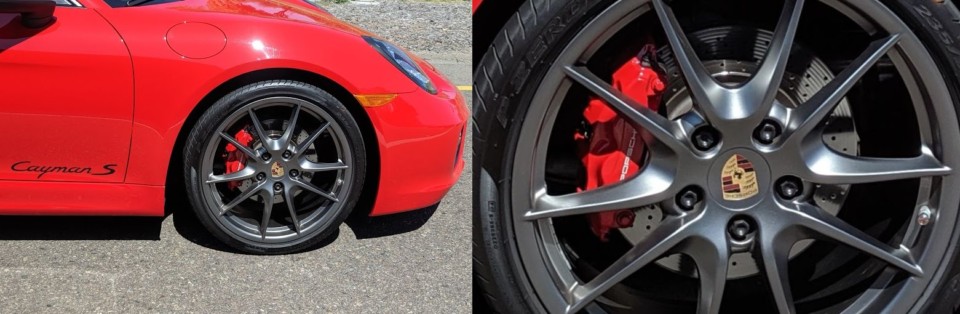
That’s how you get cracked rotors as seen above. That cooling is a double edged sword that, unfortunately, is sharper on the side facing you in this case. Oh, and that uneven wear pattern I mentioned earlier, check out the rotors on this Porsche I saw at a stoplight just the other day:
“OK,” you’re saying to me now, still righteous, but a little less indignant, “what about slotted rotors, huh, smart guy?”
Like I mentioned, slotted rotors are in fact found quite often in motorsports, even among serious race teams. There are a few reasons for that, namely the ability to provide runout for water, dust, and other debris (hence their popularity in rally). On top of this, they provide a way to wipe the pad’s surface to help with things like glazing, and to maintain a properly bedded pad and rotor. This is in addition to more structural rigidity maintained in the rotor (though they will still crack before straight rotors).
Everything is a trade-off, however. The (relatively minor) disadvantages of slotted rotors is that they tend to wear out pads more quickly, and in a daily driver, they can result in some noise when coming to a stop in a quiet car. Depending on the slotting pattern, this can be sort of a growling sound, or with some, under really hard braking, a quick thumping not unlike ABS lockup.
“So then why do all of these brands put drilled rotors on their performance cars rather than plain or slotted rotors?”
Because they look cool (marketing), and because most drivers generally won’t find the limits of those fancy looking drilled rotors — even in their 500+ horsepower speed machines. Doesn’t that just kind of make you sad to know? I wish more people would use the performance they pay so much for.
My last myth comes in two forms:
“What the hell, my new brakes are squeaking! They must be defective,”
or
“I just replaced my brakes a few months ago and they’re already warped? They must be defective!”
As long as you bought your pads from a reputable brand, I can almost guarantee they are not defective or warped. What we have here (for both situations) is that your pads probably weren’t bedded in properly, and a few other factors.
What does it mean to bed-in your brakes?
I’m sure most of you are familiar with this process, but if not: when you buy a set of brake pads, especially higher performance pads, they will come with instructions on or in the box on their specific bed-in procedures. This is a process to “mate” your pads to your rotors with gradually increased heat cycles to create a thin, even film of brake pad material on the surface of your rotor. Let’s get into some detail here:
The brakes on your car work by way of two forms of friction – abrasive and adherent:
Abrasive friction: As the pads are pressed against the spinning rotors, the crystalline structure of the pad and even the cast iron of the disc break down, transferring kinetic energy into heat, slowing you down.
Adherent friction: The material of the pad breaks apart and reforms, bonding to the surface of the rotor. This process saps energy away from the turning of the disc, spending it to create that bond, as well as create heat. This is the method of friction that is used to bed your pads to the rotor.
All modern brake pads use both types of friction, just to varying degrees depending on the application. Semi-metallic pads work through primarily abrasive friction, and therefore are tougher on rotors and create more dust in a trade-off that results in the ability to operate effectively at temperatures. Organic and ceramic pads primarily use aderhent friction, the trade-off being that they’re easier on rotors, have better cold performance, and are quieter at the cost of high temperature performance.
Now that we have this established, how does this pertain to the brake judder you’re feeling in your brakes?
Well if your rotors have not been bedded in properly, or they were overworked and lost that bedding, then you can have uneven pad deposits on the surface of the rotor. At first, this just means uneven drip across the surface, causing the pads to grip, then slip, then grip, then slip, etc, and that’s the judder you’re feeling as you brake. At the extremes, if this is not corrected, this can result in uneven rotor wear, and a “warped” rotor. I use quotes there, as the term is a bit of a misnomer, though that is a topic for another time (I covered it
here years ago).
What about new brakes squealing?
The confusion here comes from the fact that most brake pads come with a metal tab that will rub against the surface of your rotor to indicate that your brake pads have worn down to a certain point (as I’m sure you’re familiar with). So now when most people hear their brakes squeal, they think that they already need to be replaced, but that is often not the case.
What’s happening here is that the conditions are just right for your rotors to vibrate as they pass through the clamping pads, not unlike how a bow being dragged across the strings of a violin work — the main difference is a violin is a lovely sounding instrument, and a squealing brake rotor tends to roar in the key of “ouch.” Not pleasant.
Proper bedding of your rotors can go a long way in reducing this effect, but there are a few other factors that can contribute here. For instance, a layer of rust on your hubs when you install your brake rotors can let them sit against the hubs slightly unevenly, or with some wiggle room, allowing them to vibrate as they turn. Another reason could be your brake pads shifting and allowing play in the contact between the rotor and caliper, allowing the vibration. This can be solved using brake pad shims or some of that brake pad lube they always try to sell you at your local auto parts store.
Pro tip: A little bit of anti-seize works great, and is cheaper than that stuff they’re trying to get you to buy (assuming you don’t already have some on hand).
Source: H&R Suspension
Alright, that seems to be enough ranting for now. See anything you disagree with? Have any questions or suggestions for what myths to cover next? Drop a comment below or drop me a line at
gdavis@autoanything.com.