‘FATHER OF THE 427’ STORY AFTER THE PASSING OF JOE MACURA, 91
 Editor’s Note: It was with great sadness that the Ford community got word of the passing of Joe Macura on March 27, 2020, at the age of 91 due to declining health following a stroke. While the family will be planning a memorial service for a later date, our posting of some sort of obituary could not give full measure to the man who was known in Ford circles as “The Father of the 427,” and as such, a key figure in Ford’s historic victory at Le Mans. So instead, as our tribute to Joe Macura’s life we are reposting the feature below written by Steve Ford entitled “Dyno Heard Round The World” that we ran back in December of 2016 chronicling his contribution to the legend of the Ford 427 V-8.
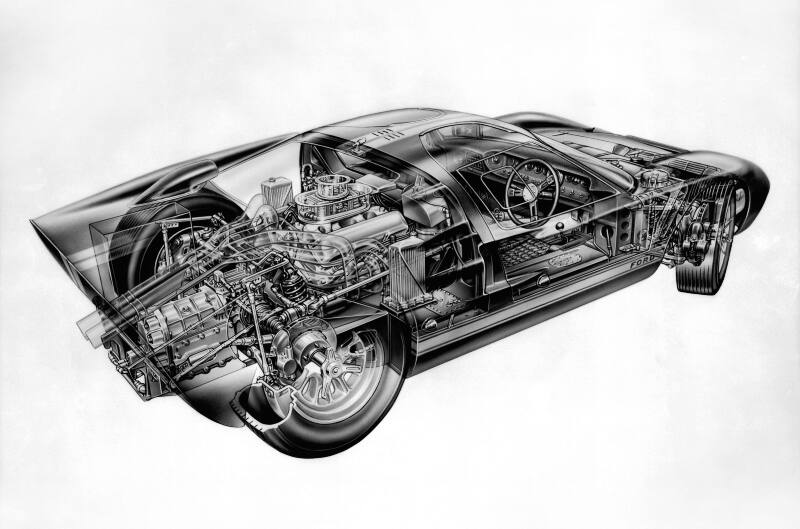
When three Ford GT40s led the overall class race at the 24 Hours of Le Mans and took victories of first, second and third as a team in 1966, they recorded one of the most epic moments in the history of international motorsports.
The destiny for that remarkable Le Mans victory for Ford Motor Company traces back to the risk-taking, mechanical ingenuity and endless curiosity from a cadre of teenage hot rodders who tinkered with V8 engines in Los Angeles during the 1930s.
Certainly the advanced engineering of the big-block Mark II 427 Ford engines in the winning GT40s was vastly beyond the visions of the teenage pioneers of horsepower experimenting with Flathead engines in their home garages. Yet few would question the relationship between the reliability of the lower-end crankshaft and connecting-rod integrity, to the flow and control of the gas charge through the intake, combustion chamber and exhaust pathways in those engines as being a reflection of the “tribal knowledge” derived from those L.A. hot rodders.
The eventual partnerships between the early dry-lake racers of Southern California and Detroit engineers collaborating on the mixing and matching of tricks and techniques to prevent detonation from shattering pistons past 4,000 rpm and escort crankshafts past 6,000 rpm, contributed to the eventual refinements of 1960s V8s. Of course, on that special day at Le Mans, all eyes were rightfully on the drama of that mid-1960s freeze frame.
STREET RACE OF THE TITANS
At the headline level for global news, the family-led Ford Motor Company in the USA demonstrated unquestionable dominance over the traditionally favored family-owned Ferraris of Italy. It was the automotive equivalent of Hollywood’s “Rocky” movie with the best of raw determination and unlimited preparation to win -- backed by pure passion. For motorsports history buffs, the Ford win at Le Mans may bring back an easy memory of Henry Ford II’s reported anger about Enzo Ferrari’s reneging on the terms of a purchase offer in an earlier proposal from Ford to acquire Ferrari.
The Le Mans event might as well have been a showdown where Enzo Ferrari had flexed his autonomy to Henry Ford in a proposed business deal, and they ended up settling their differences in a street race. It could have as easily been compared to the idea of the two of them wrestling their machines next to each other on the famed Mulsanne Straight for that 24-hours, yet with the multi-million-dollar investments each of them made, they looked to the best race teams they could assemble. Egos were primary and money was secondary.
Who says engines can’t have egos and quirky personalities, too? When an engine gives up the crankshaft or throws a rod, doesn’t it usually occur in an argument with asphalt or some other surface at the other end of the driveline? In motorsports, even as the ‘matador’ in the racing arena includes a brilliant driver, chassis dynamics and aerodynamics, there is an inevitable margin where art and science merge with the unique temperament of an engineer’s powerplant.
Through the inner circles of car culture and winding tighter inside the world of a network of earlier leaders of industry, I was fortunate to have met Howard Freers, retired chief car engineer for Ford Motor Company through the Muscle-Car era of the 1960s and 1970s. Reading about those formidable 427-inch Ford V8s prompted me to wonder what an accomplished engineer like him might have to say about such engines.
Freers’ response to my inquiry was, “I’ll do you one better. How would you like to speak with the actual Ford engineer who led the development of the 1966 Le Mans engines?” I can tell you I didn’t have to think long to answer that question.
BRING AN ENGINEER TO MATCH THIS ENGINE
Within just another 24 hours, now half a century later, Freers arranged an introduction between me and one of Detroit’s most celebrated yet obscure engineers -- and certainly one of Ford Motor Company’s finest. When I first spoke with 88-year-old Joe Macura, I was as curious to ask about “how” he became such a uniquely qualified engineer as I was to ask “what” it was like to be right there when three GT40s (fitted with his 7.0-liter V8s) won Le Mans. Even as our conversation took us back more than 50 years, Macura welcomed my questions and readily took me back to his remarkable “future.”

Joe MacuraHaving been recruited to work for Ford Motor Company in 1956 after serving nine years at General Motors, Macura was already an accomplished mechanical engineer. He had paid his dues at G.M., and honored his engineering mentors who took him forward beyond his obtaining a B.S. in engineering from General Motors Institute. Macura valued his engineering role at G.M., yet saw where the offer he received from Ford would expand his range of experiences to work closer to his career specialties. One of his favorite skills was mechanical engineering analysis and in his transition to Ford, he was destined to shine quickly.
“Within ten days of being hired by Ford, I identified a design weakness for pushrod failures in the FE Ford engine,” Macura said with enthusiasm. “Engineers had been experiencing pushrod wear that resulted in excessive clearances from the tappets. Even with improvements in the metallurgy and durability of the pushrods, they’d dislodge and fail too frequently,” he said. “When I looked at simply starting over with the pushrod design,
it occurred to me that the best pushrod-end material would have to be as tough as a ball bearing -- which is exactly what I decided to use in an experiment I did that led to the solution and a new patented pushrod for Ford Motor Company.”