The term “live axle,” as explained by Steve Chrisman from
Chrisman Driveline Components, is a misnomer. “I define what many call a live axle as rather a solid, one-piece axle shaft,” Chrisman says. “The NHRA description of a ‘live axle’ was actually derived by them back in the 1960s. It has stuck to this day. If you look in a dictionary, a live axle is spelled out as ‘any mechanical differential design that powers a vehicle.’ ”
So, NHRA once asked me what I would call a rearend with a solid, one-piece 3-inch axle shaft in it if not a live axle? I answered, simply a rearend with a solid, one-piece 3-inch axle (chuckles.) – Steve Chrisman
The engineering challenge requires a larger and stronger overall housing to contain these beefier components. The assembly must also be mated to the existing 4-link suspension mounts and suspension geometry created by today’s chassis gurus.
Steven Ham, racer and owner of
TSP Racing, has supplied a new differential design that has become quite popular with the Supercharged and torque converter racers in his Australian homeland. His design is now being introduced in the US through
Jerry Bickel Race Cars and
G-Force Race Cars.
“We’re running screw blown 2700-pound cars with lockup torque converters down here in our Australian Top Doorslammer class,” says Ham. “The blower/torque converter combination is extremely hard on a smaller Ford-style third-member. They were only lasting one- to two-passes. We knew we had to do something because we couldn’t properly tune the car because you spent more time underneath working on the rearends.”
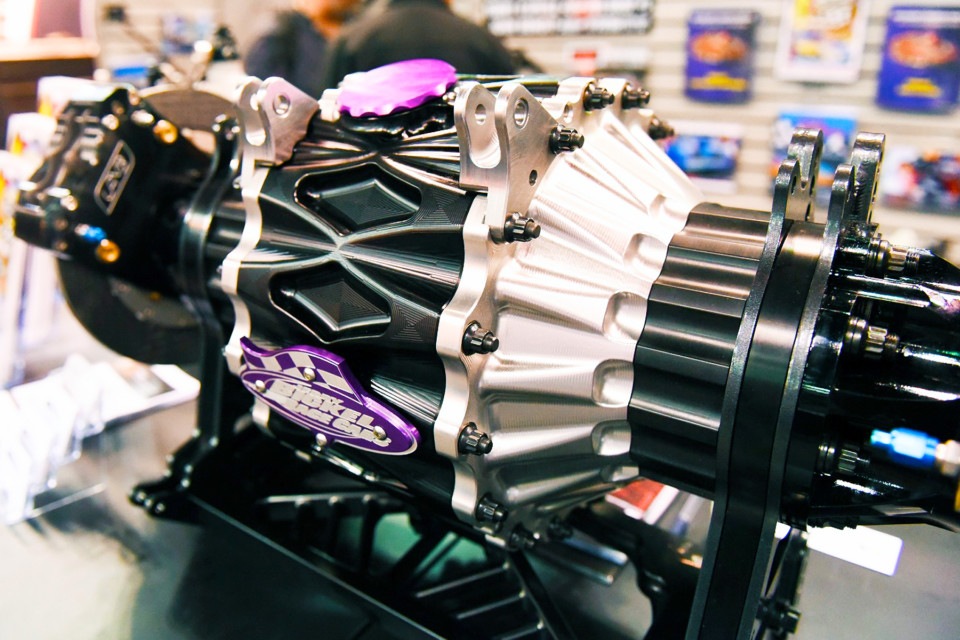
One of the new differential designs grabbing a lot of attention at the 2019 Performance Racing Industry show was the TSP Racing rearend on display at the Jerry Bickel Race Cars booths. It features another modular design rearend to house the larger ring and pinions.
“Our overall differential is a direct bolt-in for many different professional-built cars such as an
RJ Race Cars chassis,” explains Justin Carmack, whose
Carmack Engineering has been a leader in large doorslammer housings. “We have 4-link brackets ranging from 16- to 18-inches in center-to-center width for popular chassis, so this housing bolts right in.”
“Because of its physical size and structural design, the Mark Williams 11-inch ring and pinion is heavier than a traditional Pro Mod Ford unit we are replacing,” Carmack says. “Our goal was a strong but lighter overall differential that factored out the heavier weight of the drive components.”
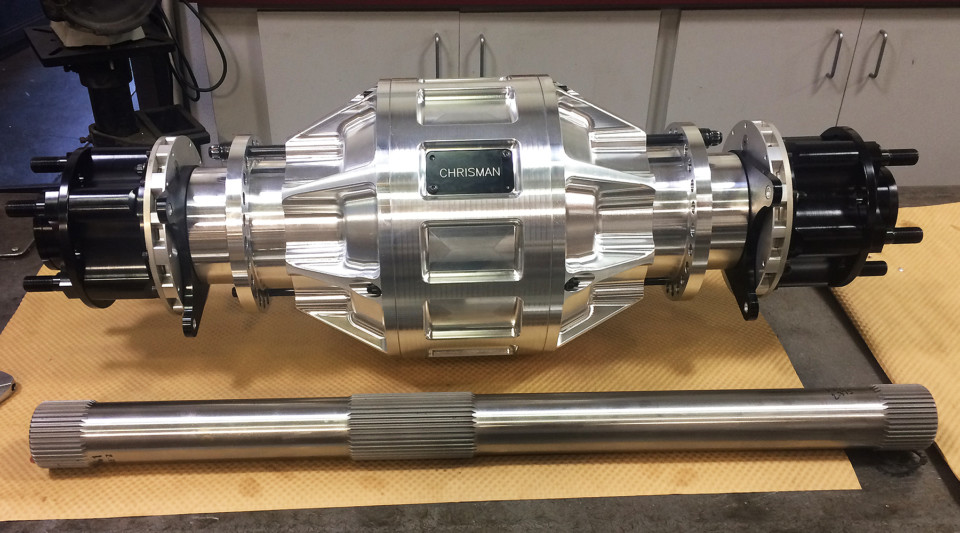
The Chrisman housing design has been proven in nitromethane and supercharged alcohol competition for years. Its new housing variation utilizes those same components for the growing load parameters that doorslammers are now facing.
When Ham designed the TSP Racing rearend, he wanted racers to be able to use a variety of components they already had. “We began with a design using the 10.5-inch Chrisman gear sets and then adapted modular sections so you could continue to use Strange Engineering or Mark Williams components. A racer can even adapt their existing brake/floater components to save the money.”
All these craftsmen note that since the pinion gear location is different in relation to the axle centerline, the mounting brackets factor that difference as not to change driveshaft-linkage-axle geometry when it comes to the bolt-in design efforts.
Carmack said those weight savings are the reason his differential design utilizes two separate floater-style axles compared to a one-piece, through-axle design. “We think this design will still handle up to 5,200-horsepower without issue.”
The advent of computer-aided design and machining processes are the underlying technologies that make rapid development of many new components in all of motorsports.