7. Track Day Caveat
Pro-Touring events are very popular, but not all street cars are set up for the abuse from lots of autocross or road course laps. If your plans include a track day, it is imperative to add an oil temperature gauge, especially if your vehicle is not equipped with an oil cooler. This is especially important if you anticipate running more than five or six continuous laps on a road course.
The combination of an oil cooler and synthetic oil will offer great insurance. Synthetics are capable of withstanding extreme oil temperatures, and without an oil cooler, it’s possible to see 275 degrees or higher oil temperatures. The same is true with running near-continuous autocross laps of more than five or six laps at a session.
Conventional oil begins to break down at around 250-degrees Fahrenheit. Synthetic blends improve that temperature threshold slightly, while full-synthetics are capable of handling 300 degrees or more. An oil temperature higher than 275 to 300 degrees, using conventional oil, is cause for serious concern.
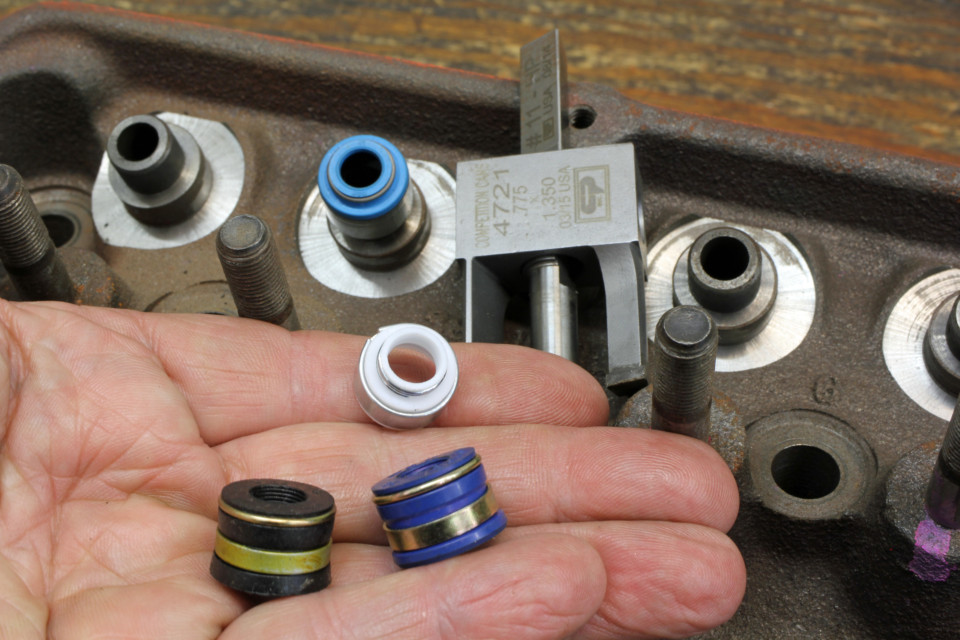
8. Guide It, Seal It
We still see those hard, white plastic valve-guide seals used on street engines. These were the original PC, or hard-mounted, valve-guide seals developed for applications where clearance was reduced due to dual valvesprings, especially on engines like the small-block Chevy. Unfortunately, these hard plastic seals can quickly wear and do not respond well to situations with increased valve guide wear on street engines. The advanced seal wear allows oil to leak past the seal, which ends up in the combustion chamber.
Today, the market is packed with many high-quality Viton rubber seals, which do a much better job, and can fit inside a 1.445-inch dual valvespring for a small-block Chevy just fine. Do a little research and you can likely find a quality Viton rubber seal that will be far superior to those original hard plastic PC seals. You can even buy inexpensive tools that will allow you to modify stock heads to mount these seals and do it yourself.