In addition to having a shorter stroke length and the associated theoretical higher RPM limit, the larger bore allows for larger valves to fit in the cylinder head, which in turn increased the engines maximum airflow potential.
Creating Efficiency
Sometimes, all-out horsepower isn’t the goal, and the goal is to have an efficient all-around performing engine, for say a street car. According to the general logic of mechanical engineering, the longer stroke provides that efficiency over a bigger bore.
“One of the reasons I’ve often heard for why long stroke engines are more efficient, is that the amount of surface area they have, relative to the volume inside of the cylinder I low, meaning there is less overall area to reject heat to, during combustion. That means more of that heat is turned into useful work pushing the piston down,” says Fenske.
“Calculating the surface area for our examples is easy enough, and we find that the oversquare engine has a surface area of 386 sq-cm, the square engine has a surface area of 349 sq-cm, and the long-stroke has a surface area of 378 sq-cm. So we see that as you move either direction away from a square engine design, you start to get more surface area.”
Those numbers may seem to not support the idea that the longer stroke is more efficient. However, Fenske points out the flaw in using the total swept area of the cylinder. “You have to factor in compression ratio and what the cylinder looks like at the time of combustion,” he explains.
“The undersquare cylinder is actually the closest to square (at the time of combustion) in this example. Running the numbers at the point of combustion, you see that the long-stroke cylinder has the least amount of surface area, and is now turning the most heat from combustion into usable work.”
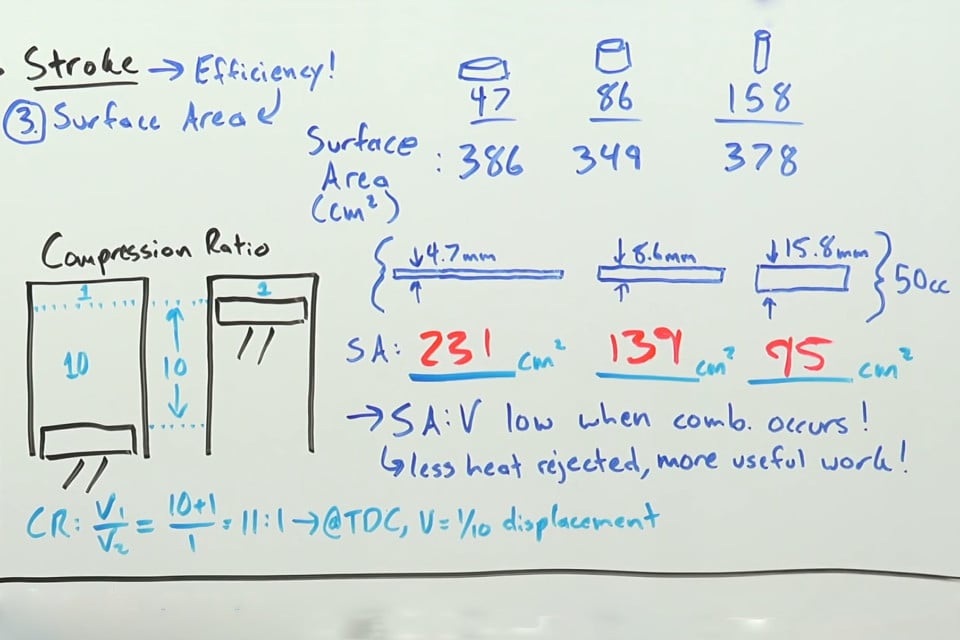
The numbers in the upper right (386, 349, and 37

show that total surface area increases the further you get from a “square” configuration. However, factoring in the shape of the cylinder when combustion occurs, (mid-lower right) shows that the long-stroke cylinder is actually the closest to square at the point of combustion, making it the more efficient design.
Tied into that is also burn duration, which, we’ll warn you, gets complex. “The logic here is that the quicker you can burn the air-fuel mixture, the more efficient of an engine you’ll have. The simple answer here as to why a small-bore, long-stroke engine burns the charge faster, is that the flame front has less distance to travel,” says Fenske.
“By the time the flame front has reached the cylinder wall of the oversquare engine, the piston has moved further down the bore that in the smaller-bore cylinder, and you get less efficient combustion.”
If you really want to dive into some of the heavy lifting on the burn-duration subject, jump to the 11:34 mark in the video, where Fenske talks about a study he found and explains the results they published. It’s interesting, for sure.
While these examples are more illustrative than practical, they do get the differences in bore and stroke across in broad strokes. Fenske does end the video with a disclaimer, saying, “There are of course exceptions to everything we’ve discussed. Just because an engine has a large bore, doesn’t mean that it can’t be efficient. Just because an engine has a long stroke doesn’t mean it can’t make a ton of horsepower. But if you isolate those variables individually, this is what you’ll see.”
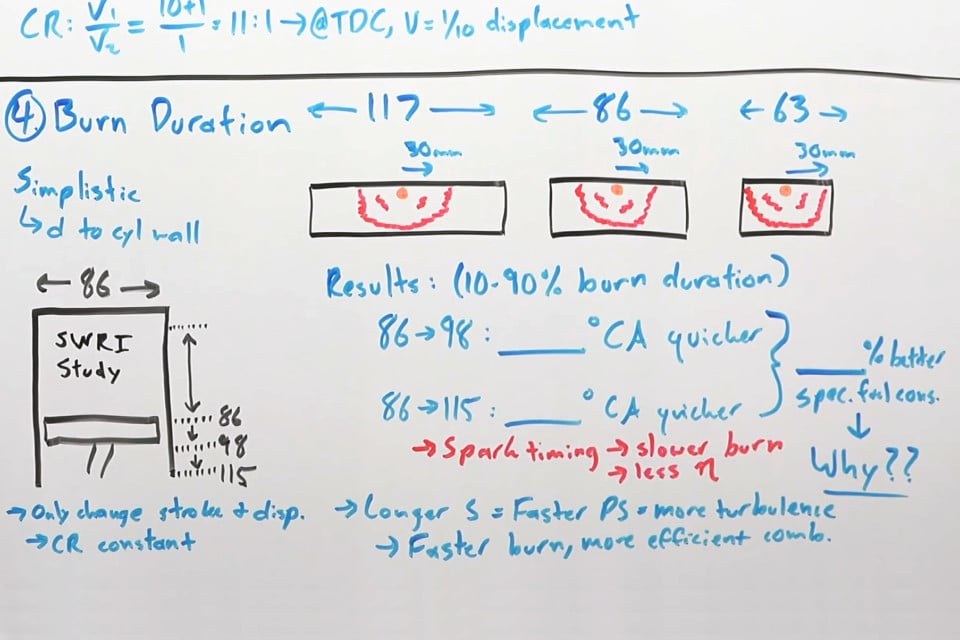
The simple explanation of burn duration in the upper right corner shows that the flame front simply has less distance to travel for a complete burn. The illustration in the lower-left corner relates to the study Fenske came across from the Southwest Research Institute and is pretty interesting, if not deeper in the scientific weeds than we can get into here.
Article Sources
Engineering Explained
https://www.youtube.com/channel/UClq...vWL9w3R48t9QXQ