1k shares
4-Liter, 4-Cylinder Built For World Domination — Meet Thor
By
Joseph Hanna January 07, 2020Engine development isn’t rocket science, but a background in theoretical physics doesn’t hurt. In 2015, Rod Pobestekof
PR Technology came to Oskar Elmgren of
Elmer Racing with a need. Pobestek was in need of an extremely lightweight, rigid, high-capacity Porsche engine. To maintain compliance with
WTAC (World Time Attack Challenge) regulations, it had to retain Porsche’s M44 water-cooled inline-four-cylinder architecture — meaning the engine’s bore-spacing and main housing bore still had to mimic the original 3.0-liter mill.
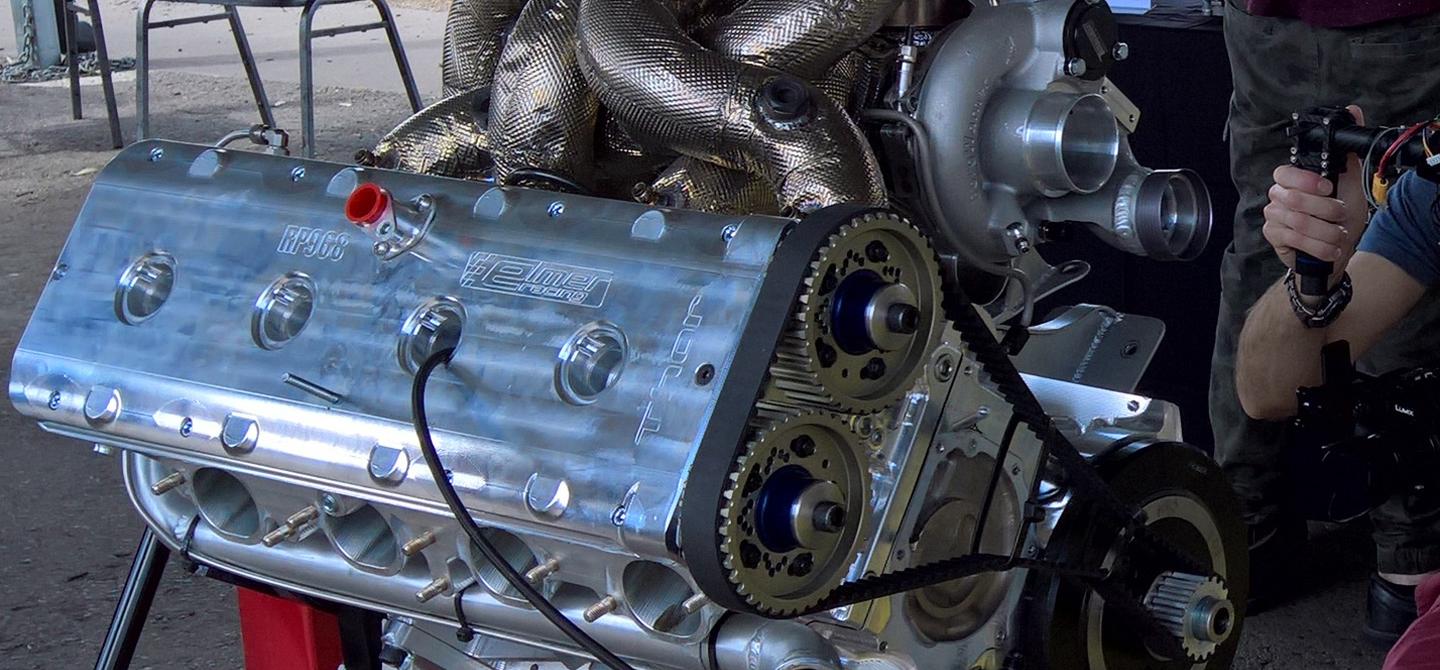
The result of Elmgren’s efforts is a 4.0-liter engine
weighing just 233 pounds in long-block dress, capable of 3,000 horsepower configured as a drag-racing engine, or a 1,500-horsepower-capable circuit-racing engine. This lightweight beast would be essential to carrying corner speed in Pobestek’s brainchild — the production Porsche 968-based
RP968.
Elmer Racing got its start in a very organic way. Elmgren grew up racing karts with his family in California. Speed was a family affair, and after moving back to Finland, he became enamored with not only speed but the “why” and “how” of going fast. A university education in theoretical physics augmented his need for speed and growing mechanical know-how.
The Elmgren family was racing Rover Minis, and as engineers do, Oskar was searching for advantages. One such advantage was a custom piston for the small British A-Series powerplant. Oskar realized that “no one was interested in small-quantity, one-off work like this.” This is where Elmer Racing got its start Before long it was
CNC-prototyping a bespoke, billet-aluminum, eight-port cylinder head for the Mini 998cc A-Series engines.
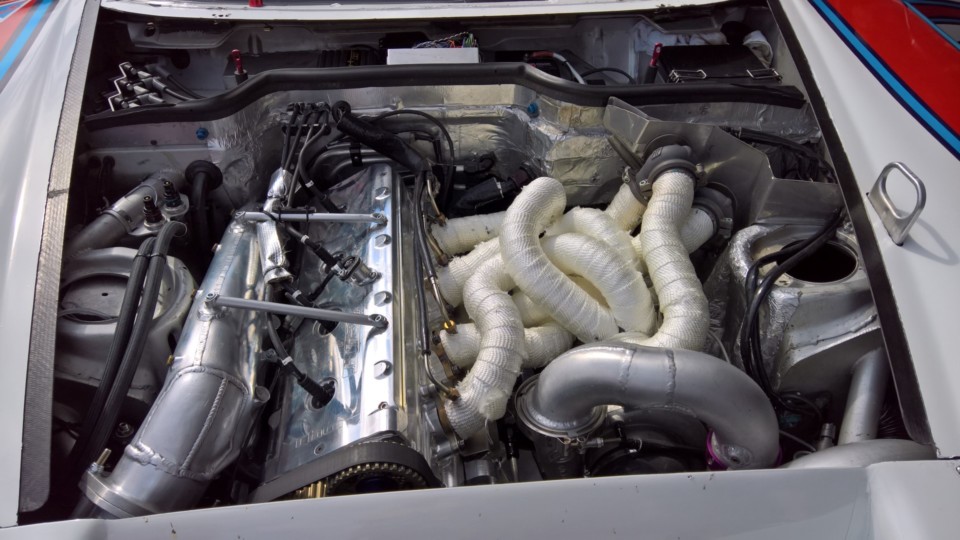
Like Thor, the 968’s original mill is slanted at a 45-degree angle. However, the intake and exhaust manifolds are reversed from factory in Thor’s configuration, thanks to the symmetrical cylinder head and engine-block design.
Packaging Constraints
Design symmetry of the engine block likely wasn’t just a happy accident on Porsche’s behalf. However, it did work to the benefit of Pobestek and Elmgren. In the case of the 16-valve 968 engine, the head is reversible on the block. Heat management is essential in racing, and even more consequential on turbocharged applications.
Pobestek’s team at
PR Technology managed to reverse the intake and exhaust positions on the OE mill. This was the basis for creating a turbo system that allows room for exhaust plumbing to safely expel gasses while shedding unwanted heat opposite a right-hand-drive cockpit.
Elmer Racing tuned this layout to optimize the cooling system to function in this orientation without hot spots or steam pockets. Computational fluid dynamics modeling and simulation made many of these changes clear in a manner of what Oskar called “just putting in the time to do it.”
No Replacement for Displacement
As Porsche was building what it thought would be the successor to the 911, it manufactured a block with an increased 4.800-inch bore-spacing. Actually, it made a couple of blocks with a 4.800-inch bore-spacing — the M28 V8 and M44 inline-four. This modular design strategy allowed Porsche engineers to use a mass-production, parts-bin strategy where smaller parts could be interchanged, as in many areas, the M44 was literally half of the M28.
The crew at Elmer Racing were able to put another 10mm into the bore diameter without a hefty cooling penalty on this billet beast. The
four-cylinder was now rocking a bore size much like a 572 Big Block Chevrolet at 116mm (4.567 inches). This increase created room for considerably larger valves and added a turbo-spooling 700cc to the engine’s displacement.
The extra capacity keeps the calibrator from having to run head gasket-eating, aggressive anti-lag, or unwieldy and unforgiving
nitrous-oxide to light off a large turbine. Additionally, big cubic inches keep throttle response much sharper below 5,500 rpm.
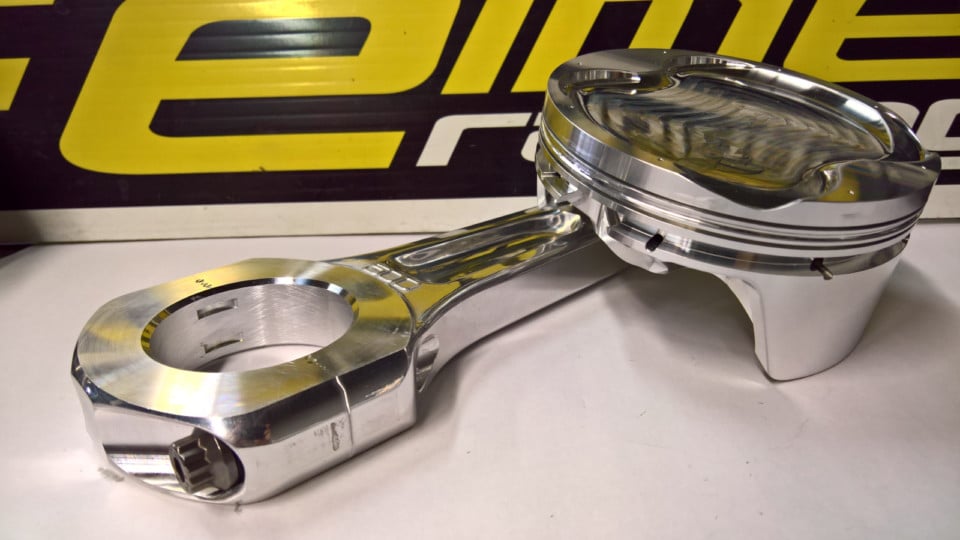
Vertical gas ports and aluminum connecting rods are not an unusual sight in a drag engine, but they feel slightly alien in a circuit application.
The compression ratio is kept in check at a very conservative 9.0:1 ratio. Rod length wasn’t disclosed, but Elmgren asserts, “It’s always best to run the
longest connecting rod that will fit. But, it’s not important enough to change engine capacity or deck height to accommodate a longer rod.”
We do know they’re
Bill Miller Engineering 500-series
aluminum rods, run at what Elmgren called “very conventional
vertical oil clearances due to cold start constraints.” He adds, “The compression rigidity is the same as, or slightly more than, a steel rod due to the rod’s cross-sectional area.”
Crankshaft weight was kept in check with a billet unit, again from Elmer Racing. Modern design techniques using finite element analysis, and the “blank canvas” afforded from billet construction allows for weight savings through the use of narrow, profiled counterweights and piston-guided rods on a thrustless crankpin.
The oil pan is integrated into a girdled bedplate for torsional rigidity and harmonics while being easily serviceable. The bedplate features slightly larger fasteners (and more of them) to tie the main housing bore into the crankcase skirting, as well as evacuation ports for the modular dry-sump and evacuation pump. The engine is attached to the RP968’s chassis at both the front and back of the engine, causing it to be a stressed member.
Crankshaft and rod bearings can be inspected in-situ without the fluid mess associated with an engine-out service. The team believes this feature can make a difference at this level of racing. Cylinder bores or rod bearings can be inspected in 10 to 15 minutes versus 10-or-so hours in a GTR’s VR38DETT. If required, the cylinder head can be removed and the engine can receive an in-frame overhaul in the pits — not unlike a long-haul truck.