Common units are selected for each parameter.
- CASS would be in MPH.
- Engine air demand is usually in CFM.
- The air scoop area is most often in square inches.
The equation can be adjusted for these units.

This equation includes some simplified factors to get the 1.64 constant. The conversions to get CFM and square inches to produce an answer in miles per hour simplify to a constant of 1.64. If you started with different units for any of the variables, the constant would change.
As an example, we’ll assume a carbureted mountain motor of 700-plus cubic inches. Note the following:
- Engine air demand of 1,600 cfm at 8,000 rpm
- Air scoop frontal area = 55 square inches

Rounding up to 48 miles per hour as the Critical Air Scoop Speed — below 48 mph, there will be a small vacuum in the air scoop. That vacuum will increase the float level in a carburetor, which may cause the engine to run richer.
At 48 mph, the pressure inside the scoop is equal to atmospheric pressure. Fuel delivery is correct for the atmospheric air pressure.
Above 48 mph, there is positive pressure in the air scoop, and the pressure increases with vehicle speed. The pressure may reduce float levels in the carburetor, which in turn, may make the engine lean out.
To a certain extent, the carburetor venturi will compensate for increasing amounts of air going through the air scoop from increasing speeds. However, an adjustment may be necessary with higher air scoop pressures, if the demands are beyond the compensation range of the carburetor.
RPM Effects on the Critical Speed
After the transmission shifts and the engine drops to a lower RPM, the airflow demand of the engine is lowered. That lowers the CASS, which may affect the tuning in and of itself. It’s something to be considered when changing transmission shift points as that change in RPM can cause a domino-effect of changes that could leave you chasing your tail.
Similarly, a change in the differential gear ratio or tire size can all cause changes to the CASS. Raising the engine-RPM at a given wheel-speed with a higher numerical gear ratio or a smaller drive tire will increase the CASS. Conversely, a lower numerical gear ratio or a larger drive tire lowers the CASS. Again, the change in the CASS may affect the tuning all by itself. Without this awareness, the effect may be overlooked, and the required tuning may be ignored.
In a race boat, a propeller pitch or diameter change would affect the RPM, the CFM value, and the CASS. Raising the engine-RPM with a lower pitch or smaller diameter propeller raises the CASS while lowering the engine-RPM with a higher pitch or larger diameter propeller lowers the CASS. For the boat racing scientists, changing the propeller cupping usually would change the RPM, CFM, and CASS as well.
For racing boats with narrow power bands that need to slip the propeller to get up on plane, high-RPM slip would most likely be at sub-critical speed. CASS would not be reached until a level of speed where the propeller hooks up in the water.
Timer controlled fuel enrichment often used on drag boats may miss the transition if the point of hook-up is a variable. Fresh water is different than salt water and affects the point of hook-up as well as the planing speed. The CASS is an added awareness of numerical control tuning.
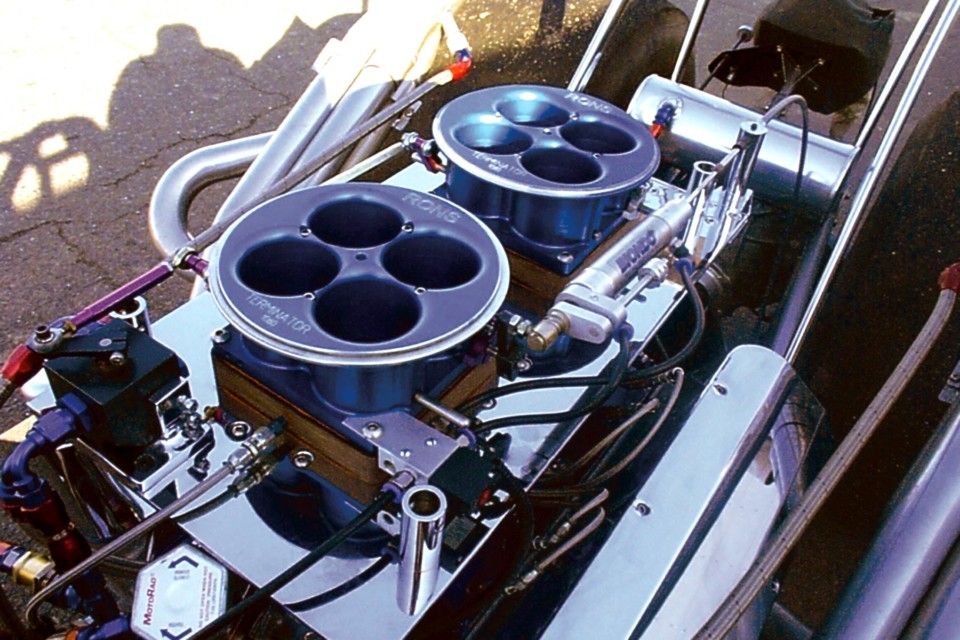
Although the air scoop is removed, RONS Dual Terminator Mechanical Fuel Injection throttle bodies are supercharged by ram-air at speed and may need more fuel at high speed. For open-loop EFI systems and some carburetor setups, that would be the case as well.
CASS With Mechanical Fuel Injection
For a mechanically injected application, we’ll assume the following for a supercharged Top Alcohol V8 drag race engine:
- Engine air demand = 4,200 cfm (9,000 engine rpm with a 14-71 supercharger, 50-percent overdriven)
- Air scoop area = 65 square inches
