It brought up the occasional debate about whether physical assault that occurs in a sporting event is actionable, whether it is subject to legal judgment. What leaped to mind is the recent NFL fight at the close of the Cleveland Browns-Pittsburgh Steelers game. But we have seen hockey fights and baseball brawls, and NASCAR slugfests. And, of course, long before the Internet and social media, sports fans have witnessed targeted, genuine violence – à la Juan Marichal’s clubbing of Johnny Roseboro’s head with a baseball bat in 1965, Detroit Tiger Dick McAuliffe’s attack on Chicago White Sox pitcher Tommy John in 1968 that separated John’s shoulder, Kermit Washington’s nearly deadly punch that delivered massive head injuries to fellow NBA player Rudy Tomjanovich in 1977, and Oakland Raider Jack Tatum’s paralyzing hit on Darryl Stingley the next year in a meaningless preseason football game.
It’s peculiar that the NHRA showed absolutely no sense of outrage at the Torrence-Ferré encounter. Publicly, it was silent until Monday afternoon, when it issued this tepid statement: “The NHRA is disappointed in the situation that occurred between Steve Torrence and Cameron Ferre after the first round of Top Fuel competition at the Auto Club NHRA Finals. We are evaluating the matter and any potential penalties will be assessed after a thorough review.” Privately Sunday, at the racetrack, an NHRA official visited the Terry Haddock Racing pit of Ferré and, according to credible Dragzine sources, told Haddock and Ferré the sanctioning body had no plans to reprimand Torrence and that Haddock and Ferré were not to discuss the matter with media or the public. It doesn’t sound like the NHRA conducted or completed any “thorough review” before that edict.
But really? The NHRA “is disappointed” with what happened? Well, many of us “are disappointed” that we’re not skinnier, richer, better-looking, and driving a Ferrari around town. So what? But that’s the best the NHRA can do? Honestly?
A certain amount of insults and verbal rivalries spice up the sport. They show emotion, convey excitement and passion for the sport, and, frankly, are entertaining. But hitting somebody ought to be punished in some way.
As marvelous a show as Steve Torrence put on in 2018, as much as he plowed through a second straight championship season even when it didn’t look like he had all the momentum of the year before, as much as he overcame a heart attack and childhood cancer just to be healthy enough to race, as much as his straight talk is refreshing, as likeable and charming as he can be, as much as he loves the sport and works hard to excel at it, and as strong as his values are, Steve Torrence did something wrong and should be subject to some consequence.
Now, what he did was not even close to being on the level of what Marichal, McAuliffe, Washington, and Tatum did to their targets. But something as simple as deep-staging (which Ferré has the right to do, as does any other drag racer) is immaterial. Nothing justifies crossing a line into physical attack. Ferré could have suffered a serious injury. We have no indication he did, but a nose, mouth, or neck injury could have occurred.
It’s debatable what punishment fits the crime: suspension? fine? points deduction? That, too, might be moot, as the NHRA was slow to react at all, not even making a statement at the very least that it doesn’t condone physical altercations.

Cameron Ferre, racing at his home track, found himself on the receiving end of Steve Torrence’s open hand following their first round Top Fuel matchup.
Then again, maybe the NHRA does condone it. We know about several fistfights in the pits involving prominent racers. Maybe the NHRA condones a number of unprofessional behaviors. Evidently the NHRA would rather “suspend indefinitely” three-time Top Fuel champion Larry Dixon for a misunderstanding about a meaningless, expired safety sticker on a dragster on display at a trade show – not at a racetrack – than reprimand a prominent racer, a champion, for striking an opponent with his hand. Dixon is reinstated now, President Glen Cromwell acknowledged, though the organization never has announced that publicly. In 2008, it fined team owner Don Schumacher $100,000 – a record penalty – for allegedly using unapproved fuel. And, like Dixon, Schumacher didn’t hit anybody. But one racer hits another because of starting-line gamesmanship and nothing happens but a rather lame response?
It’s dumbfounding that Sunday, NHRA executive Peterson was quick to confront Hight following his long, smoky, fan-pleasing, final-round burnout that ended up kicking the rods out of the engine that left Hight no choice but to abandon his car mid-track and give Jack Beckman a solo pass to win the race. Peterson questioned Hight’s reason for exiting the disabled car, even before Hight knew what caused his car simply to quit running. But the competition boss didn’t intervene in the Torrence-Ferré scrap.
The NHRA is revenue-driven. Maybe it figured if it can’t get the racers to stop fighting, people are going to keep buying tickets. And maybe it figured Torrence would be mad enough about a punishment and his family would sell its two dragsters and go home to Kilgore, Texas, and not return. And they need the car counts elevated.
Greg Anderson successfully positioned himself 15th in the Pro Stock qualifying order, intentionally creating a date with points leader Erica Enders in the opening stanza. His hopes of assisting teammate Jason Line in winning the championship were dashed by a matter of inches.
A certain amount of insults and verbal rivalries spice up the sport. They show emotion, convey excitement and passion for the sport, and, frankly, are entertaining. But hitting somebody ought to be punished in some way. And after that, everybody ought to be quiet about it and talk about something else. And Steve Torrence should be able to get on with his career after paying the fine or serving the “sentence” or whatever the penalty happens to involve.
If people don’t want to cheer for him anymore, they don’t have to. This is America. This is drag racing. It isn’t the Fellowship of Christian Athletes – besides, Christians aren’t perfect, just forgiven.
NHRA bans aren’t always terribly effective, anyway. Decades ago, Connie Kalitta was “banned for life” from NHRA activities. But here he is, a key player in the sport today and has been for years. Funny Car racer Bob Gilbertson got the same lifetime ban for a non-racing pit incident, but the NHRA overruled its decision. Same for Pro Stock’s Jerry Eckman. All those reinstatements, by the way, were positive moves.
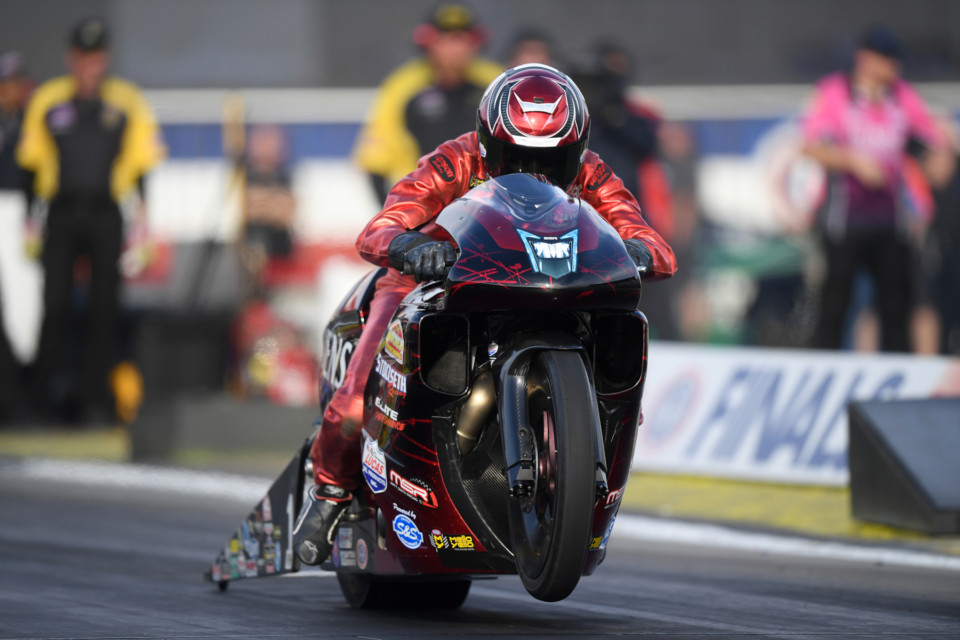
Reigning Pro Stock Motorcycle champion Matt Smith put a $1,000 bounty on points leader Andrew Hines. Jianna Salinas, in shocking fashion, collected the money in round one, but turned down additional money when the two met in the semifinals. Photo courtesy NHRA/National Dragster