All tuning was performed using this Holley HP management system.
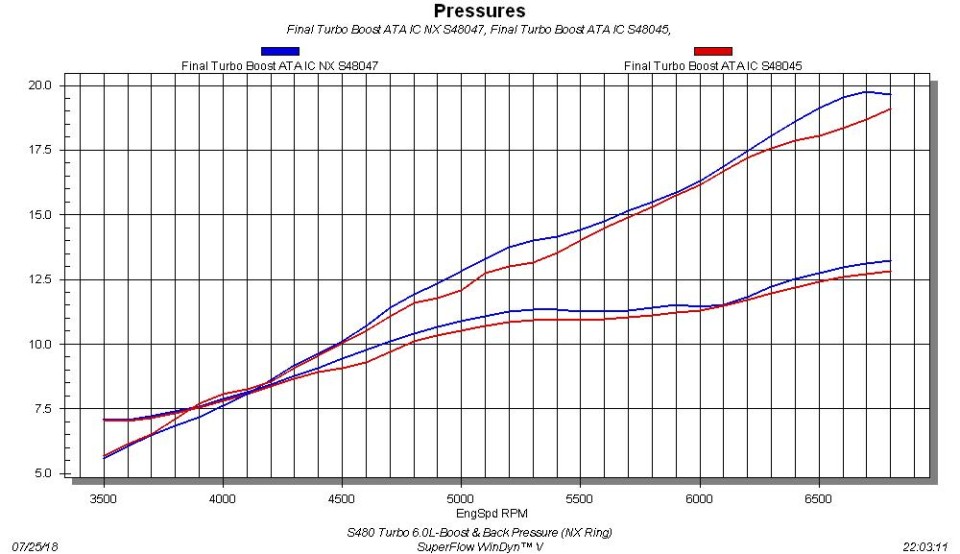
With everything set up, it was time to test. The first order of business was to run the turbo motor in anger with just the air-to-air intercooler, then repeat the process after activating the N-Tercooler. Naturally, the air/fuel ratio and timing remained constant during the testing, while the boost was controlled by a manual wastegate controller from Turbosmart. Run with just the air-to-air cooler, the turbo 6.0 produced 947 horsepower at 6,800 RPM and 797 lb-ft of torque at 5,200 RPM. The peak boost registered was just under 13-pounds, while the peak air temperature in the manifold was 137-degrees. After activating the N-Tercooler, the air temperature dropped to 118-degrees and the power output jumped to 974 horsepower and 820 lb-ft of torque. The N-Tercooler improved the power output through the majority of the curve (see graph), while simultaneously increasing the boost pressure ever so slightly (see boost and back-pressure graph). While we used nitrous oxide in the NX ring of power, it is also possible to run less expensive CO2 with similar cooling properties. Remember, lowering the charge temperatures not only improves power but also reduces the chance of detonation. Cooler is better!
Graph 1: Turbo 6.0L-ATA Intercooled vs NX Cooling Ring (Horsepower and Torque)
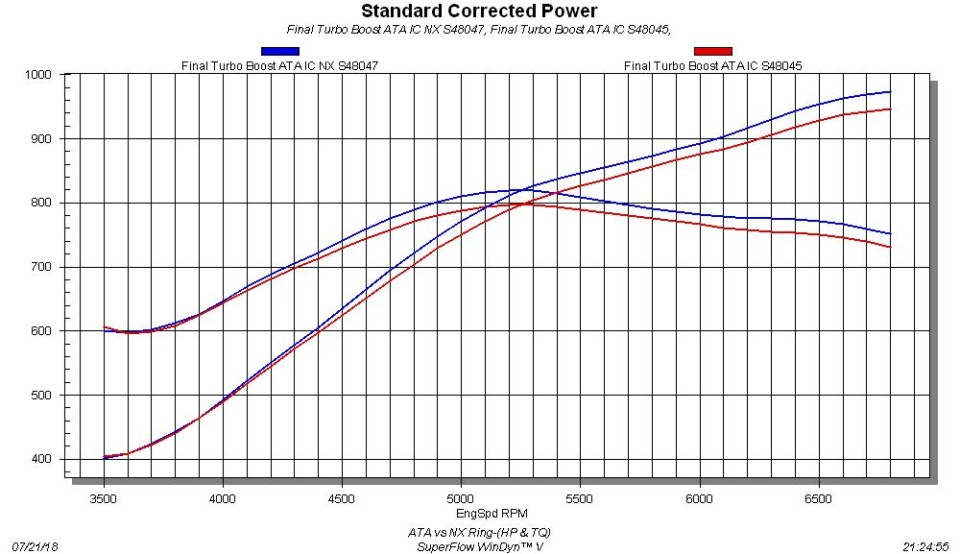
As is evident by the change in power, turbo motors like to chill out. Run with the air-to-air intercooler alone, the turbo 6.0-liter produced 947 horsepower and 797 lb-ft of torque. The combination was perfectly repeatable at this power level. After activation of the NX N-Tercooler, the power output jumped to 974 horsepower and 820 lb-ft of torque. Both combinations produced peak power and peak torque at the same engine speeds. The cooler air charge charge improved the power output through most of the curve.
Graph 2: Turbo 6.0L-ATA Intercooled vs NX Cooling Ring (Boost & Back Pressure)