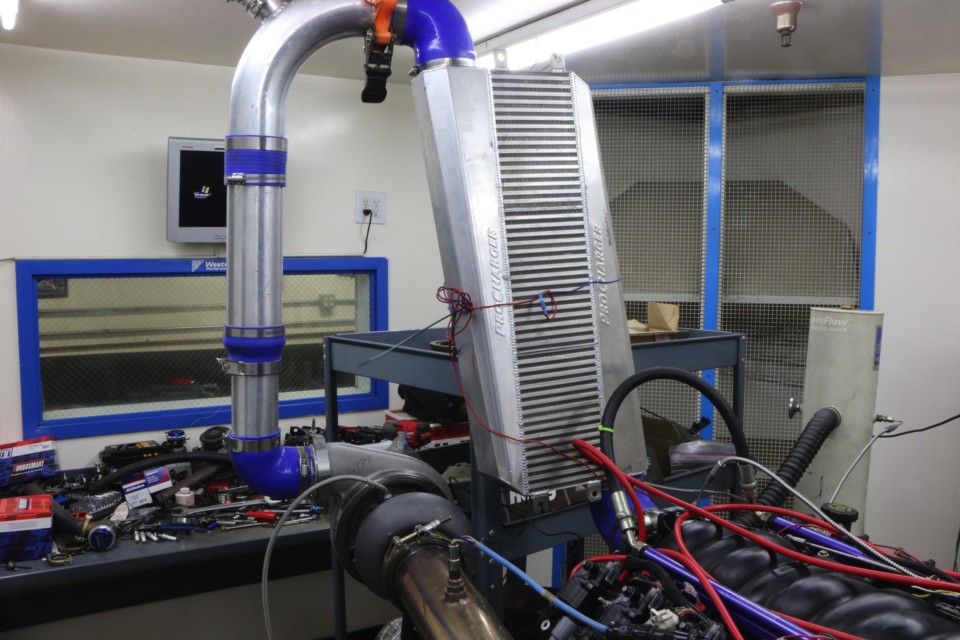
Feeding boost for our test was a billet-wheel, BorgWarner S480 turbo from Little Jon Motorsports (LJMS). The turbo featured an 80mm, billet compressor wheel, standard compressor housing, 92mm turbine wheel, and 1.25 AR T4 turbine housing.
Lest we confuse you, it should be stated that we were not running nitrous oxide through the motor, though that works very well on turbo applications. Instead, we employed nitrous oxide through a cooling ring supplied by
Nitrous Express (NX). The ring was positioned in front of the air-to-air intercooler in such a way that the super-cool (-129-degree Fahrenheit) nitrous oxide was injected across and through the core. The idea was to allow the heated charge air from the turbo to come in contact with the super-cooled intercooler core. The result should be a further drop in temperature and, we hoped, an increase in power. Before we could run the test, we needed a suitable test motor, so we dusted off an old turbo 6.0L. The 2008 high-mileage, LY6 short block featured only one change, extra ring gap using the original rings. This 6.0-liter engine had previously been subjected to 29.2-pounds of boost at 1,543 horsepower and lived to tell the tale, so this turbo testing was no problem. The stock bottom end was augmented with a Stage-3, twin-turbo cam from
Brian Tooley Racing, a set of
Trick Flow TFS Gen X 225 heads and Dorman LS6 intake manifold (complete with inlet air temp sensor). Additional goodies included a set of 120-pound injectors, a
Holley HP engine management system, and
Accufab throttle body.
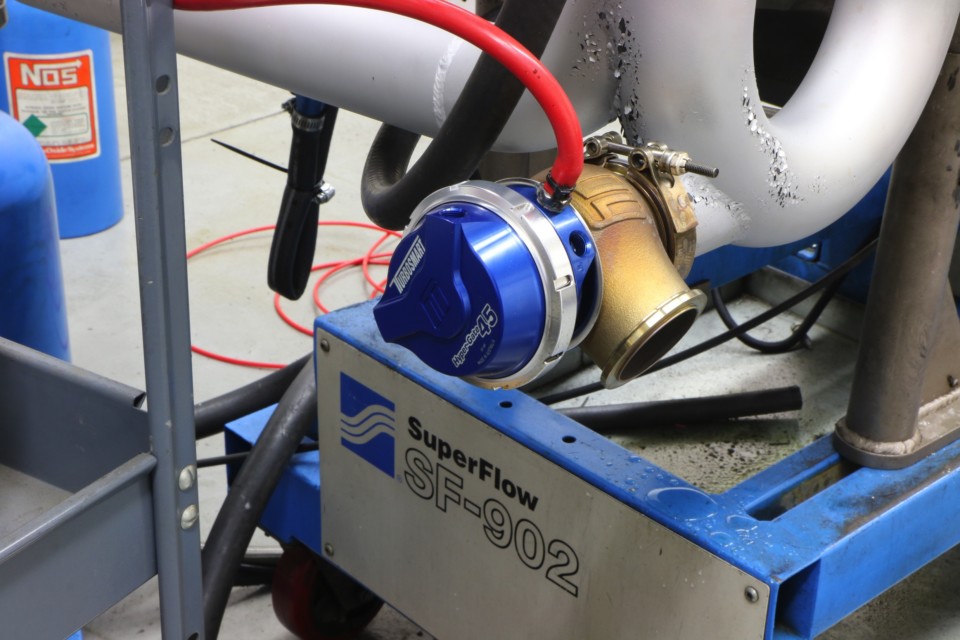
Since boost control was critical, we relied on a pair of Gen-V, Hyper-Gate45 wastegates from Turbosmart. The new design even featured provisions for water cooling.
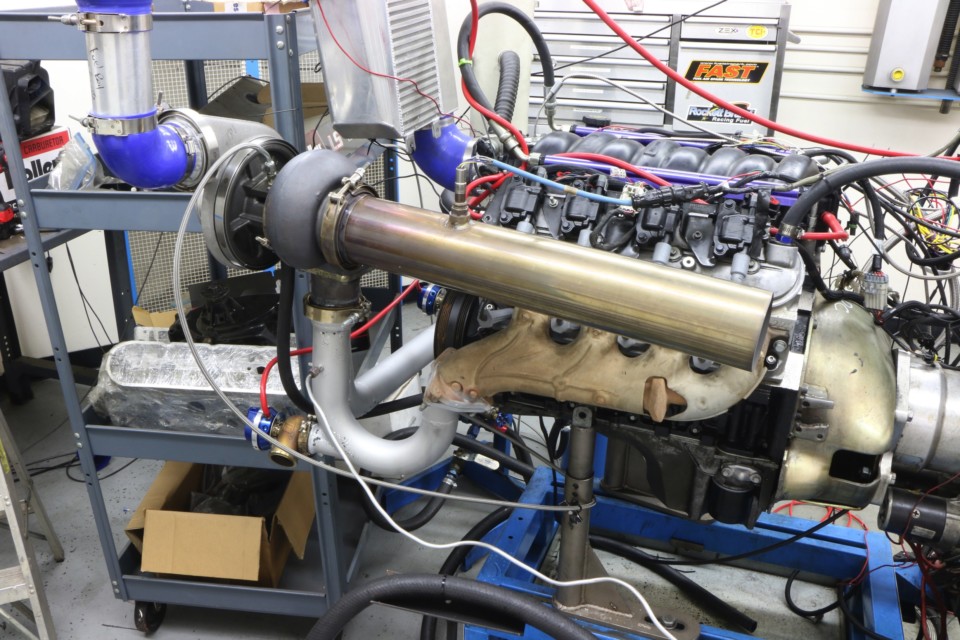
The exit out of the turbo consisted of a free-flowing, 4-inch open exhaust. Note the oxygen sensor used to dial in the A/F curve of each combination.