71 shares
Whittling Away For Performance: Lightweight Rods Do More With Less
By
Jay Sicht September 03, 2019Advanced metallurgy, computerized machining, and computerized quality control give connecting rods that are stronger than ever, allowing consistently reliable power levels previously thought impossible. But that strength comes with a weight penalty, which, for certain applications, can mean a slower-revving engine.
Enter lightweight rods. “Because lightweight rods are a compromise of weight and strength, they’re not the best choice for every application,” says Shane Turner, sales and marketing manager for
Oliver Racing Parts. Oliver is familiar with lightweight rods as it offers Standard Light and Ultra Light rods for small-block Chevy and Ford, Modular Ford, and Sport Compact (Mitsubishi) applications, and Standard Light for LS Chevys.
If you have a lightweight rod and a lightweight piston, the crank can spin that easier. It’s not having to lug that up and down, and the engine is going to accelerate a lot quicker. – Shane Turner, Oliver Racing Parts
Lighter Rods Equal Easier Revs
Applications using power-adders such as turbos, superchargers, or nitrous oxide will call for a beefier rod, such as Oliver’s Speedway series for small-blocks, or Max or Max-Plus for big-blocks. But, naturally-aspirated engines, which have lower cylinder pressure, don’t demand a rod with as much ultimate strength. Since a lighter reciprocating assembly means the engine can gain RPMs faster, many opt to trade a little absolute strength for a lighter component weight in an N/A application.
As an example, for the Gen-1 small-block Chevy, Oliver’s Standard Light Series rods are designed to be used in naturally-aspirated high-horsepower, high-RPM engines, such as in late-model stock cars, 410-cubic-inch sprint cars, and late-model dirt cars. The Ultra Light Series is typically used in moderate-horsepower applications where 8,200 rpm is common. Those typical applications include 360 Sprint cars and pavement Late Models.
“If you have a lightweight rod and a lightweight piston, the crank can spin that easier. It’s not having to lug that up and down, and the engine is going to accelerate a lot quicker,” explains Turner.
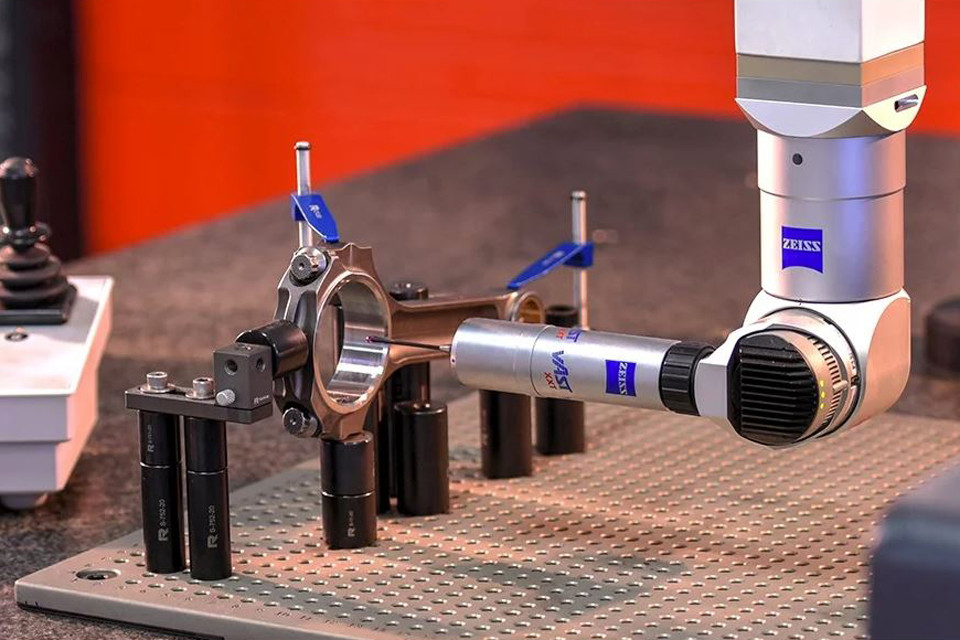
Manufacturing rods is a high-tolerance game. Oliver uses an incredibly precise Zeiss coordinate measuring machine to ensure all of their rods’ dimensions match the design print. This is only one step of the Oliver QC process.
Three Weights, One Forging
Whether it’s an Ultra Light, Standard Light, or Speedway Series rod, each one (within its family, such as a small-block Chevy) starts as the same U.S.-made forged blank, made of 4340 AQ (aircraft quality) steel that meets AMS2301 specs. The rod is heat-treated twice during its multiple machining processes at Oliver’s Charlevoix, Michigan, headquarters. They are stress-relieved after rough-machining, and quenched and tempered for a martensitic grain structure for optimized durability and strength.
It’s the final CNC-machining processes that determine the rod’s weight, with the difference being roughly 50 grams between each small-block Chevy series: the Ultra Light (610 grams for a 6.0-inch-long rod), Standard Light (665 grams for a 6.0-inch-long rod), and Speedway (705 grams for a 6.0-inch-long rod).
Lightweight is a relative concept, and OEM rod weights can vary application-to-application. So, sometimes a Standard Light or even an Ultra Light series rod can tip the scales a little heavier than a factory rod, but with much greater strength.
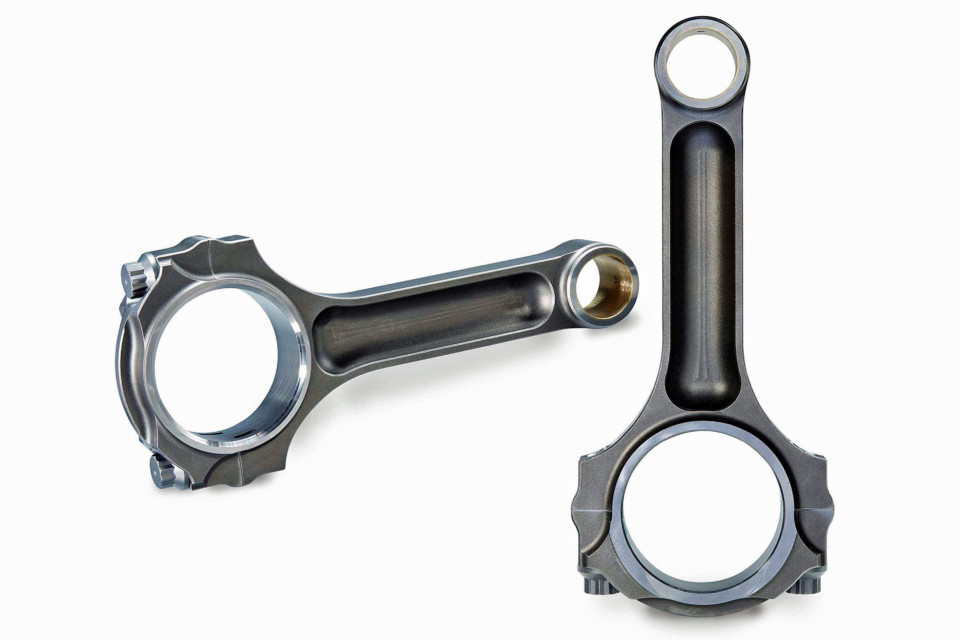
Surprisingly, all of Oliver’s rods — from standard-weight all the way to the Ultra-Light line (pictured here) — start life as the same forging. Weight reduction is all accomplished via ultra-precise machining after forging.
The Next Level of Lightweight
As he’s called upon customers, Turner has found some builders even take weight-saving measures to the next level, shaving off even more material. “Rod-to-stroke ratio is just one of many considerations engine builders take when deciding to remove weight,” Turner notes. However, he cautions that applications with poor rod-to-stroke ratios suffer from additional stress, both on the rod and the major thrust side of the piston. Those applications would not be a good candidate for such creative carving.