With the first runs out of the way and changes made via remote tuning, it was time to swap to the 2.75-inch pulley from the 3.25-inch pulley and see what kind of numbers the additional boost would post. After the first pull on the smaller pulley, it was apparent that the fuel system was good to go, as the boost peaked at 19.5 psi.
There were two more pulls made, with Lund making minor tweaks between each. The final numbers posted were 875 horsepower and 702 lb-ft of torque at the rear wheels and 19.5 psi peak boost. Not the ultimate goal, to be sure, but we reached the limit of the stock diameter crank pulley and 2.75-inch blower pulley.
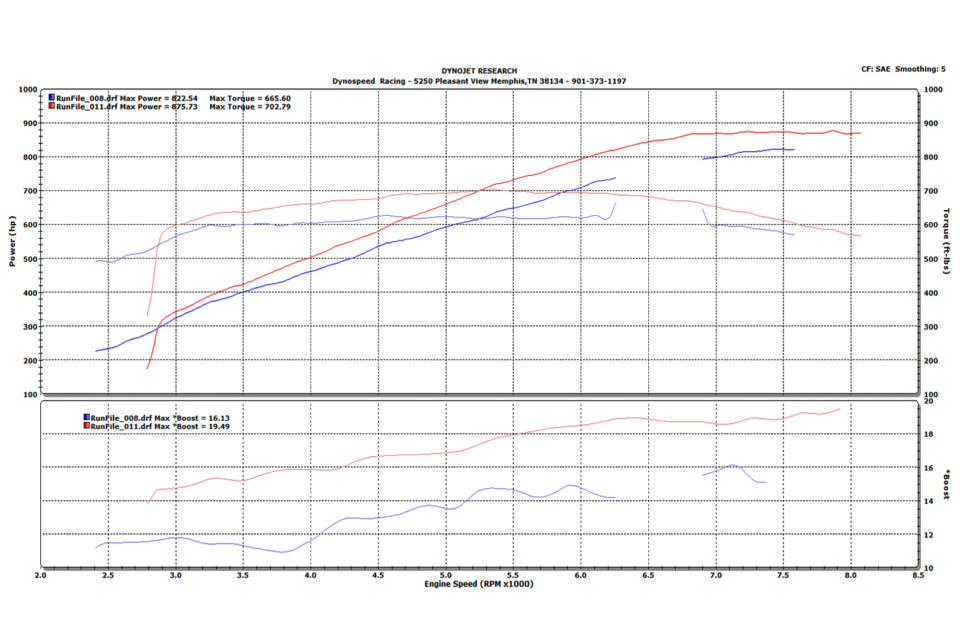
As you can see, with the new fuel pump, we had room to move to the smallest upper pulley recommended for this application, giving us 19.5 psi of boost. We were also able to pull all the way to 8,200 rpm this session. Now, we have a choice — switch to a bigger crank pulley or switch to a bigger blower.
“The 875 number had optimal ignition timing, based on my experience. Beyond 20 degrees of timing on these engines, you typically begin to see diminishing returns per degree of timing added,” explains Lund. “Typically, I don’t like to push beyond that 21- to 22-degree area because I don’t think another two degrees is worth it for maybe 15 rwhp in sustained use. I’d rather add boost instead of timing once we’re at this point because the HP gain per psi of boost is pretty consistent.”
With that said, the only way to get more boost at this point is to overdrive the crank pulley, which Ivan is hesitant to do. “Every one pound of boost on a supercharged setup usually sees a 25 rwhp gain on average,” says Lund. “So, if we did a 20-percent overdrive lower pulley and saw another 4-5 psi, we stand to see another 100-125 rwhp with other changes.”
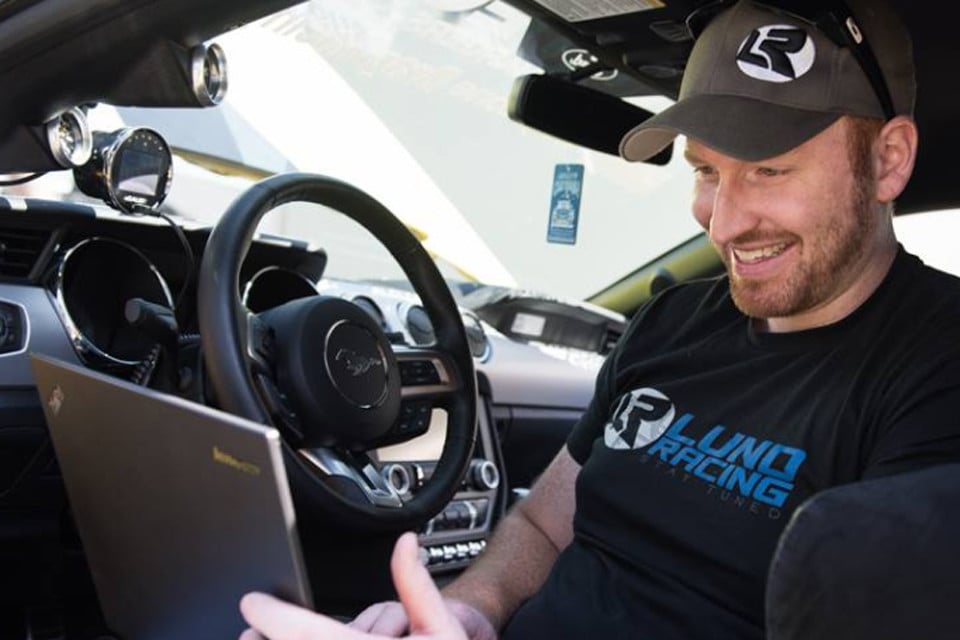
Since Lund Racing and Jon Lund, Jr. (pictured here) are extremely adept at remote tuning, all we had to do was make a pull on Dynospeed Racing’s Dynojet chassis dyno, send Lund the tune, and the revision was sent back. Then the process was repeated.
While that would put us at the 1,000 rear-wheel horsepower goal, there is another option. Remember when we mentioned something about testing with Whipple earlier in the article? They offer an upgrade to this supercharger kit using the Gen-5 blower and intercooler from the Ford Performance Cobra Jet program. That supercharger is more efficient thanks to an improved rotor and intercooler design, which means more power at similar boost levels.
“I suspect the Gen-5 Whipple may see a 30-35 rwhp gain over the Gen-3 at the same boost levels, on average,” says Lund. “If there’s a gain in boost at high-RPM [on the same pulley configuration] due to the increased efficiency, we may see a little more peak power, too.”
So stay tuned as we continue Ivan’s quest to make 1,000 horsepower at the rear wheels with his Livernois Race-Series Coyote engine and add a Gen-5 Whipple supercharger.
Article Sources
DeatschWerks
(405) 217-0701
Dynospeed Racing
(901) 373-1197
Fore Innovations
(727) 258-4826
Livernois Motorsports and Engineering
(313)-561-5500