Dew Point, Humidity, & Surface Treatment
Spray-on surface treatments with subsequent dragging provides an exceptional track surface for low levels of moisture from dew. However, after heavier amounts of dew formation, track coatings even with dragging cannot compensate, and the track becomes too slippery for drag racing. According to Chad Head,
PJ1 Brands consultant, TrackBite is not water-soluble.
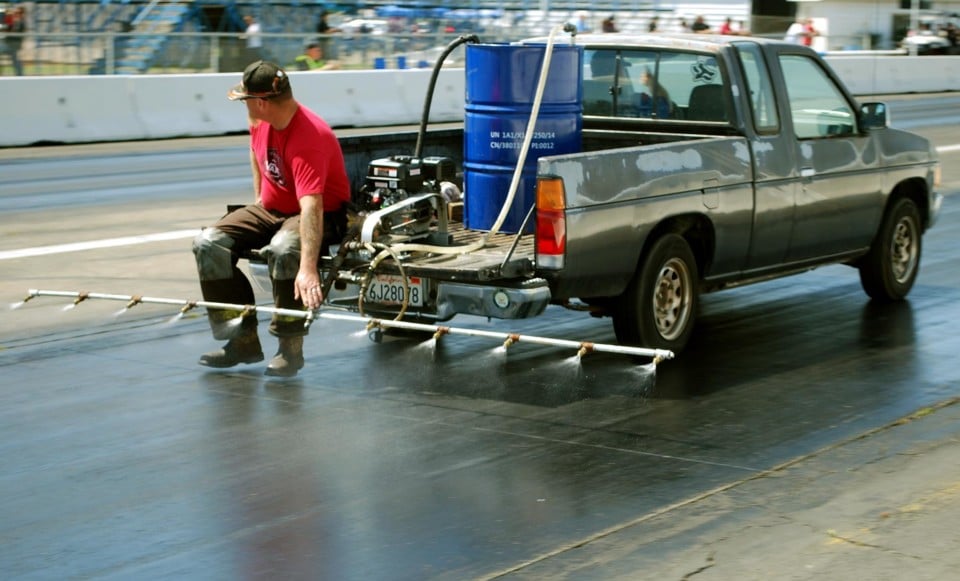
Spraying surface treatment onto the racetrack prior to dragging in preparation for high powered drag racecars
Methanol is a common thinning additive for some spray-on surface treatments used to spread the treatment out. Many tracks develop mixtures for various track conditions. A common mixture of 80-percent surface treatment and 20-percent methanol is used. Our local track often uses a 60-40 mixture. Walker reports a 75-25 mixture for the Indianapolis track. Different brands of spray-on surface treatment are available, as well, that may have different recipes.
Surface Treatment Amount And Contamination
Thicker surface treatments are often used on cooler track surfaces while thinner amounts are used for hotter days. Chemical studies reported a major problem when surface treatments are mixed with methanol that may be water-contaminated. Water-contaminated methanol also contaminates the surface treatment and leaves a gooey surface with poor traction. Scraping removal is necessary.
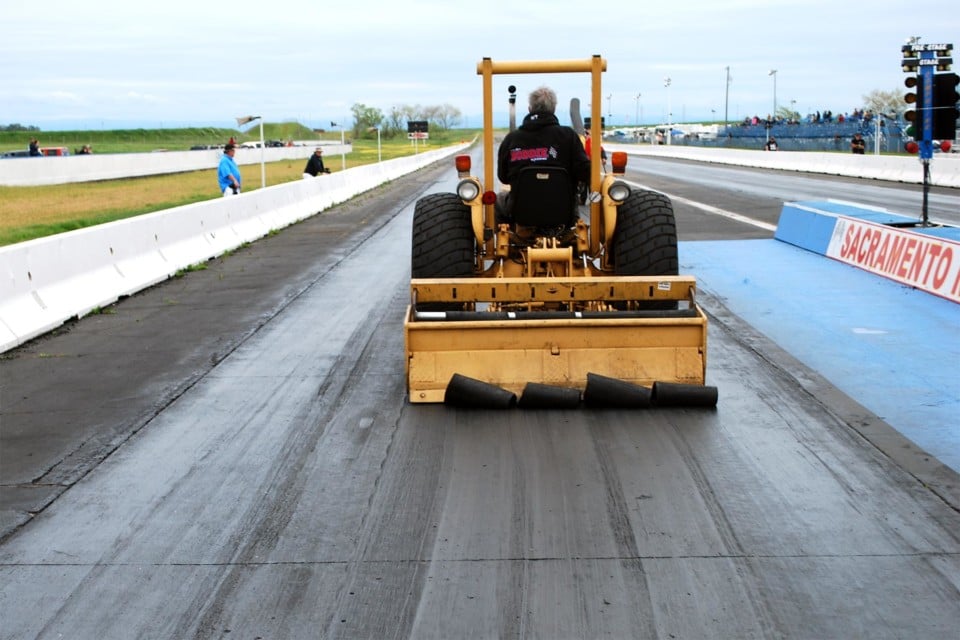
Dragging rubber over a racetrack after spray-on surface treatment
Dragging Surface Preparation
After the track is cleaned and surface treatment is applied, rubber tire tread from discarded racing tires is dragged over the surface treatment to form a coating of fresh rubber on the sticky surface. Using a surface treatment without dragging creates a surface that is a bit more gummy with less traction.
Walker reports that racing slicks that are take-offs from recent racecars are used for dragging. Occasionally new ‘blems’ are available that work best. He avoids tires approaching a year old, as they are too dried up for dragging.
Concrete vs Pavement
Concrete is popular but pavement is a more common surface type. Some racetracks begin with concrete and transition to pavement somewhere along the length of the strip. Often, there is a remarkable drop in traction when the racing vehicle leaves the concrete and hits the pavement.
At our local track, when the starting line was fresh concrete, the track maintenance crew would spray water over the hot track when surface temperatures got too high. The water would quickly evaporate cooling the track surface, and traction improved.
That does not work with older concrete starting lines. Walker shares that older concrete is more cured and porous. It will absorb moisture more readily than newer concrete, so much so that water should not be used for cooling a hot track, especially with well-cured, older concrete.
Paul Bradner is an expert who worked drag racing track preparation for decades. He agrees that concrete, which is common on starting lines, is porous and absorbs more moisture from the air than pavement. Sunlight will heat the surface. Rubber will accumulate from burnouts and multiple launches from powerful racecars. Bradner says water will emerge from concrete under the rubber, breaking the bond between the rubber coating and the track. The surface rubber will pull off in chunks.
This is a good example of a failure between the track surface coating and track surface. Your racing vehicle is hooking up to the surface coating. The surface coating is not staying connected to the track.
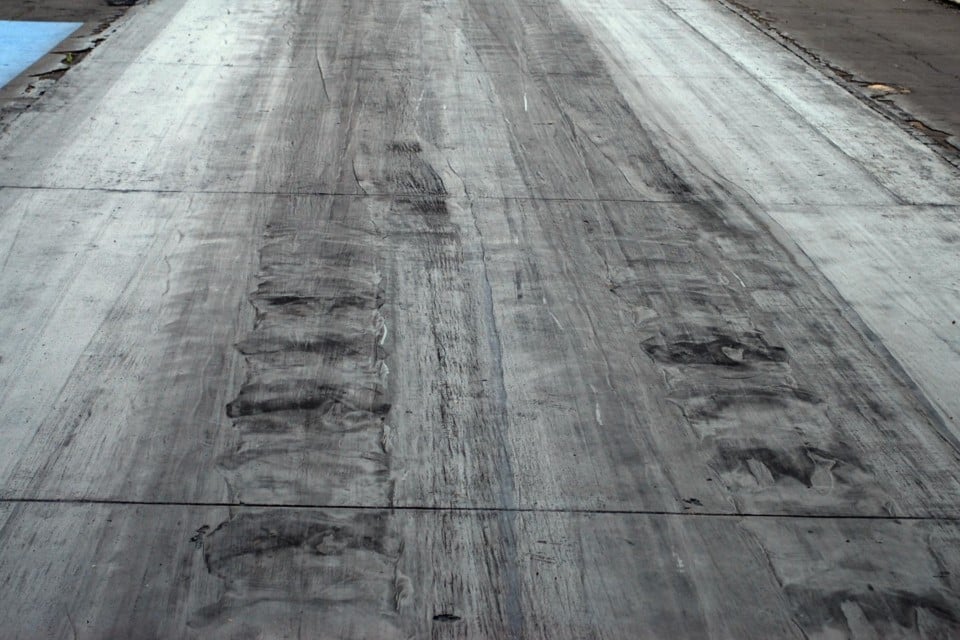
Tire chatter lines from excess traction on this sticky track surface.
You can get an idea if there’s a traction problem between the tire and the track (your problem) or the bond between the track surface coating and the pavement (racetrack problem) by examining tire chatter marks. Twist your shoe on the bumps and the valleys to see if there is a difference in resistance. If the difference is remarkable, the bond may be breaking between the pavement and the surface coating.
Bradner was one of the first to use spray-on surface treatments such as VHT (now TrackBite), starting in the late 1970s. He said that more recently there’s a difference in track preparation for small-tire versus big-tire racing, radial versus bias-ply.
According to Rhett Gardner,
Darlington Dragway General Manager, “Big-tire cars that race in NHRA and PDRA want wheel speed. If you ever watch a slow-motion video of a Pro Mod or any type of big-tire car, you’ll see that car tires start to “slip” when it takes off and by the 80-foot mark the slip is gone. Prep-wise, not much glue is sprayed on the starting line, but at about 60-feet the glue is sprayed and drug in. Radials, they want a very tight track but with more glue used for traction. Radials do not want wheel speed — they dead-hook and go.”
Bradner says a sticky track can cause tire shake, as it causes the tires to ball up and snap loose. Some racecars have tire shake also when the racetrack is not well prepared. Attention to the level of stickiness is needed to determine which is occurring.
Flatness
Many years ago, we walked down Rockingham Dragway, North Carolina in the rain. We saw very even runoff indicating a level track. That levelness is ideal for high-powered drag cars. Several years before that, we raced on a drag strip in the midwest that had a noticeable dip at the end of the track. It was a challenge to stay on the throttle going over that dip.
Horizontal and Longitudinal Groove
Track preparation is concentrated in the center since that is where most cars and motorcycles line up. Some racers will line up intentionally off-center for less traction to get wheel speed up. The horizontal groove is ignored by most. Behind the starting line, the best traction is an average wheelbase-length away from the staging beams. Of course, long wheelbase dragsters place their rear tires behind the point where most other drag racing cars launch. Differences in traction can occur from long wheelbase to short wheelbase cars as a result.
Walker said bald spots will occur at the common rear tire locations behind the starting line that often require touch-ups during the rounds.
Scraping
Rubber will build up, especially on the starting line. Scraping is done to remove that rubber. A propane torch is often used to heat the surface rubber, and hand scrapers lift the rubber away..
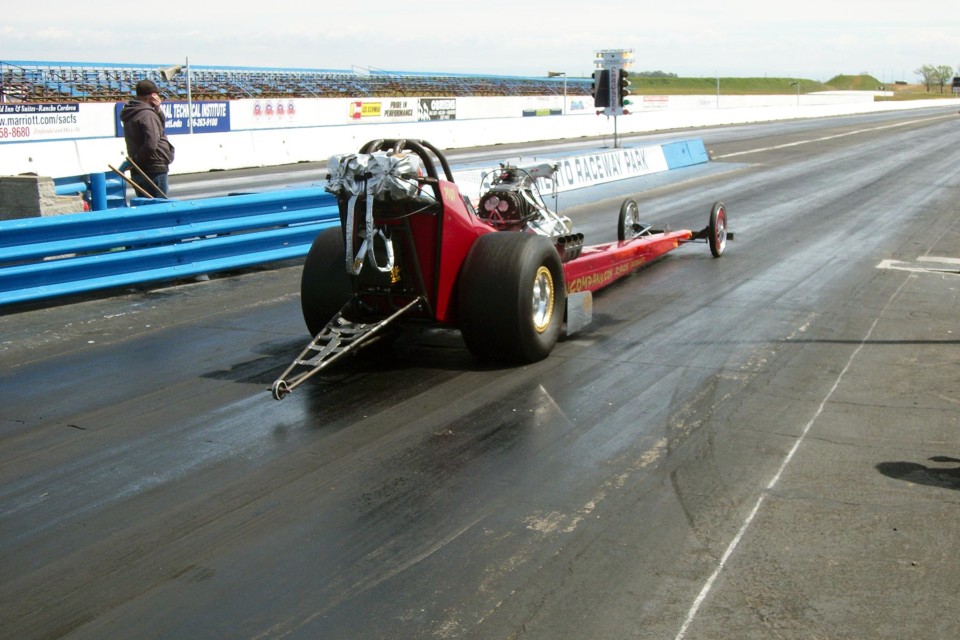
The shiny surface seen under the rear center and to the side of this dragster is surface treated pavement. Flat black tracks seen under the tires are from burnouts and launches from previous racecars that lay down an added coating of tire rubber on the surface.
Racing Slicks On The Track
Tire traction is best in a newer tire with a durometer hardness in the mid 30s. After the first use, the tire hardness will increase with age and the tire will have less traction. A racing slick will have a durometer over 40 after six months beyond its first usage and over 50 beyond a year of usage. As the tires get harder, traction is lower on any racetrack surface regardless of the preparation. We encountered a year-old set of slicks with only one prior run on them that measured over 50. The Pro Mod using these tires would not hook up on a well-prepared track surface.
A racing slick that is spinning during launch – turning hard to get-up-on-the-tire – may heat up to a surface temperature of well over 180-degrees Fahrenheit (optimum rubber tire surface temperature reported in some road racing circles) and result in reduced traction. Older tires have a traction failure temperature that is more sensitive. Racing slick age is all-important.
The hotter the surface, the hotter the starting point for the slicks. A cold track surface establishes a cold starting point for the racing slick surface temperature. Long burnouts on a cold track can be useless to heat up the tires. Tires cool down from rolling back over a long cold track surface when returning to the starting line.