Depending on your application, the low-pressure spring might actually be a better option. Going with a lower pressure from the dedicated fuel system will give you more options for tuning and pushing your nitrous usage.
“Going with the low-pressure spring changes your fuel side jetting. Running the low-pressure spring allows you to make smaller fuel adjustments without changing the fuel jet. That’s one of the reasons some like to go with that option, because they’re trying to chase that absolute edge of their tune so they have more options. That’s getting into max effort race car territory where you’re just making the smallest of pressure changes,” McDonald says.
For the Red Dragon, we opted to go with the low-pressure spring setup. This gives us a bit more room to tune on the car so we can get more aggressive if we want. Since there could be some additional changes to the car’s engine package in the future we can grow into using the full potential of the dedicated fuel system using the low-pressure spring.
The only real limitation with this dedicated fuel system is the horsepower level you’re trying to achieve.
A dedicated fuel system isn’t a magic wand for every nitrous setup; there are some applications where the dedicated fuel system will be limited in how it can be used. Even with those limits in play, there are ways to expand the system.
“The system isn’t compatible with methanol, so if you thought you were going to run methanol, it won’t do it. The only real limitation with this fuel system is the horsepower level you’re trying to achieve. This is geared more toward the street car market, so that dictates the amount of nitrous you’re trying to spray. You could put a bigger pump in the tank but then the line feeding the fuel into the nitrous system would become the limiting factor,” McDonald explains.
The best way to get the most out of a fuel system for a nitrous application is to understand what it’s capable of.
“This system really allows a user to get the most out of it via tuning. You get the most out of it by reading your plugs, looking at your fuel coloration, and checking the timing mark on your spark plug strap. It allows you to make fuel pressure changes, jet changes, or adjust your flow to get your tune up as spot-on as you can get it. Ultimately, you’re limited by what the engine can handle within reason,” McDonald says.
GM World Class Technician Scott Cordell led the charge on getting the Nitrous Outlet Pro Wiring Harness, ProMax, and dedicated fuel system installed on the Red Dragon. One of the things that stuck out during this process was the level of quality the Nitrous Outlet parts have.
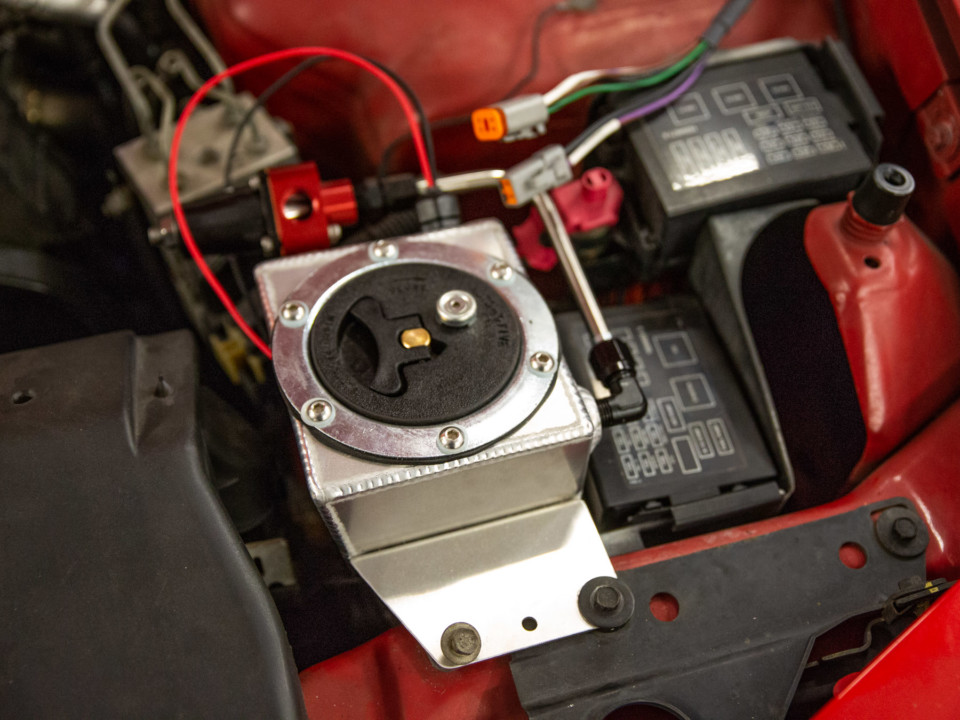
The fuel cell is mounted on the driver’s side toward the front on the car’s core support. Nitrous Outlet included mounting hardware to use and the tab on the fuel cell lines up nicely with three holes already in the core support. If you have a Camaro, the fuel cell bolts right in; for Trans Am owners you need to relocate the headlight control. After the fuel cell is mounted you just need to wire in the fuel pump per the directions with the ground and power wires. After the wiring is done you run the fuel line from the regulator to your fuel solenoid with the supplied hose and AN fittings. This is where you can also add a fuel pressure sensor if you have one and you add the fuel pressure gauge to the standalone fuel system. This is used to monitor and adjust the system’s fuel pressure. Finally, you block off the unused port on the fuel regulator.
After getting everything installed and tested we took the Red Dragon to
Dynotune Motorsports where we strapped it to the rollers to see what gains were possible. After Scott worked his magic and did some baseline tunes with the system, the 200 horsepower jetting was added to the plate. The Red Dragon spun on the rollers several times and after adjusting the progressive controller the car put down over 650 horsepower and nearly 700 foot-pounds of torque. So far we have only been able to go to the track one time due to inclement weather, at which time the car laid down a 10.89 at 127 with a lot of tire spin. This was a new best run for the Red Dragon, but there is obviously plenty left in the combination.
The Nitrous Outlet dedicated fuel system gives users a larger tuning window to maximize the amount of horsepower they can make. By understanding how the system works there is a lot of potential to safely increase your nitrous-assisted horsepower that’s available. Stay tuned as we put the Red Dragon through its paces with the Nitrous Outlet dedicated fuel system.
Article Sources
Nitrous Outlet
(866) 648-7637