By
Greg Acosta February 26, 2019When it comes to valvetrain, lighter is better. One of the simplest ways to shed weight in that area would be to switch from stainless steel valves over to titanium pieces. Titanium valves of the same size as their stainless counterparts can shed as much as 42-percent of the weight, with all of the strength. However, as Zeke Urrutia of
Ferrea Valves explains, titanium valves still have some mystery surrounding them.“For most applications, you don’t need titanium valves in a typical mild performance or street application,” Urrutia explains. “In fact, Titanium valves aren’t right for a lot of applications.” Because of that, the Ferrea tech line gets a lot of the same questions each week. To clear those up, Urrutia made this list of the top five most commonly asked questions relating to titanium valves.
What type of coating is used on Ferrea titanium valves?“We’ve used several coatings throughout the years. For the past ten years or so, we’ve used chromium nitride (CrN), which is a coating that is applied at a very controlled thickness on the valve. Chromium nitride is applied to the entire valve, top to bottom.”
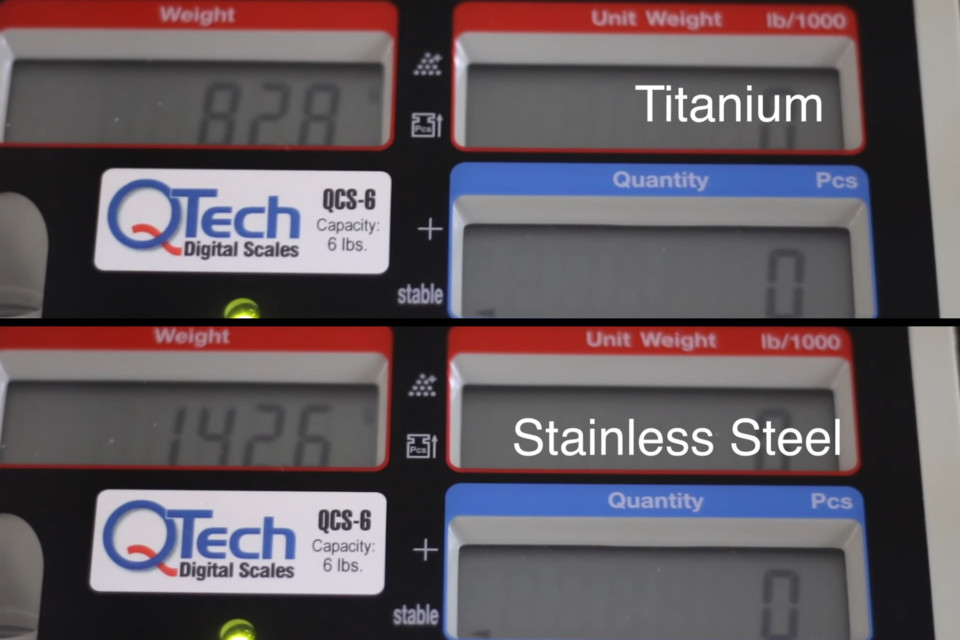
On this scale are two identical (dimension-wise) Ferrea intake valves; one in titanium, and one in stainless. If you do the math, the titanium version is 42-percent lighter than the stainless steel version, and can account for a significant valvetrain weight savings.
“This is a great question, and one that comes up a lot. Typically,the use of titanium valves in a turbocharged engine comes down to the type of fuel you’re using. If you’re using methanol or alcohol, the properties of those fuels keep the combustion temperatures on the low end, so running a titanium valve is allowable on both the intake and exhaust side. A lot of Pro Mod engines use titanium valves on both sides, and that’s due to their use of methanol.On the other end of that spectrum, if you’re running race gasoline in a turbocharged application, you’ll have to measure your exhaust gas temperatures to see what actual temperatures you are running, to see if you can run a titanium exhaust valve. In a lot of cases, we run a stainless exhaust valve with a titanium intake valve on the intake side.”
What is the best valve guide material to use with titanium valves?“The best material to use with titanium will be a bronze-type guide. There are a lot of different types of bronze out there, whether it’s an Ampco 45, or a copper bronze – which we use a lot of – both materials’ properties work really, really well with titanium. Bronze dissipates heat very well and has a very high natural lubricity. Bronze shines, especially when compared to a cast iron type material guide which retains a lot of heat and, in turn, concentrates a lot of heat into the [valve] stem area. That can cause some unwanted growth in the titanium.”