“What we are talking about here is the bleed down rate and effective lash (clearance) that reduces the dynamic duration and stability of a hydraulic roller lifter system at high-RPM,” explains Godbold. “While valve bounce can lead to the hydraulic system holding a valve open, there is not an actual mechanism that can accurately be described as ‘pump-up.’ The valve bounces up, and the dumb hydraulic system just adjusts to hold it up for quite a while.”“While the bleed down rates definitely change dynamic duration, and it changes based on RPM and all kinds of other influences, we have not seen anything that can accurately be described as ‘pump-up.’ The closest thing we have seen on the Spintron is when you go into severe valve bounce,” Godbold reveals. “Unlike with a solid lifter bounce, which has a natural, symmetric parabolic shape, when you have significant bounce on a hydraulic system the inner piston can move up and hold the valve open for as much as an extra 50 degrees of crank rotation. I believe the guys running engine dynos in the ‘70s through ‘90s would see fuel standoff above the carburetors when this happened, and they knew the intake valve was being held open.”
“While that part of their hypothesis was correct, the mechanism was initiated by valve bounce, and then the lifter auto-adjusting, and not any ‘pumping-up’ of the hydraulic lifter,” explains Godbold. “Engine builder [and multi-time Engine Masters Challenge Champion] Jon Kaase told me a story once about his experience with hydraulic lifter pump-up. Neither he nor I can fully explain it…”
“They had an internal check valve that got stuck in an oil pump, and the oil pressure went ballistic at higher RPM. This hydraulic lifter engine acted exactly like textbook ‘pump-up.’ The high-pressure piston has a little under half a square inch of surface area, so you would assume that nearly 400 psi of oil pressure would be required to overcome a 150 lb/in spring,” says Godbold. “That type of calculation does not even mention the crazy 1,500-plus-pound inertial forces from opening and closing the valves, but once Jon replaced that messed up oil pump, the engine ran just fine!”
CharacteristicValueUnit of MeasureNotesHydraulic Lifter Piston Diameter.625inchTypical for most hydraulic liftersPiston Area.307square inchArea=Pi(R) squaredOil Pressure100 psipounds of force per square inchForce on Pushrod30.7pounds of forceF= pressure x areaRocker Ratio1.7:1The force to the tip is reduced by the rocker ratioTotal Force Acting Against the Spring Seat Load18.0pounds of forceFor typical seat street loads, these values could be enough to offset more than 10% of the total spring seat load, but not nearly enough to overcome the total seat load.
Here is a quick calculation table with real numbers of the force acting to open the valve. You would have to approach 1,000 psi of oil pressure to actually overcome the valve seat load, but even 100 PSI could offset ten-percent or more of the seat load.While interesting, that is second-hand experience, which Godbold hasn’t been able to duplicate. “I have never seen anything similar on the Spintron, but we have never gone ballistic with oil pressure either. We could probably make a lifter [overpower the valvespring], but the math looks skewed against it being possible until you get well past 150 psi of oil pressure,” says Godbold. “At that point, you might effectively take away almost 50 lbs of seat load from the spring and thereby make your system unstable, resulting in the bounce up, and then holding open the intake valve 30-plus degrees like I described originally.”
Racers are an ingenious breed, and have tried many things in the past in order to run more aggressive camshafts while being limited by hydraulic lifters. “There are some tricks that have been tried with running tight lash solid profiles on very high bleed-down lifters, but this is not extremely effective as you are typically setting the lash off the collapsed height of the lifter and would be better served with a solid lifter,” Godbold relates. “A Comp Cams ‘Short Travel’ lifter has a smaller high pressure chamber, and can run either a more aggressive profile or higher RPM, and both paths have been used quite successfully. The only factor to consider if using that style lifter is that the preload needs to be set accurately.”
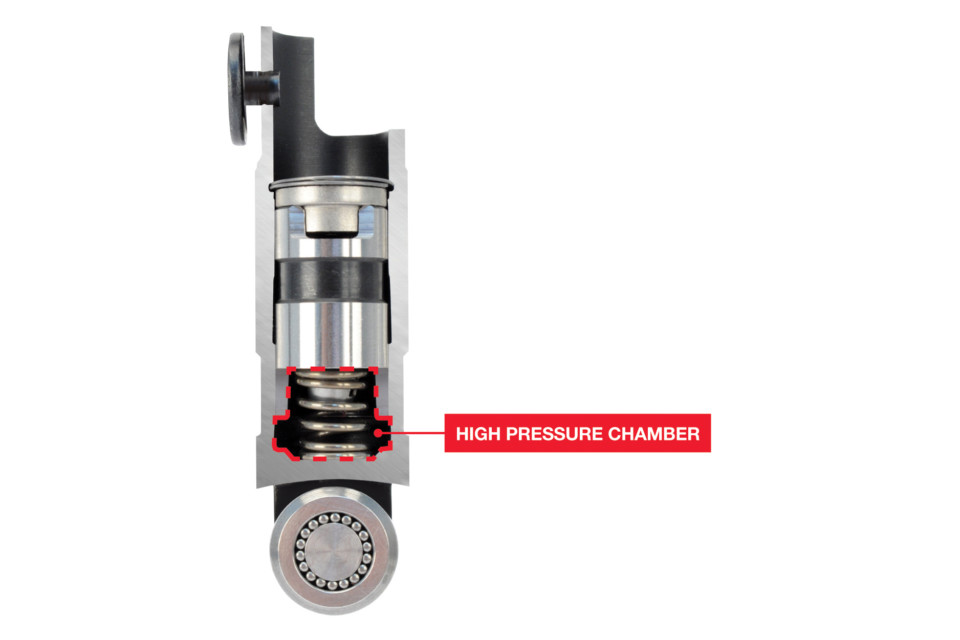
This side view cutaway shows the high pressure chamber where precious lubricant circulates and is pumped through. You can also see the spring described in the text that some feel is overpowered by high oil pressure. Research has proven this phenomenon to be very rare.
There are also other factors which affect the behavior of the lifter, such as the engine oil itself. “Both oil temperature and aeration play major factors in the effective stiffness of the lifter. As the oil generally becomes more aerated at higher RPM, and the inertial pushrod loads increase dramatically, we do see the hydraulic lifters ‘act’ like they have more lash with RPM,” reveals Godbold.
As oil temperature changes, so does it’s actual viscosity. “The effective duration decreases with temperature. People would be shocked to see just how much the effective lash on a hydraulic lifter changes with these conditions. The short travel lifters reduce this effect, but the reason solid adjustment is so much more common in racing applications is the consistency of valve motion under different temperature and oil aeration conditions,” says Godbold. “I hate to be overly critical, but discussing the effect on pump-up is like asking who would win in a fight between Bigfoot and the Loch Ness Monster. It’s that rare.”
Flat or Roller – Is Anyone Safe?“The internal adjustment system is very similar in both flat-tappet and roller-tappet designs. Both systems have very similar bleed-down rates. There are minor dynamic differences due to the typical mass, acceleration and velocity characteristics, but in general, these two types of hydraulic lifter behave in very similar ways,” Godbold explains.Herheim concurs, saying, “Both hydraulic roller and hydraulic flat tappet cams are technically susceptible to pump up. We have seen this problem in hydraulic rollers more often than hydraulic flat tappet cams. This is due to the significant weight of the lifter and the aggressive cam profiles that are being used.”
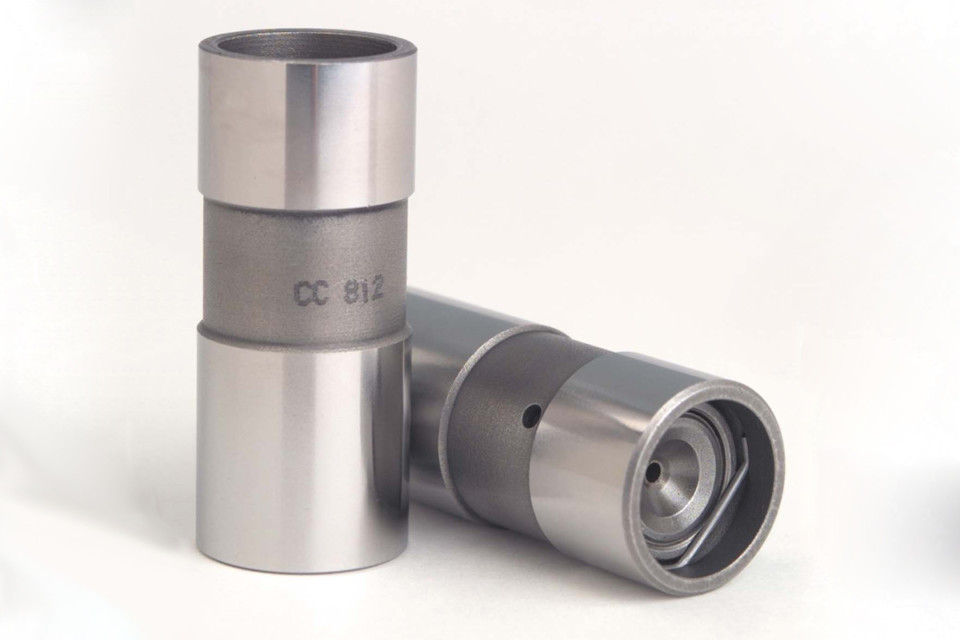
The traditional flat-tappet lifter remains a popular entry level option for budget based performance enthusiasts. The engineering inside, along with the improved engineering in the materials and oil control capabilities, make these a great choice for many. Following the break-in procedures to the letter, and using oil with adequate zinc level during the critical break-in period, is key to helping them perform perfectly for the long-term.
Godbold continued to dive deeper. “The real differences in bleed-down rates, effective lash, and the dynamic stability are quite dependent on oil viscosity,” he explains. “Like we mentioned earlier, it is the actual running viscosity that matters, hence the dependence on temperature and aeration in the oil as well as the rated viscosity.”