By
Scott Parkhurst August 28, 2018There is an age-old decision that high performance engine builders must make: hydraulic lifters, or solid lifters? Typically, (or more accurately, traditionally) the school of thought has been that hydraulic lifters were a better choice for street engines that accumulated a lot of miles at varying RPM, and solids were a better call for race engines that spent more time at high-RPM and were rebuilt regularly.
These opinions were created way back in the flat-tappet era, and followed the respective designs into the modern roller generation. Since hydraulic lifters did not require adjustment once they were set, they were a lower-maintenance item that street enthusiasts would appreciate. Setting hot lash was an art form reserved for the more hardcore race crowd. Certainly, the stability of a solid lifter offered consistency and strength to survive extended periods of high-RPM use, and by setting the lash at the minimum, every thousandth of an inch of precious lift and every degree of duration would be delivered to every valve.
At idle, the reduction in oil pressure would allow a bit more civilized idle in the hydraulic designs, while the solids would demand perfect adjustment to deliver a signature “crisp” lopey idle sound, and the requisite mechanical performance advantage to match.Well race fans, it’s deep into the twenty-teen years now, and most of those ancient myths are busted. Modern technology and advanced engineering are blurring the line between hydraulics and solids. While both designs have seen durability increase over the years (mostly due to improved materials, tighter tolerances, and wider roller bearing surfaces), the real advances have been on the hydraulic side of the fence.
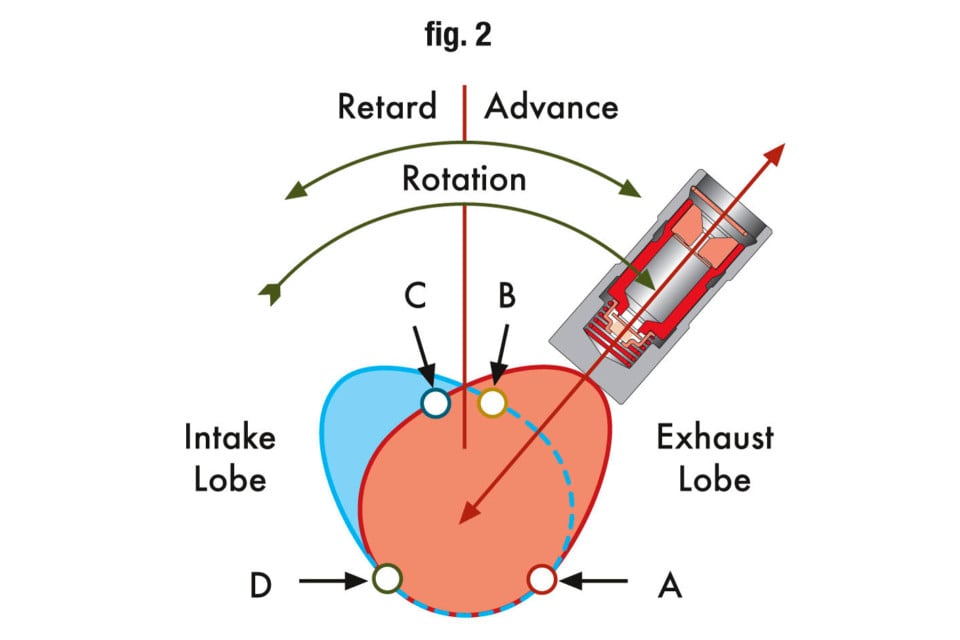
This image was developed to show the various phases of the cam lobe, but we can also see how the flat tappet hydraulic lifter in the illustration relies on its internal spring and oil passing through it to work like a shock absorber as the cam rotates against it.
Modern engineering has led to more precise plunger, spring, and retainer systems. These have resulted in more consistent fluid control, both in and out of the lifters. Combined with the rest of the aforementioned advances, and with the benefit of decades of research on every part of the lifter design, the modern hydraulic roller lifter gives up little, if anything, to its solid counterpart. The benefits of the hydraulic design, especially that lack of a need to set lash or adjust anything once it’s set properly and locked down, brings plenty of benefit to enthusiasts whose valve covers aren’t easy to access.
The current trend toward turbocharging brings with it a commitment to relatively exotic plumbing. The deep engine setback of modern performance cars makes pulling valve covers a real challenge. Not having to do so between races (or, in extreme cases, between rounds) is a real gift. Certainly, improved poly lock designs have really helped minimize the need to set valve lash on a regular basis. Compared to the early parts racers had back ten or twenty years ago, things are much improved.
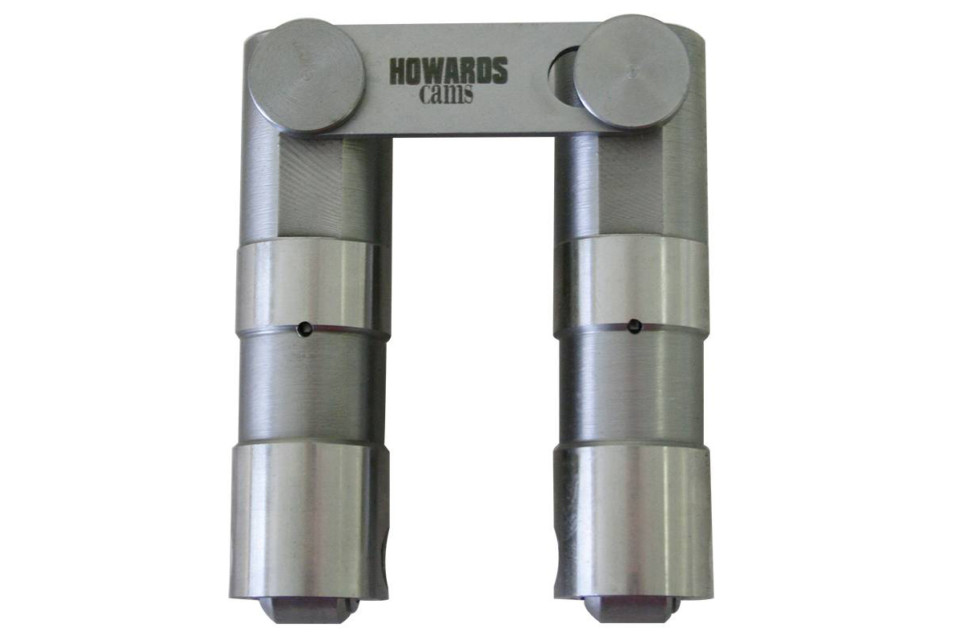
Premium quality tall hydraulic roller lifters like these units from Howards Cams offer a wide range of benefits. The taller bodies offer increased support while shortening the requirements for the pushrods (shorter pushrods have less potential to flex). The tie-bar keeps the lifters aligned perfectly with the cam lobes.
The question is, can a hydraulic lifter be pumped up past it’s adjustment point, overcome all of its preload, and subsequently hold the valve open? This phenomenon is called “pump-up” and it’s the kind of thing people claim to have seen or experienced, but very few have genuine evidence.Many of us have experienced the well-documented phenomenon of valve float, where the valve springs are too weak to keep up with the actions of the valve and the valve isn’t able to close all the way. Can people be confusing valve float with lifter pump-up?We spoke directly with a couple of the industry’s most experienced race lifter experts and got their opinions. We learned a lot, and we think you will too.We asked Ben Herheim of
Howards Cams, who is familiar with the concept of hydraulic lifter pump-up, if he could explain how pump-up could happen, and what we could do to prevent it. “Pump up can be the result of several problems in the hydraulic valvetrain. The most common is dynamic instability of the system. This occurs when the spring is unable to retain contact between the system components, due to insufficient spring load,” Herheim explains. “The rare ‘pump-up’ phenomenon is not constant throughout the RPM range. It can only occur when the spring margin or system stiffness become inadequate.”
“Higher-load springs can sometimes be used to remedy this issue, or a change in cam profile is needed. Other times, pump-up can be caused by system deflection, where one or more of the components in the system actually bends enough to unload the check ball and the lifter reacts by filling with oil,” says Herheim. “Unfortunately, it is filled to a higher level than needed and can hold the valve off the seat. Oil temperature could cause this on a cold start if the oil pressure was great enough to overcome the load from a seated valvespring. It would have to be quite high, though.”
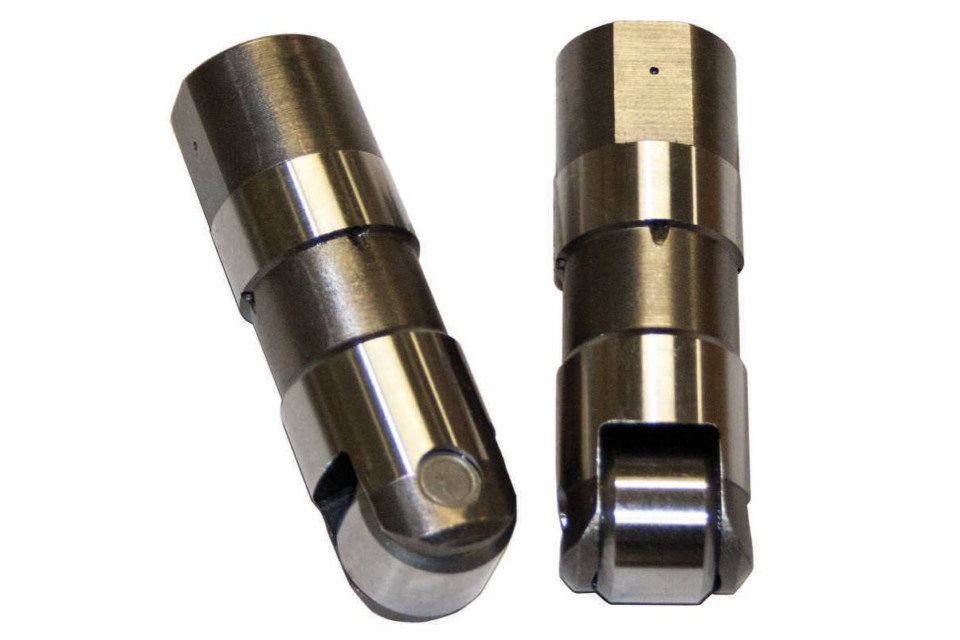
Not all hydraulic roller lifters require tie-bars to prevent rotation. LS hydraulic roller lifters (pictured) use lifter trays which engage the flats on the lifter body to prevent rotation, while OEM roller small-block Fords use a “spider” brace to hold down “dogbone” retainers, which engage the flats and keep the roller wheels aligned with the cam lobe.
Billy Godbold, Valvetrain Design Engineering Chief at
Comp Cams feels that enthusiasts are seeing something that might be mistaken for pump-up, and is still a problem that needs to be addressed.