By
Greg Acosta August 21, 2018The ability to optimize a camshaft for a specific combination is definitely something that only comes with a lot of education and experience, and that’s why it’s usually left to the camshaft professionals to sort out for the average person. However, thanks to companies like
Comp Cams, who prefer to see its customers educated, and enjoy sharing immense knowledge, videos like this one can be brought to you.
Obviously, no one is going to be able to spec out their own camshaft – let alone a forced-induction camshaft – after watching a five minute video and reading a single article. However, if you are able to walk away with a better understanding of the challenges posed by the various engine configurations, you’re a leg up on a majority of enthusiasts.Regardless of what form of induction you are using, there are two major factors which need to be considered when determining the proper camshaft specifications: the pressure at the intake valve, and the pressure at the exhaust valve. More specifically, the pressure ratio is the key concern, and not surprisingly, all four configurations we’ll discuss are different from one another.
Natural AspirationThe first configuration is by far the most common, and that is a naturally aspirated engine. With nothing but mother nature’s atmospheric pressure to assist in getting air into and out of your engine, it all falls on the shoulders of piston motion and camshaft specs to make power. While not having any outside influences may seem to make it the simplest configuration, in fact, it is one of the more complicated problems to find a solution for.Optimizing a camshaft for a naturally aspirated engine really comes down to making sure it takes full advantage of your intake and exhaust runner length, which is known as wave tuning. “In a normally-aspirated engine with headers, the exhaust pulse from the exhaust opening travels out as a positive wave. You set the header length so that an overtone is reflected back as a negative wave arriving back at the chamber at intake opening,” says Comp Cams’ Billy Godbold.“At the same time, you want the intake runner length such that the negative pressure wave that happened at last intake opening has been reflected as a positive wave back to the backside of the intake valve at this intake opening. The combination of the negative pressure wave in the chamber and a positive wave in the runner can result in a net pressure drop across the valve at intake opening, even though the piston is still going up towards TDC.”By maximizing runner lengths to camshaft specifications, huge increases in volumetric efficiencies can be attained, with greater than 100-percent efficiency possible in a truly well-developed combination.
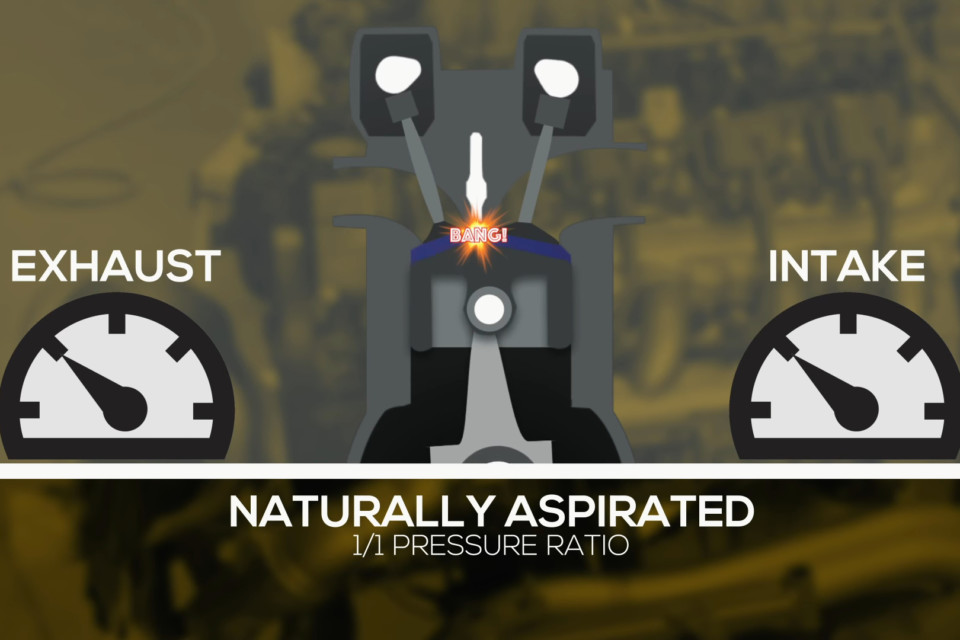
While the naturally aspirated combination may seem like the simplest camshaft to spec out, with a 1:1 pressure ratio, it’s deceptively simple. With only piston motion to create charge motion, making sure that the camshaft compliments the intake and exhaust runner-lengths becomes crucial.
Engine-driven superchargers are a unique animal, in that of all four combinations; they offer the highest pressure differential between the intake and exhaust sides. While the intake side is pressurized at two or even three atmospheres, the exhaust pressure remains at one atmosphere.With the positive pressure on the intake side, you aren’t reliant on piston motion to impart motion on the intake charge, and as a result, you can open the intake valve earlier than in a naturally aspirated combination. You can also run a narrower lobe separation angle than other forms of forced induction, but has to be weighed against the potential to have “blow through” during valve overlap.