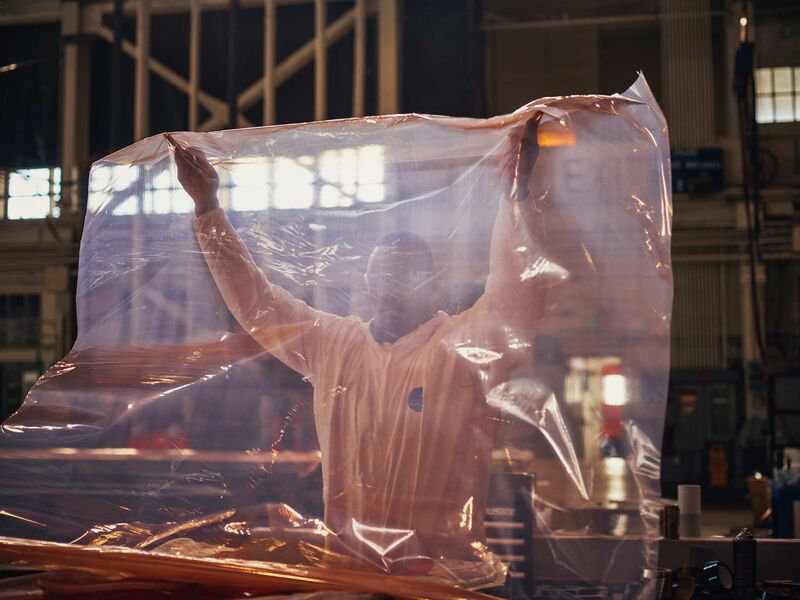
The Alameda factory.
Photographer: Balazs Gardi for Bloomberg Businessweek
NOAA says it plans to use about two dozen saildrones in the next year for missions that include weather and climate change research. CSIRO just put three in the water off the coast of Tasmania as part of a series of yearlong missions. They’ll be sailing up the eastern coast of Australia to the climate-change-devastated Great Barrier Reef, monitoring animal life and water health and looking for places to bury atmospheric carbon under the ocean floor.
Saildrones may be most useful for weather forecasting. The robots can pick up and map much richer data than the sparse, static sensors used to build forecasting models today. “If the data gets that much more accurate, there will be weather prediction like we can’t even imagine today,” says Dipender Saluja, a partner at Capricorn Investment Group, a Saildrone investor. “It will affect transportation, logistics, agriculture, and energy markets.”
Take Superstorm Sandy. As it approached New York in 2012, European and U.S. models differed about the temperature of the water in front of the storm, a significant factor in determining its strength. The U.S. model reported that the water was cool, which would weaken Sandy’s intensity, while the European model saw warmer water that would exacerbate the storm’s devastation. (That one was right.) Soon, Saildrone plans to send its robots right into hurricanes to relay information about water temperature and other conditions. Along with the strength of the storms, such data can also provide better measures of when and where they’ll make landfall.
The humanitarian and scientific missions seem obvious enough, but will they yield enough data business to justify the hardware and management costs? Far more competition for big contracts is coming, including sailboats, surfboards, and other vehicles from startups with names such as AutoNaut, Ocius Technology, Sailbuoy, and Ocean Aero. NOAA’s Meinig worries that military and energy-industry money will prove too tempting for many otherwise-altruistic researchers. “Our challenge as scientists, frankly, is conveying the need here to get people and Congress to increase their funding,” he says.
Liquid Robotics Inc. offers a cautionary example. It started in Silicon Valley in 2007, making a robotic surfboard that harnessed wave motion to propel itself. Like Saildrone, Liquid began working with NOAA and other science agencies on weather and marine-life research missions. Eventually, however, it turned away from that work. “There is no money in the science market,” says Chief Executive Officer Gary Gysin. “The research organizations and NGOs are never going to throw $100 million at a problem and go solve it.”
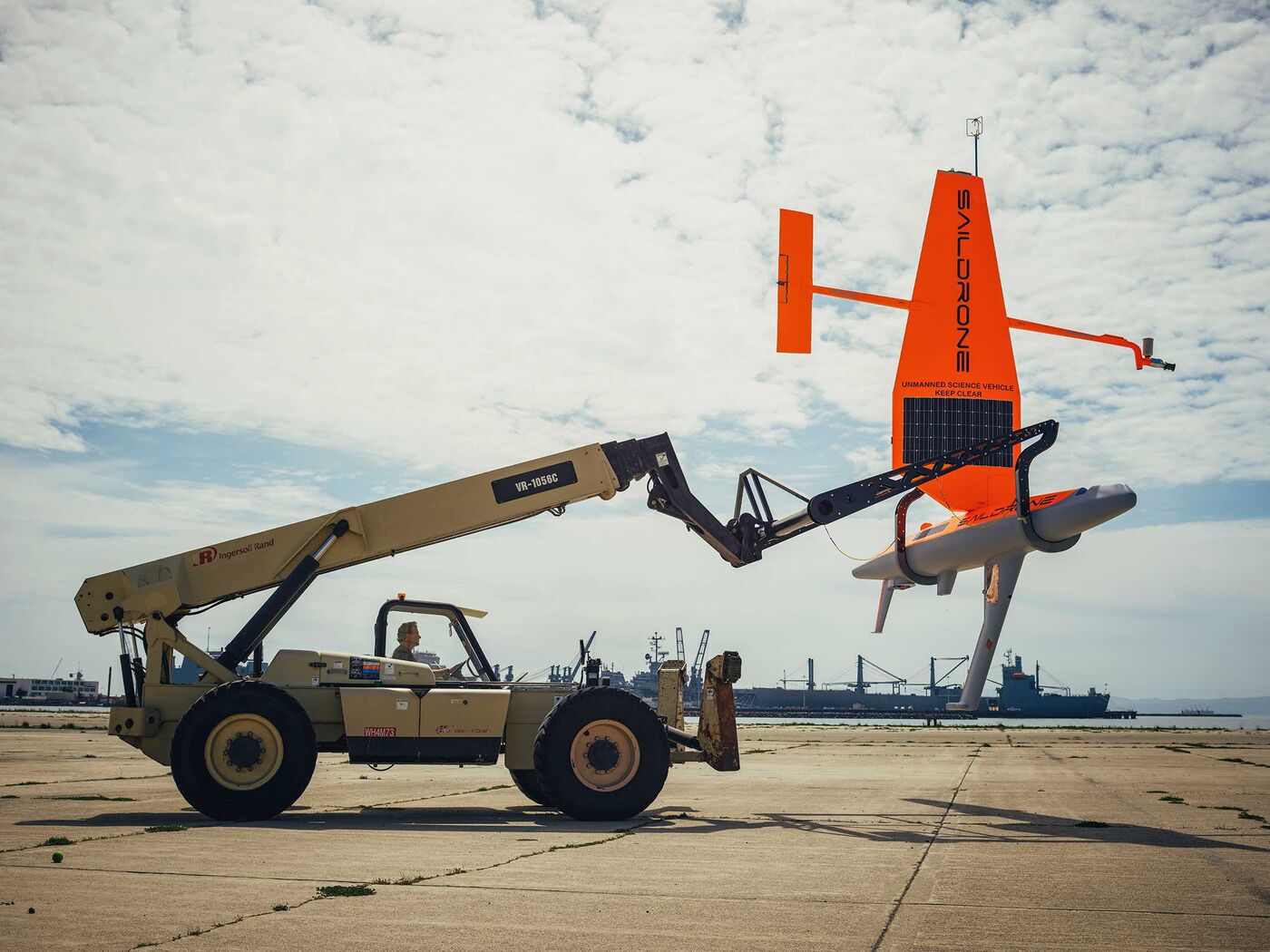
Outside the Saildrone facility in Alameda.
Photographer: Balazs Gardi for Bloomberg Businessweek
In 2016, Boeing Co. acquired Liquid for $300 million, and the company has since moved into military and commercial work. Its robotic gliders lurk out at sea, watching the movements of boats and submarines and trying to spot illegal fishing. At oil and gas rigs, they provide weather data to help manage platforms’ operations and environmental data to make sure the drillers are complying with regulations. Liquid charges $5,000 a day per glider and has about 400 of them at sea. “Unless you transition to a commercial program,” Gysin says, “you will never get to build a real business.”
Saildrone’s investors say they’re taking a longer view, and that a global database of the oceans will benefit the company’s future more than chasing whatever business it can book today. “The most important asset is the data, and getting data that no one else can accumulate,” says Chamath Palihapitiya, founder of investor Social Capital. Palihapitiya, like several of Saildrone’s other big backers, tends to support companies with social and environmental bents, and to allow for a bit more time to work out a business.
Still, Jenkins has been paired with Chief Operating Officer Sebastien de Halleux, who has a long track record of turning startups into big businesses. It’s de Halleux who convinced Jenkins that money could be made from understanding the weather. “Sebastien will keep it tethered, while Richard does his thing as a creative genius,” says Palihapitiya. Saildrone plans to sell data to all comers, building a software platform that almost anyone can tap, and to go after commercial work, particularly with fisheries and logistics companies.
Like Jenkins, de Halleux is a sailor, and he’s been coaxed into land yachting by his business partner. On the weekends, their families head out to the desert and try out prototypes while the two executives compete to see who can put back more beer. “I’m Belgian and he has Australian roots, so there’s a love of cheap lager and lots of it,” de Halleux says. “I still think I can drink him under the table.”
Later this year, possibly by August, they plan to revive the goal of replicating Magellan’s voyage with a couple of saildrones. In order to make the circumnavigation official with the World Sailing Speed Record Council, the drones must start out in the Northern Hemisphere, cross every longitude line, and cross the equator twice. “We’ll fulfill all of our contracts first, and as soon as there is a boat available, we’ll set them off,” Jenkins says. “It’s all about priorities, right?”