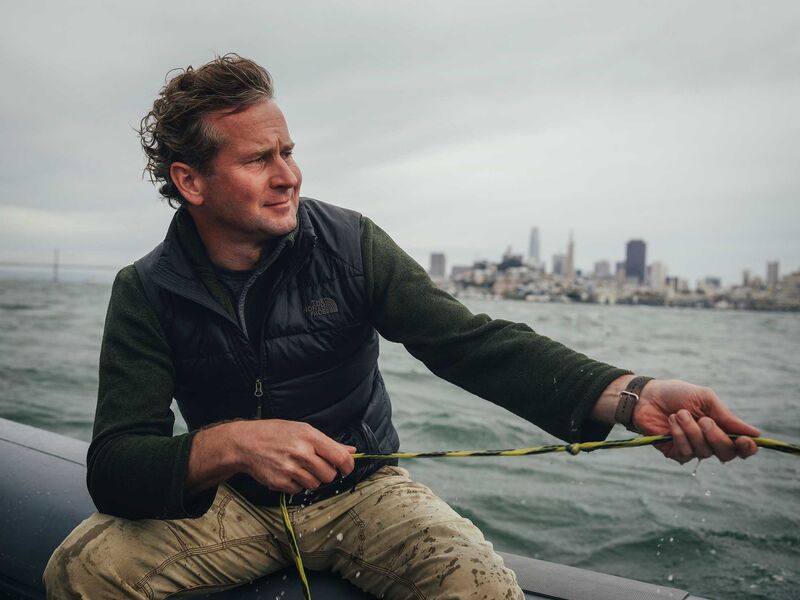
Jenkins, with downtown San Francisco behind him.
Photographer: Balazs Gardi for Bloomberg Businessweek
The tinkerer never took to school. He claims the only nontechnical book he’s ever read is Sun Tzu’s
The Art of War. But by age 14, he was studying carpentry and, in night classes, traditional wooden boat building. At 17, he went to work for local builder Green Marine, helping to make racing boats, sailboats, and luxury yachts. Before enrolling at Imperial College London to study mechanical engineering, he took a year off to sail the world, delivering the yachts he’d built.
While an undergrad, Jenkins’s mates at Green Marine approached him about trying to make the fastest-ever version of a land-sailing yacht. The confusingly named craft looks a lot like a sailboat, except that it travels on wheels and usually traverses desert tracks. At the time, the world speed record for a land-sailing yacht stood at 116.7 mph. From 1999 until 2009, Jenkins devoted his life to beating it.
That meant spending months at a time in American and Australian deserts, pushing his designs across dry lake beds. During winter, Jenkins traveled to Montana or Canada and ran his yachts on the ice. He paid out of his own pocket and kept budgets tight. “I spent $110,000 over the 10 years, including my living costs, building the vehicles, and transportation,” he says. “I recorded all the receipts because I kept thinking a big sponsor would come through and pay it all back.”
Mostly, Jenkins lived on his own, sleeping in an $800 Dodge van. “I would work on the vehicle during the day and eat steak and corn, the diet of kings, at night,” he says. One day, an ex-highway patrolman spotted Jenkins in the desert, and gave him a handgun and a huge bag of bullets. “He said, ‘There are freaks out there,’ but I never saw anyone,” Jenkins says. “So I just drank a lot of beer and shot at the cans.”
In his solitude, Jenkins kept learning about engineering and aerodynamics. He tried adjusting the size of the wing, the racing tires, and the land yacht’s materials and shape to find the right balance of force and drag. Most days brought setbacks. Once, a 25-pound hunk of metal flew off the vehicle and into the cockpit, just missing his head.
Over the course of his decade in the wild, Jenkins went to extremes to keep his project going. For a while, he earned extra cash working in a nickel mine, climbing 1,500 feet down a rickety ladder with fertilizer on his back to blow up rock around promising seams. Occasional floods at his campsite sometimes stranded him for weeks at a time.
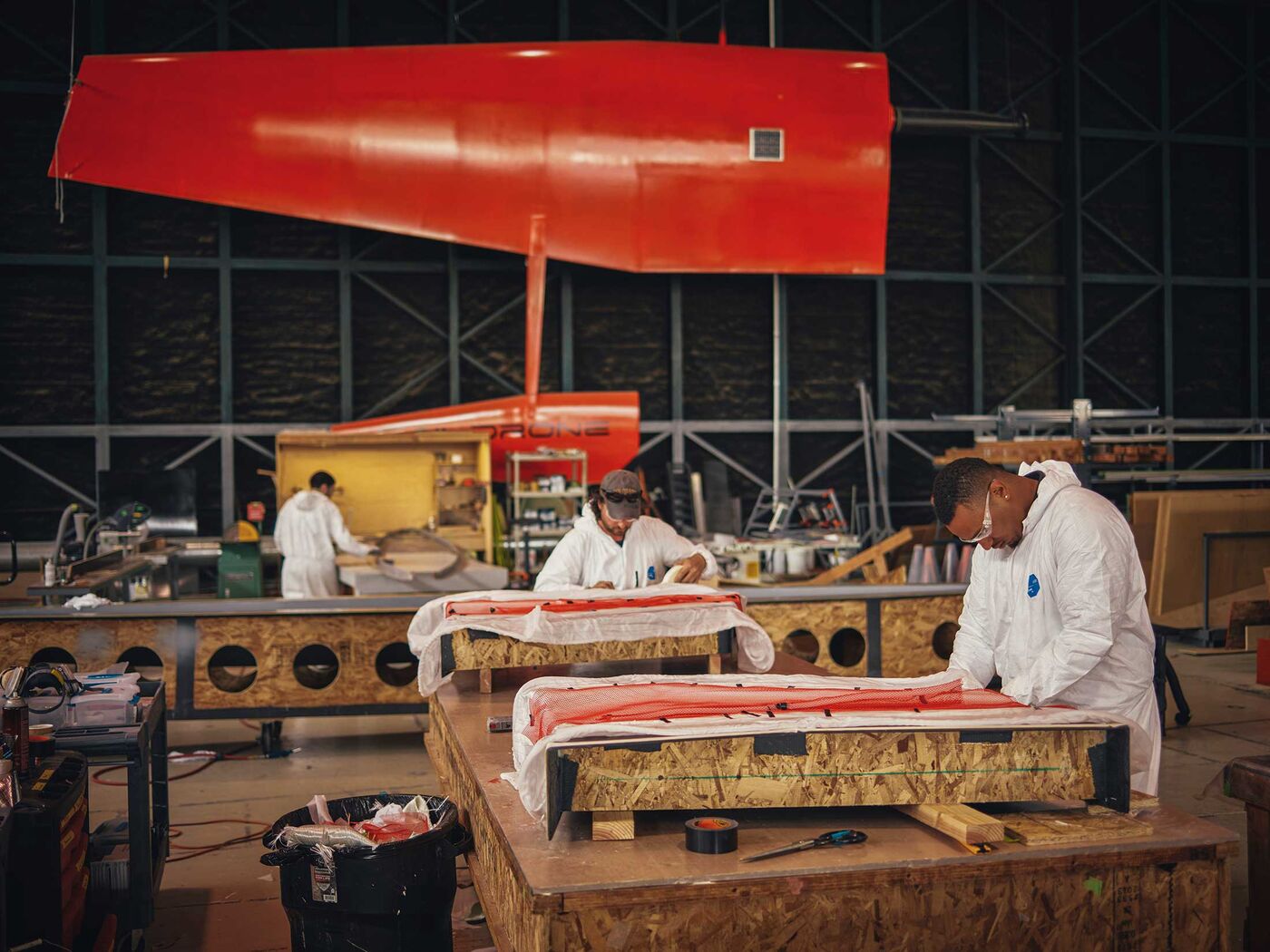
Workers manufacture Saildrone components at the company’s factory in Alameda, Calif., on April 4.
Photographer: Balazs Gardi for Bloomberg Businessweek
The land-yacht breakthrough came around 2008. On a model with a long, narrow body, Jenkins attached what looked like an airplane wing, only vertical, behind the cockpit, with a rod with a rectangular tail about a third of the way up. Wind passing around the wing created forward lift, propelling the vehicle at three to five times wind speed. With pulleys and hydraulics, Jenkins could adjust a small tab on the tail to tweak the angle of the sailboat’s wing even at high speed without spinning the vehicle out of control. In March 2009, he invited observers to Ivanpah Dry Lake in the Mojave Desert to watch his land yacht, the
Greenbird,
hit 126.1 mph and crush the previous record.
“Once you say you’re going to do something, you have to do it, right?” Jenkins says. There was no other immediately obvious reward. “Potential sponsors would always ask if there was anything about the vehicle that could be commercialized,” he says. “The problem was, I could never think of a single thing.”
Alameda is a small, sleepy island of 80,000 located next to Oakland and across the bay from San Francisco. Six miles long and a mile wide, it’s full of Victorian houses and has a citywide speed limit of 25 mph. At the island’s western edge sits an old Naval air station with giant warehouses where ships and fighter jets were once built. More recently, rocket makers and vodka distilleries have set up shop there. In 2009, so did Jenkins, eager to figure out what came after the land yacht.
For two years, Jenkins and a couple of boat building pals rented a little slice of a warehouse for what amounted to a very niche consulting business. They built specialized kitesurfing boards for the likes of Google co-founder Larry Page. “Richard was a bit lost,” says Damon Smith, one of the pals. “It was probably the first proper job he’d ever had.”
Quickly, the record-breaker in Jenkins got the best of him again. How cool would it be, he thought, to replicate Magellan’s 16th century globe-spanning voyage with a modern twist and less death? Using a tail like the one he put on the land yacht, he figured, it might be possible to build a drone sailboat that could take itself around the world, powered by the sun and guided remotely as needed.
“They’ve all come back without a single scratch, just a beard of barnacles”
By 2011, Jenkins had a prototype, and he started to think it could be useful for scientific research, as well. That year, he crossed paths with Wendy Schmidt, the businesswoman, philanthropist, wife of former Google chief executive Eric Schmidt, and co-founder of the Schmidt Ocean Institute, which has invested in oceanographic research vessels. “The idea of having a vessel that could be self-propelled and go where large, expensive research ships can’t was appealing,” Schmidt says. “He needed some money, and we were able to give it to him for research and development.”
Scientists and the more business-minded felt Jenkins had little hope of protecting his robotic boats and their data from the storms and salt that threaten even the largest of ships. Undeterred, he began testing in 2013. By the end of the year, one drone had traveled 2,100 nautical miles from San Francisco to Hawaii in 34 days, the first unmanned vehicle to cross an ocean. Since then, saildrones have survived 40-foot waves in the Bering Sea and pushed through the low-wind doldrums near the equator. “Our longest mission has been eight months and 10,000 miles, and we’ve gone 200,000 miles overall,” Jenkins says. “They’ve all come back without a single scratch, just a beard of barnacles.”