The Robots Roaming the High Seas
https://www.bloomberg.com/news/featu...quer-the-ocean
The Robots Roaming the High Seas
This Armada of Saildrones Could Conquer the Ocean
Engineer and adventurer Richard Jenkins has made oceangoing robots that could revolutionize fishing, drilling, and environmental science. His aim: a thousand of them.
By Ashlee Vance
May 15, 2018, 5:14 AM EDT
Every spring, thousands of great white sharks begin a mysterious migration. From up and down America’s West Coast, they head straight for a Colorado-size patch of the Pacific about halfway between San Diego and Hawaii. Once there, they hang for months at what marine biologists call the White Shark Cafe, frolicking and diving 1,500 feet or more. For decades, we didn’t know much more about what they do there—or why. This year, we should get some answers, thanks to a pair of saildrones.
Each drone is a 23-foot neon-orange sailboat that catches wind with a solid wing more durable than a cloth sail. As the name implies, they’re seaworthy, autonomous robots, though a human pilot can take control remotely. In mid-March, two saildrones packed with sensors, cameras, and scientific instruments launched from a dock in the Bay Area city of Alameda, gliding past Alcatraz and beneath the Golden Gate Bridge to begin a three-week, 1,200-mile journey to the Shark Cafe.
By early April, the saildrones arrived and began picking up signals from a group of 37 sharks that researchers had tagged with acoustic transmitters. The drones pinpointed the sharks’ locations, then sailed back and forth, using sonar to see what they were up to. Via satellite, the drones relayed images and other data to Barbara Block, a Stanford marine biologist who started planning a research voyage to the Cafe three years ago. Block has studied these sharks for much of her career, but this was her first detailed look at their vast deepwater playground.
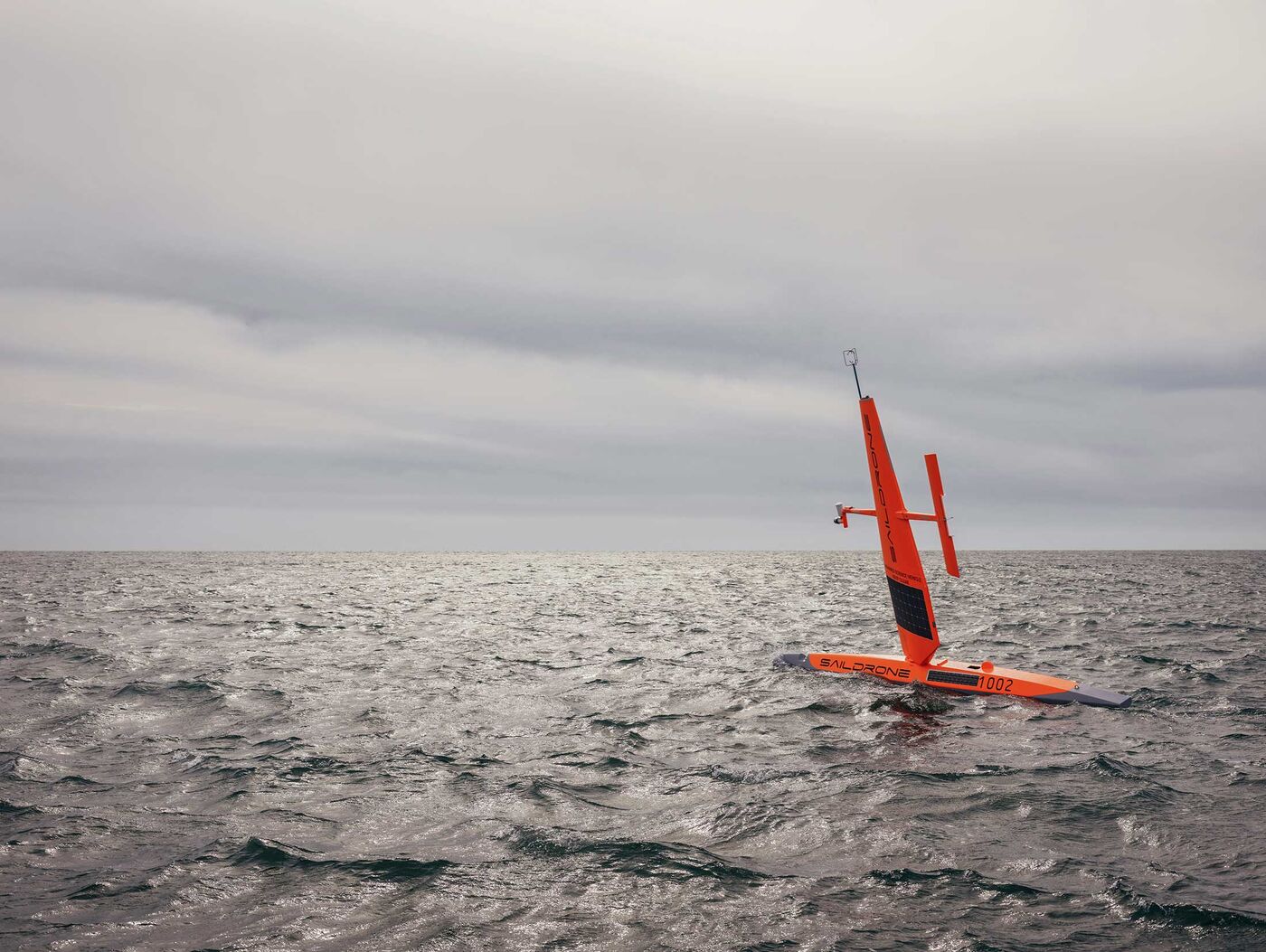
A saildrone off the coast of San Francisco on April 5, 2018.
Photographer: Balazs Gardi for Bloomberg Businessweek
“We’re talking about a place that is a long way from anywhere, that few people have ever been to,” Block says. “Then I’m sitting in my office, and the images start to appear of the sharks doing dives in these day and night patterns. What I saw was almost unbelievable.” The sharks appeared to be diving toward a layer of deep ocean teeming with fish, which suggested they came to the Cafe to dine. Block has since set out with a dozen researchers to sail alongside the robotic scouts and learn whether some special kind of food, or perhaps a romantic getaway, helps draw the sharks to the middle of nowhere. “This is one of the largest migrations, one of the largest stories, and we don’t know enough about it or about what goes on in the ocean overall,” she says. “I think this type of technology will help us fill in the gaps at a crucial time for our planet.”
The robotic vessels come from an Alameda startup called
Saildrone Inc. Backed by $90 million in venture capital, Saildrone is a big bet on the market for information about the ocean. Founded in 2012, the company has spent the past few years proving its 1,200-pound craft can withstand months of punishing waves to churn out precise data far more cheaply than a traditional research vessel. Within four years, it wants a fleet of 1,000 drones scanning the world’s oceans more or less constantly. The objective: salable insight into the environment, weather, fishing, shipping, and oil and gas exploration.
This plan rests on Richard Jenkins, an engineer, sailor, and adventurer who invented the saildrone more or less by accident. Jenkins doesn’t act like one of Silicon Valley’s world-conquering capitalist nerds. For starters, he tends to skip the usual platitudes about disruption to focus on sailing, beer, and sailing with beer. “What’s the definition of a sailor?” he asks while launching one of the drones off the Alameda dock. “A primitive organism for turning beer into urine.”
Jenkins, 41, is tanned, and his mop of bushy brown hair is flecked with streaks of blond from the sun. He often commutes by boat from his bayside home to Saildrone’s nearby headquarters at the water’s edge, and ties up his craft with hands calloused from years of rigging and fixing sea-addled machinery. His office attire consists of a ratty T-shirt and khaki pants stained with grease, paint, and epoxy.
Jenkins’s accent is tough to place, and for good reason. He was born in England to Australian parents, and spent much of his childhood bouncing between his home near the yachting mecca of Southampton and his grandfather’s farm in Western Australia. At age 12, he began making his own sailing dinghies and other small vessels. His parents’ living room became a workshop, with hulls in place of the couch and spare parts covering the TV. “My parents were pretty tolerant,” he says.