By Jason Torchinsky
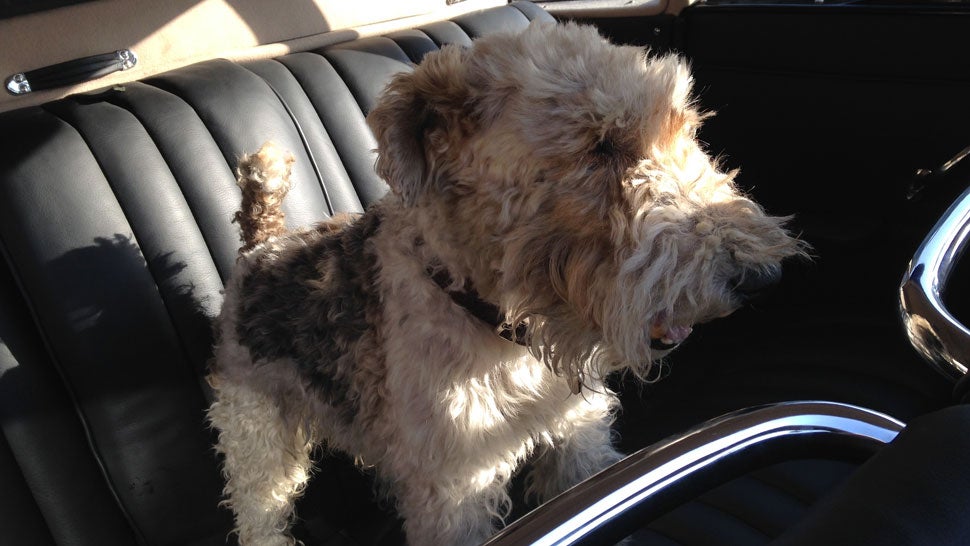
The overall feeling in the cabin is an amazing combination of overstuffed leather chair from some important old man's study and bright airiness, two things I would't have thought possible to combine. The headliner is a 30s-opulent-looking beige mouse fuzz, the seats are rich leather overstuffed couches with chrome grab handles, the windshield is a panoramic bay window, and there's a large sliding sunroof above. I rode in the front and back and I can't think of a better place to sit on anything, anywhere.
There's plenty of quirkiness, too — the huge fuse box that looks like a left-hand glove box with a special handwritten guide that Paul labored obsessively to re-create, and, most notably, the bizarre luggage compartment.
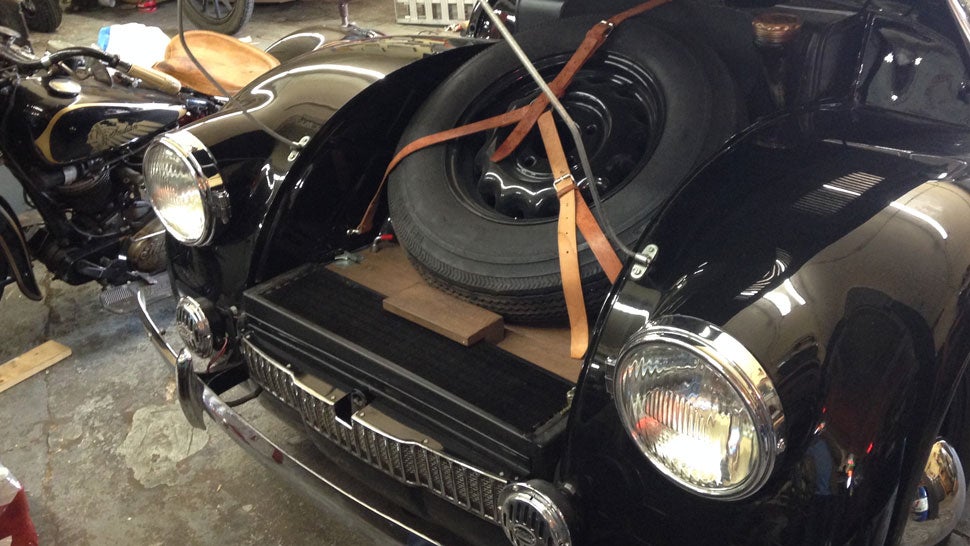
The front trunk is too full of a pair of spare tires and an oil cooler to be really useful for stowing any cargo, so the Tatra has this odd closet behind the back seat. You get to it by sliding a pair of latches that look just like chrome versions of the things you find on house doors, and lift the window'd panel. Inside is a pretty good sized area for your probably monogrammed mongoose-leather suitcases.
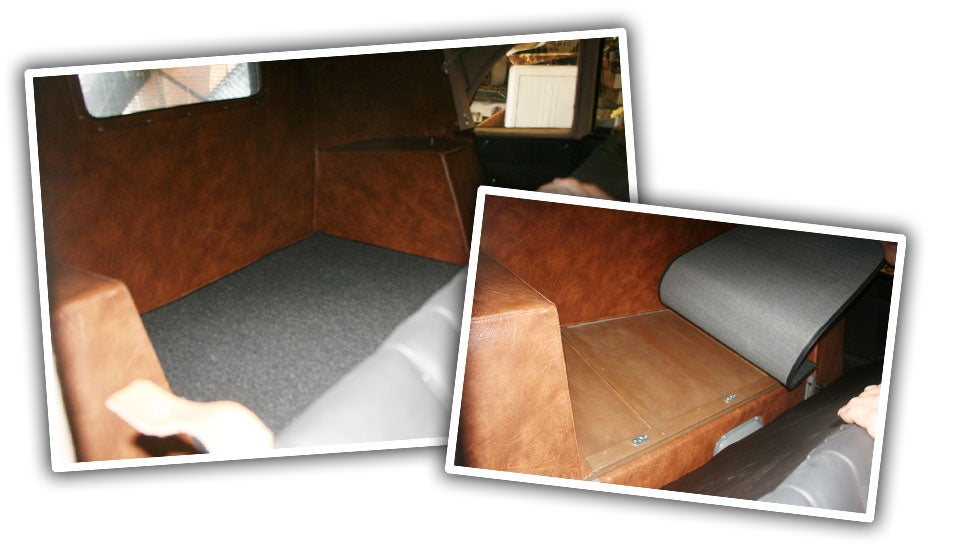
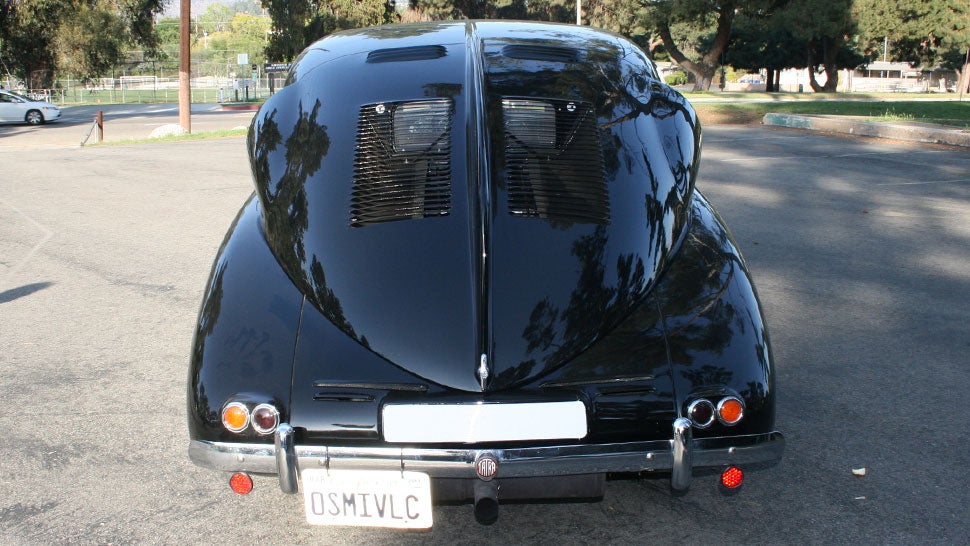
Under the carpet is a wood floor that looks nicer than the ones in my house, and opens to allow access to the transmission below. But it's the windows that really get eyebrows aloft here. There's three — one on the outside of the luggage panel, one on the back, and one immediately behind that on the bulkhead to the engine bay. And then those louvers in the rear hood.
So, when you look backwards, you're looking through three panes of glass and a set of louvers. It's not great. But, as Paul points out, nothing had good rearward vision in the late '30s/early '40s.
Acceleration: 7/10
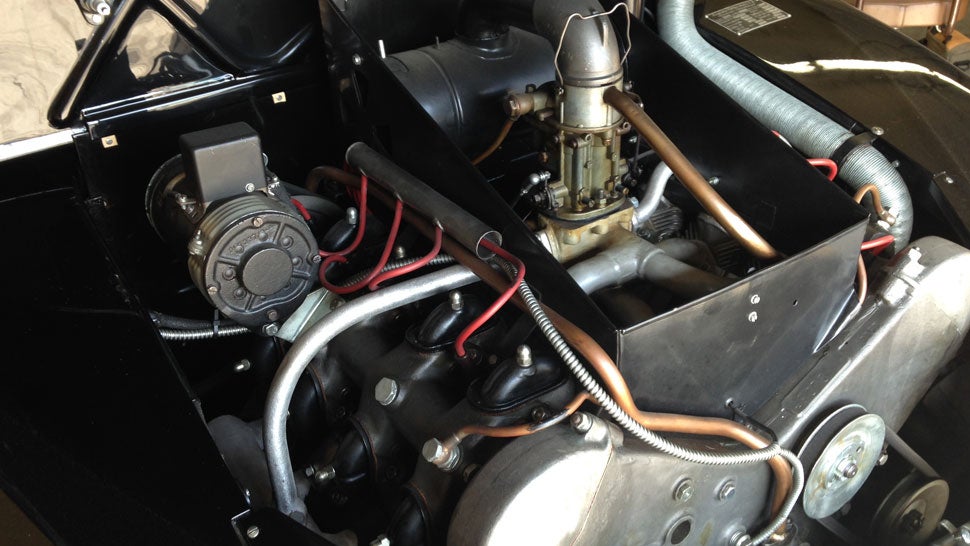
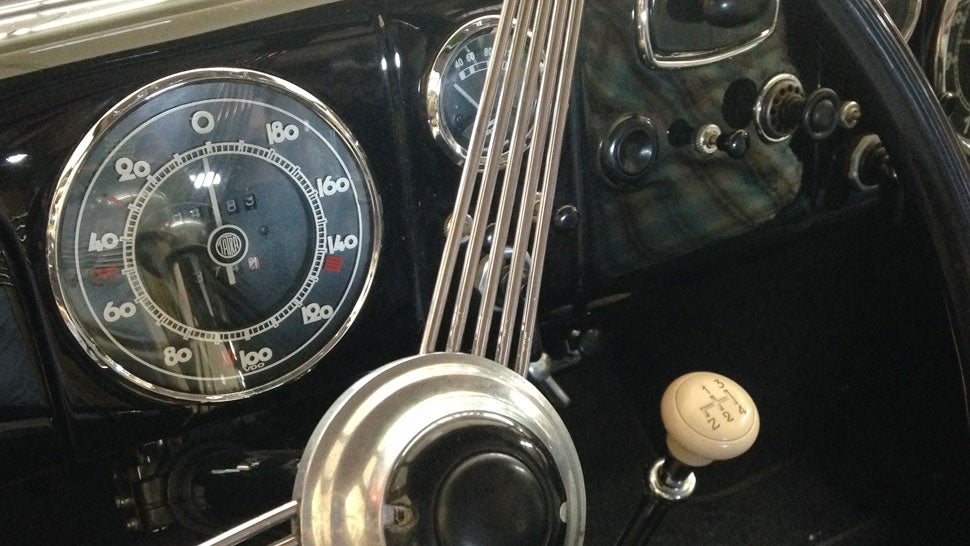
By modern standards, the Tatra is by no means a fast car. At all. But you have to keep things in perspective. Back in the 30s/40s, this was one of the fastest production cars of the era, one of the few good-sized four-door luxury sedans to be able to make and hold 100 MPH. And that's all from a 2969cc overhead-cam air-cooled V8 making about 85 HP (I have seen it reported as low as 75 and as high as 94).
This was a seriously advanced engine for its time, and if you think about what similar engines were making then, it shows. For example, the same year as this Tatra was built also saw the
Studebaker I reviewed a while back. That Studebaker had a similar sized engine (2.7L I6) but it only made 78HP. And that Studebaker wasn't going to make 100 MPH even with a big cartoon cloud blowing on it, which is a testimony to the Tatra's advanced aerodynamics.
 1941 Studebaker Champion: The Jalopnik Classic Review
Remember the car you had at 16? I remember mine. A Wrigley's-gum beige 1968 VW Beetle I saved…
Read more
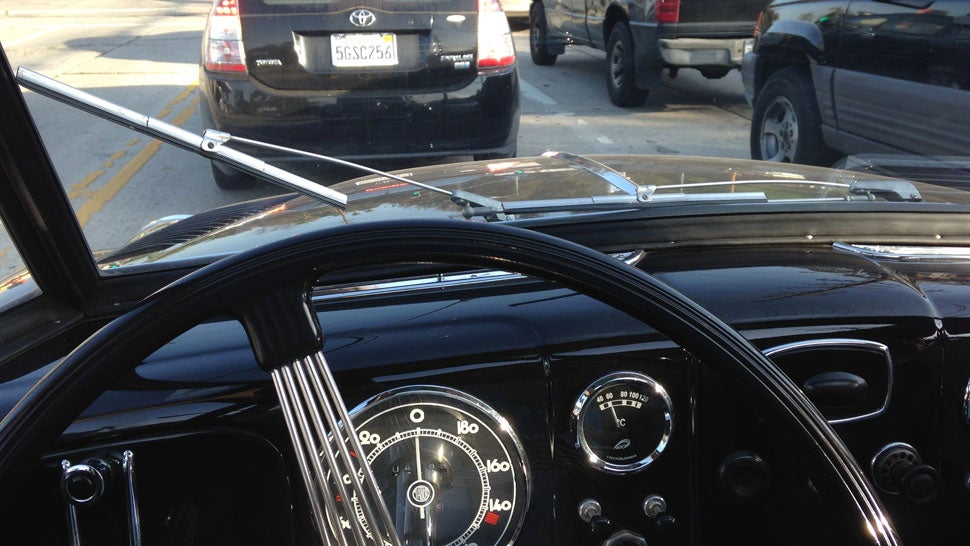
Driving in modern traffic, the T87 did remarkably well. I had no problem keeping up with boring old Priuses at lights, though they may have been repelled by the megawatt-level awesomeness field the car produces. It never felt sluggish or heavy, and the engine was willing and actually peppy.
Braking: 6/10
Again, if we compare the Tatra to that Studebaker (it's the only other 1941 car I've driven, so forgive all the comparisons) the Tatra comes out light years ahead. Both cars have drums all around, but I never had that gradually-increasing terror I felt when stopping the Studebaker.
It may be the light front end, but the brakes manage to stop the car effectively and without drama or much fade. For a car this old, it's hugely impressive, and makes the car much more usable in modern traffic, since nobody leaves even obviously vintage cars the stopping room they really need.
Ride: 7/10
It's very apparent that the T87 was made for people of much higher societal value than myself, because my body had that 'they better not catch you in here' feeling as I rode in the car. Because it felt too damn nice.
Paul said something interesting about the car:
Tatra knew what it took to make a good car, but the technology didn't quite exist to exactly do it right.
If you look at the car's design, you can see what he means. For example, they knew that independent suspension was the way to go, for ride quality and handling, but there weren't all that many good options. As a result, the car ended up with a semi-independent system using fractional leaf springs and swing axles at the rear.
The result does manage to give a supple yet not mushy ride. Much of the comfort is likely due to the generously stuffed and sprung seats, but the fact is it's plenty comfortable, even over some really crappy LA roads.
Handling: 5/10
Handling issues have long been seen as the T87's Achilles' Heel, and Paul has some very strong opinions about that. He thinks all those stories about the car being a
Czech secret weapon because of how many SS officers managed to kill themselves in them are just not accurate. For one thing, many of those dead SS bastards were in T77s, and secondly, a lot of blame needs to go to the tires.
 1937 Tatra T77
The Tatra T77, with its air-cooled V8 and slippery-even-by-2008-standards drag coefficient of…
Read more
Paul pointed out that lots of the Tatras the British and other armies were evaluating were running on bald, worn-out tires, and those on the rear of a rear-biased car just means trouble.
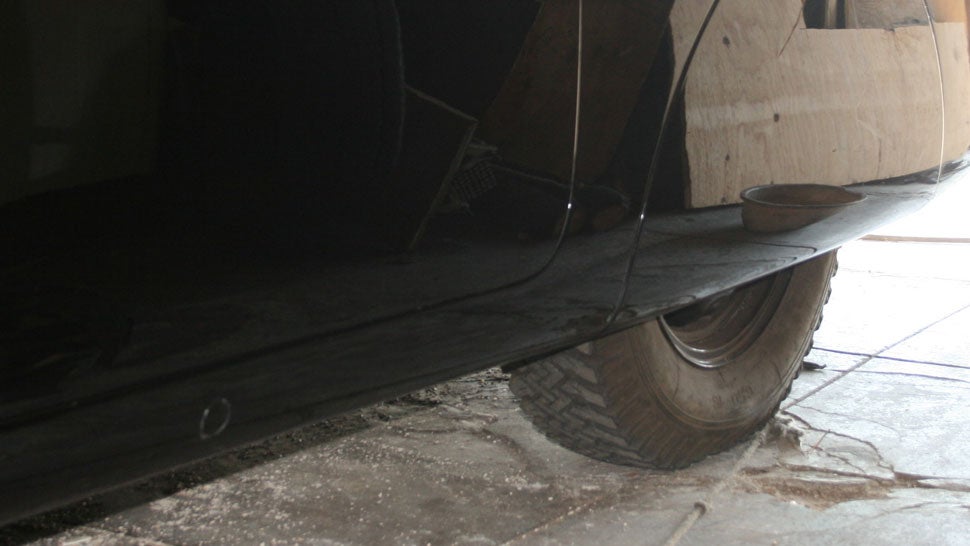
In fact, Paul uses snow tires on the rear and keeps them inflated to very precise numbers — numbers they were not inflated to when I drove it, so consider this a big caveat.
I've been driving rear-biased cars most of my driving life, so it felt pretty natural to me. Granted, it is a good bit bigger and heavier than a Beetle, but I never actually felt unsafe. I did feel a certain oscillation of weight from the rear at speed, though Paul assured me that with the proper tire pressure that was much less pronounced.
The light front end makes parking and maneuvering easy in a way almost none of the Tatra's contemporaries could claim, too.
Still, the car does have a significant ass-heaviness, and if you don't respect it, you absolutely could end up facing the very wrong way. You don't want to lift in a turn, and you should be chanting 'slow in, fast out' on every corner you come to.